
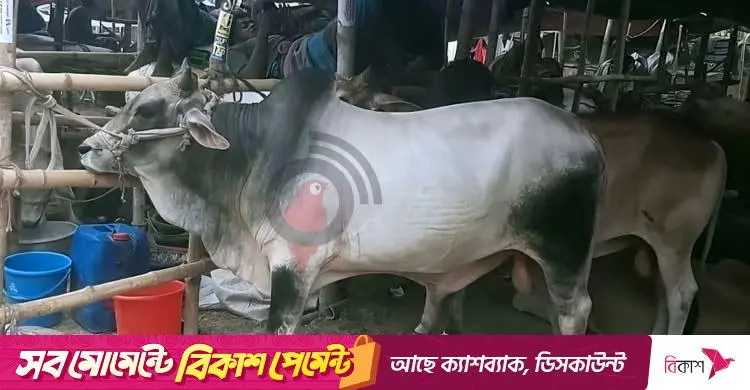
Eid-ul-Azha is only a few days away, and devout Muslims will sacrifice various kinds of livestock hoping to earn Allah's pleasure. But around Eid a section of dishonest traders engage in an unhealthy race to fatten cattle artificially. Hoping for bigger profits, they inject animals with various harmful substances. The animals look attractive on the outside, but various health risks build up inside. Eating the meat of such sick cattle can cause problems in people such as fluid build-up in the body and reduced immunity.
To help the faithful when buying sacrificial animals, Prof Dr Md Bahanur Rahman, dean of the Faculty of Veterinary Science at Bangladesh Agricultural University (BAU) and an animal specialist, has given guidance on how to recognise artificially fattened animals. He also urged farmers to refrain from fattening animals artificially.
Signs of artificial fattening
The professor said an artificially fattened cow will have a dry nose. Its body will be flabby and appear to hold a lot of water. Such a cow breathes rapidly, gets out of breath after walking a little and always looks tired. Artificially fattened cattle are usually unwell, and their body temperature may be much higher than normal. They lose their appetite and do not want to eat. They may drool excessively, sometimes with froth and sometimes without.
He said artificially fattened cattle do not chew the cud regularly like normal cattle. Meat builds up abnormally in different parts of the body and is unevenly distributed. If you press the body with a finger, the spot sinks in and takes a long time to return to its original state. The thigh meat of cattle fattened with injections is much softer than that of normal cattle. Their bones are soft and pliable, so there is a greater risk of fractures if they fall in an accident.
Because of the excess water in their bodies, these cattle become heavy, do not want to move normally and sit in one place for long periods. So if the animal is sitting, it is best to make it stand and walk, which shows its physical condition.
Signs of a healthy animal
On recognising healthy cattle, the professor said the upper part of a healthy cow's nose will be wet or have beads of sweat. Its skin will have no marks, and it will react where it is touched. A healthy cow is always lively.
Even a healthy cow may have a higher temperature when it has been walked a long way to the market, but this settles within one to two hours. Healthy cattle show interest in food as soon as they see it. Try to buy cattle with little saliva or froth at the mouth. A healthy cow chews the cud regularly. A healthy animal's coat will be glossy, its hump thick and its skin taut. When pressed, the flesh of a naturally fattened animal will not sink much, and what does sink returns at once.
At the market, buyers and sellers are sometimes unsure whether an animal is sick or healthy. For this, Professor Bahanur gave some simple checks.
He said an animal's temperature cannot be measured like a human's; for animals, the rectal temperature has to be taken. As this is not possible while buying, the temperature can easily be judged by placing a hand at the base of the ear. Another simple check is to touch the upper part of the nose (the muzzle): if it feels dry, the cow should be taken to be sick.
Advice to farmers
Addressing farmers, Professor Bahanur said most farmers fatten animals artificially at the urging of quacks. They fatten animals by feeding them drugs such as dexamethasone and prednisolone or by injecting them. This seriously damages the animals' liver and kidneys and drives them towards death. Farmers should fatten cattle by natural methods, and he said they would get good advice by consulting upazila livestock officers and veterinary surgeons.
Source: Jagonews24. First published in Bengali on The Agro News.

Comments
(0)