
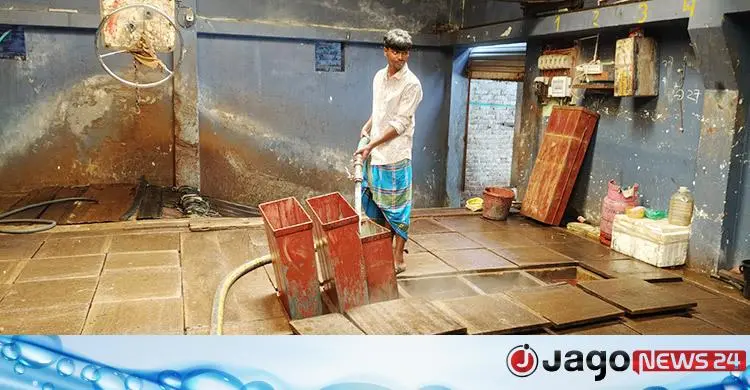
Fishermen at the Alipur-Mohipur fish port in Kalapara, Patuakhali, should now be busy catching hilsa. But constant load-shedding has caused a severe ice shortage, and although they are ready with gear and supplies, they cannot go to sea without ice.
Even at higher prices the ice they need is not available. A can of ice that cost Tk 150 is selling for Tk 300, and hundreds of fishing trawlers are anchored at the ghat waiting for ice.
A visit to ice plants around the Alipur and Mohipur fish ports on Sunday (9 August) found production disrupted at most of them because of the power shortage. Many trawlers have been waiting at the ghat for four or five days, and fishermen and trawler owners are deeply frustrated.
36 ice plants hit by power cuts
There are about 36 ice plants, large and small, around the Alipur and Mohipur fish ports. Some produce 20 to 25 cans a day, others up to 200. But long load-shedding over the past 10 days has sharply cut production, so hundreds of trawlers cannot go to sea even at the height of the hilsa season.
Shukkur, a fisherman on the trawler FB Nishat, which has been waiting four days for ice, said: "We need 200 to 220 cans of ice to go fishing, but we can't get a single can. Fishing at sea is impossible without ice. Ice is the life of our fish. Without it our livelihood is about to stop."
Hundreds of other trawlers at anchor, including FB Tamanna, FB Ma Moni and FB Kamal, are in the same position. Enough ice cannot be produced locally to preserve the catch and send it around the country, so traders are buying ice at higher prices from Khulna, Barishal and other parts of Patuakhali.
Rahim Khan, a wholesaler at Khan Fish, said: "We have to pay Tk 300 for Tk 150 worth of ice, and even then there isn't enough. We stand in queues and get only a token amount. There is a terrible crisis in Alipur-Mohipur, so we are forced to hire trucks to bring ice from other places, which has pushed costs up a lot."
Md Fazlu Gazi, former president of the Alipur-Mohipur Fish Wholesalers' Cooperative Society, said sudden severe load-shedding was disrupting ice production and raising prices. If it continues, the ice plants may shut down altogether, he said.
Ice plant owners said load-shedding lasts 12 to 14 hours a day, cutting production far below normal. Demand for ice has risen in the hilsa season while production has fallen, causing a large supply gap and pushing prices up every day.
Mohipur fisheries association leader Gazi Md Majnu said ice production needs continuous power, but after an hour of electricity there are hours without it. Ice cannot be produced with repeated load-shedding like this. To keep the fish port and fishermen going, power supply must be specially ensured for Alipur-Mohipur and the Kuakata area, or the business will be ruined, he said.
Power supply at 52 per cent of demand
Abul Kashem, general manager of Patuakhali Palli Bidyut Samity, said: "Load-shedding is under way because of the fuel crisis. The district's total power demand is now 130 megawatts, against which we are getting 85 megawatts from the national grid, a shortfall of 45 megawatts. We can supply only 52 per cent of demand, and the 48 per cent shortfall forces regular load-shedding."
He said he hoped load-shedding would ease once the fuel crisis is over and power plants closed for maintenance come back on line.
Source: Jagonews24. First published in Bengali on The Agro News.


Comments
(0)