
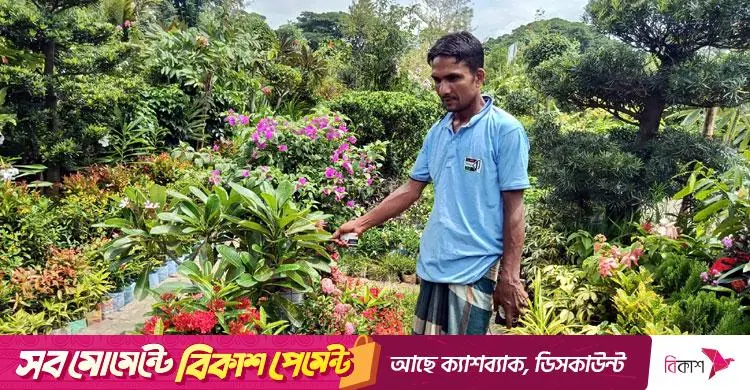
Many of the trees that were once familiar and useful in the countryside of Bengal are now described as near-extinct. At the tree fair organised by the Forest Department, lost, rare and near-extinct trees have found a place this year.
A visit to the fair at Agargaon in the capital on Tuesday (1 July) found visitors searching out these trees and buying them. Some were taking photographs. Some had never heard the names of many of the trees, while many tree lovers were moved as they matched them with memories of their childhood.
What the nurseries brought
According to nursery owners and sales staff, the rare and near-extinct medicinal, fruit, flower, forest, ornamental and spice trees on sale include banshpata, dolonchampa, chitta, parul, rudrapalash, gutijam, joishthomodhu, bonsai, shatamul, kau, red sandalwood (rokto chondon), panbilashi, bilati gab, ashwok, sarpagandha, wild date palm (bonkhejur), balborax, long trias orchid and bolgach, among many other species. Each tree carries a small signboard identifying it.
Nursery sales staff also listed ornamental trees such as pakur, kurchi, jhinuk, mocha and mohua. Timber trees on offer include garjan, lohakath (ironwood), chhatim and water bamboo. Notable flowering trees include sonalu, koksia, gardenia, Tipu Sultan, shimul, anjana and mohua.
Why they are disappearing
Environmental scientists say these trees are being lost to climate change, urbanisation, indiscriminate deforestation, the timber trade and a lack of afforestation.
According to experts, if these trees cannot be conserved, not only will the balance of nature be harmed, but a large part of Bangladesh's biodiversity will also be lost. So it is important not only to buy trees at the fair but also to commit to keeping native species alive from generation to generation.
Jahangir, manager of Khan Nursery, which is taking part in the fair, said: "We try to raise saplings of near-extinct trees. People are showing interest in planting these trees again. But the government should play a role in protecting them."
Rabiul Islam, a salesman at Kingshuk and Green House Nursery, told Jagonews: "Because we run a nursery, we have to keep all kinds of trees. People want to buy many trees after seeing them in books. That is why we go to a lot of trouble to keep every kind of tree in our collection. Nurseries collect near-extinct trees by travelling through forests and jungles."
Nila Alamgir, who came to the fair from Sutrapur in the capital, told Jagonews: "I have visited many nurseries in Dhaka but could not find the trees I wanted. At the fair I have found many trees I had never seen in my life. I bought a mohua tree and a parul tree. I also took a panbilashi."
Tree lovers at the fair said the tree fair is not just a place to sell trees but a place to revive the country's natural heritage. They said the time has come to be active in planting and conserving these near-extinct trees in their own areas.
Source: Jagonews24. First published in Bengali on The Agro News.

Comments
(0)