
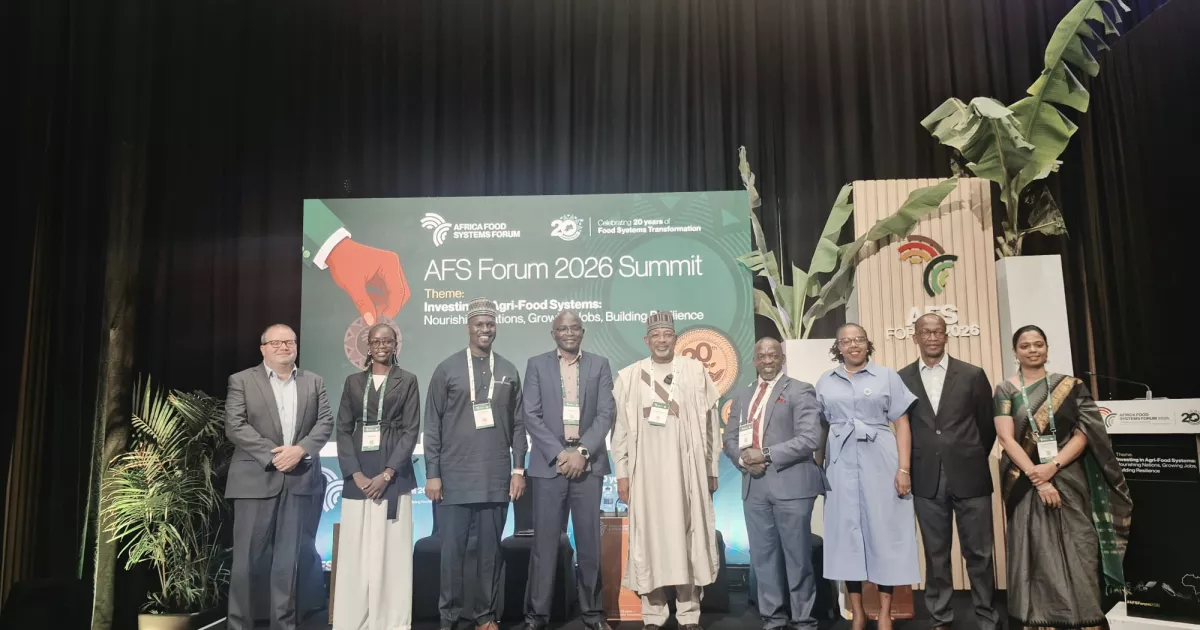
Undernourishment in Africa is caused less by a lack of production than by poor distribution, from the continental level down to the household, researchers and policymakers heard at a session organised by the CGIAR Policy Innovations Science Program and AGRA at the Africa Food Systems Forum 2026 in Kigali, Rwanda, on 1 September. CGIAR published a synthesis of the session on 28 September.
CGIAR Chief Scientist Sandra Milach said food sovereignty does not mean every country producing everything, but domestic production combined with trade. Africa spends USD 75 billion a year on food imports, a figure projected to reach USD 120 billion by 2050. James Thurlow of CGIAR Policy Innovations said African agriculture must grow at 6 percent to address existing undernourishment, and that because food processing yields higher returns than primary production alone, policy should shift towards processing.
Panellists said blanket rice self-sufficiency policies ignore agro-ecological limits, and pointed to the African Continental Free Trade Area, which links 55 African Union members, as the framework for intra-African food trade. Rosine Uwamariya of Trademark Africa said a cargo tracking system had cut food corridor costs by 50 percent and that one-stop border posts had shortened waiting times.
Nigeria's Minister of Agriculture and Food Security, Abubakar Kyari, described the shocks his country had faced, from the 2022 floods to a currency redesign during the harvest season, and said the government had distributed more than USD 134 million in fertiliser. IFPRI's Oliver Kiptoo Kirui and the Gates Foundation's Joshua Ariga argued that research must move from producing documents to supporting policy implementation, including AI-based decision tools for ministers.
The session's recommendations were regional specialisation based on each area's agro-ecological advantages, cheaper trade corridors with lower tariffs, finance and certification support for agribusinesses, and donor funding aimed at lasting national policy capacity. The synthesis was written by Getachew Legese Feye of ILRI and Rajalakshmi Nirmal of CGIAR Policy Innovations.
Photo: CGIAR
Source: CGIAR


Comments
(0)