
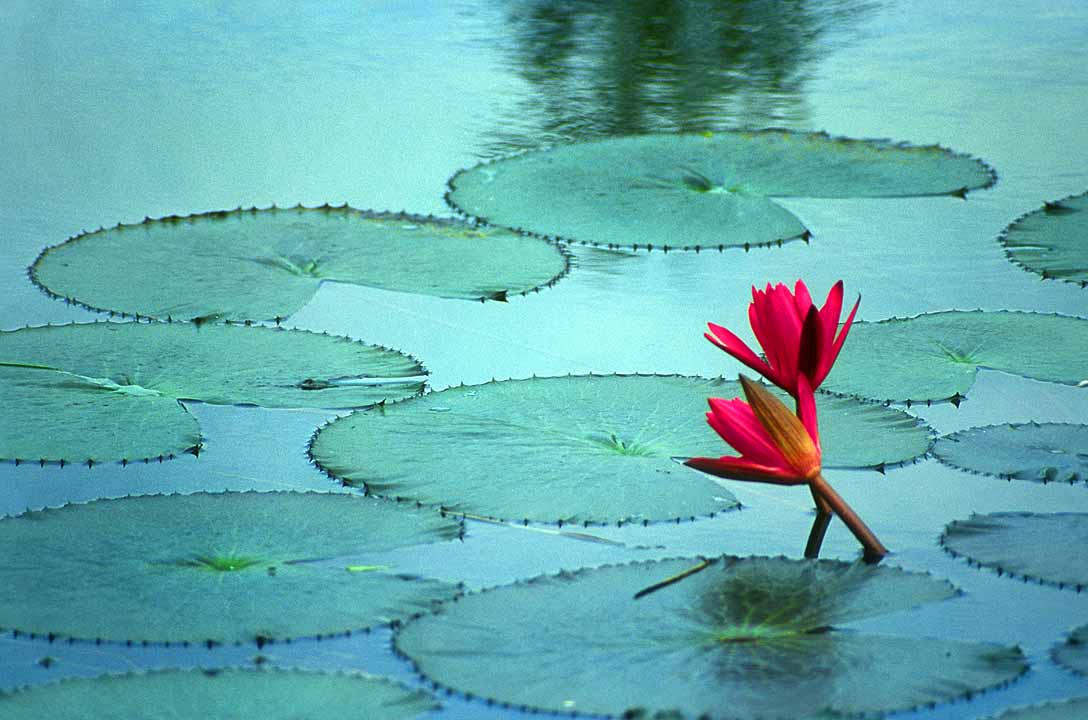
The water lily, shapla in Bengali, is among the most familiar flowers in Bangladesh, found in ponds and wetlands across the country. The family Nymphaeaceae holds about fifty species worldwide, and the white water lily, Nymphaea nouchali, is the national flower of Bangladesh.
The flower, or its watermark, appears on the national emblem, on banknotes and coins and on the stamps used on documents. White lilies are the most common, though pink, blue and purple ones also grow. The rainy season and autumn are the best time for them. The flowers open at dawn and close as the day brightens; the round leaves are green above and dark beneath.
Shapla is food as well as ornament. The flower stalks are cooked as a vegetable. A fully open flower holds tiny seeds in its ovary, known as bhet; these sticky seeds are sun-dried and roasted into a popped snack called dhyaper khoi. The potato-like tuber at the base, shaluk, is boiled and eaten.
Sri Lanka's national flower is also a water lily, a blue one known there as nil mahanel. The flower is described in ancient Sanskrit, Pali and Sinhala literature and stands in Sri Lanka for excellence, discipline and purity.
The plant has a long written history. According to the article, Theophrastus, a pupil of Plato and Aristotle, wrote about it, and in ancient Egypt water lilies were used for decoration, food and herbal medicine for a thousand years.
In Bangladesh the shapla remains a symbol of rural life, and gardeners now grow it in garden ponds and aquariums, taking it into towns as well.
The article is by Robiul Husain.
Photo: Steve Evans / Wikimedia Commons (CC BY 2.0)
Source: Desh Rupantor

Comments
(0)