
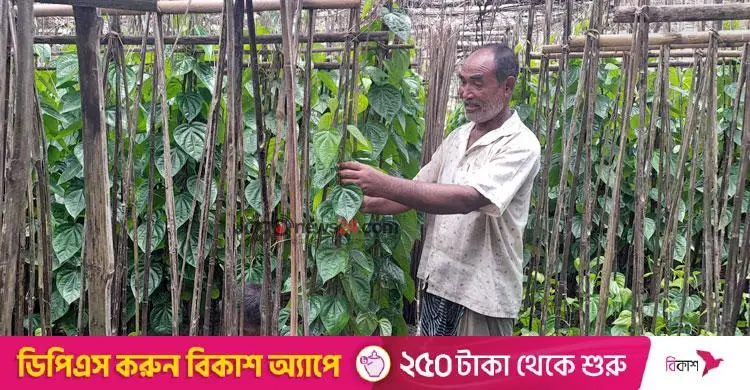
In Ulipur, Kurigram, betel leaf is a green heritage that stands for the local economy, employment and culture together. Mixed with the farmer's sweat and the smell of the soil, it has created a farming culture passed down through generations. Step inside a baroj, the shaded betel enclosure, and the soft green of the leaves fills the heart. Ulipur's betel leaf was once famous not only there but in neighbouring districts too. Yet growers are steadily turning away from this traditional crop. Because costs are high compared with output and they do not get fair prices, they are removing their barojes and turning to other crops.
A field visit found more than 400 large and small betel barojes on about 20 hectares in Panduul, Tobokpur, Dhoronibari and other unions of the upazila. Betel leaf and areca nut are essential at weddings, festivals and when welcoming guests, and they reflect the culture and hospitality of the area.
Costs up, prices down
Growers said the high price of materials for building barojes and the lack of fair prices are forcing them to give up the family occupation. Many once took up betel farming because of its demand in the area. For growers, a baroj was like a bank: whenever they needed money, they picked leaves and sold them at the local market. Many became self-reliant through betel farming, but now they face losses for various reasons.
Monojit Kumar, a grower in Panduul, said irregular rain, excessive heat and cold now stop the vines growing properly, on top of diseases and pests. The prices of bamboo, thatch, fertiliser and pesticide have risen. Wholesalers used to come to the baroj to buy leaves; now growers have to take them to market, which has raised costs somewhat.
Bimal Chandra Roy, a baroj owner in Apuar Khata village, said his father's and grandfather's households ran on the baroj, when betel was a profitable business. After his father died the baroj closed. In 2015 he and his brother separately built four barojes on an acre of land. Now each baroj needs Tk 50,000–80,000 a year in repairs, and the profit does not match. There is some profit from the Bengali months of Bhadra to Kartik, but losses the rest of the year.
Sukumar Roy of Barai Para village in Tobokpur said: "We have four barojes. A bundle of 100 leaves used to sell for Tk 90–100. That has now fallen to Tk 50–60. Costs have gone up compared with before, but the price has fallen."
"Many are breaking up their barojes"
Grower Pobitro Chandra said: "I have run a baroj for a long time, inherited from my father. Many people in the area learned from me, built barojes and ran their households well. Now, with little profit, many are breaking up their barojes and growing paddy and rabi crops."
Charubala Rani said: "We women work in the barojes alongside the men. Watering, cleaning the leaves and separating the diseased ones is our work. With market prices down, we do not get proper wages."
Jotin Chandra of Panduul said: "My baroj is on 20 decimals of land. I have grown betel for 30 years and have to give it time every day. My household runs on the baroj. I regularly pick leaves and sell them at market to meet expenses, and when I need money I collect leaves from the baroj. If the government gave facilities, barojes could be expanded."
Upazila agriculture officer Mosharraf Hossain said: "Farmers grow betel leaf in various unions of the upazila. Besides earning a living, they are becoming financially self-reliant. From the upazila agriculture office we regularly give these growers the advice they need."
Source: Jagonews24. First published in Bengali on The Agro News.
Comments
(0)