
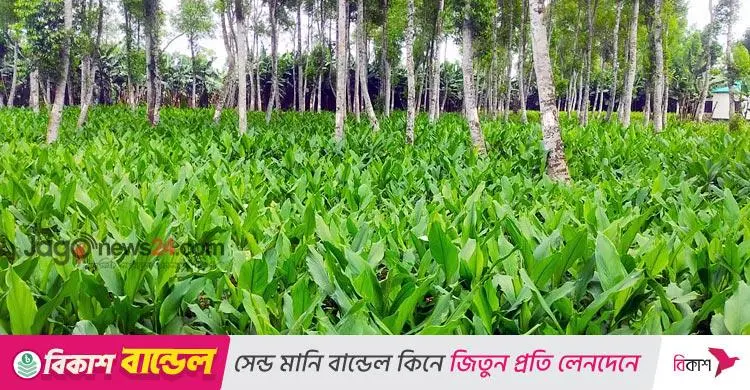
Turmeric farmers in Tangail are dreaming of good times this year, and will profit if there is no natural disaster. Turmeric is more profitable than other crops, and a lot can be grown on a little land at low cost. In the hill areas it is grown as a companion crop. This year farmers in Madhupur expect to sell about Tk 58 crore worth.
Farmers say turmeric is not troubled by cattle, goats or insects, and the risk of crop loss is low. It does well on fallow land. Demand for turmeric as a spice is high and prices are better than for other crops, so cultivation is growing steadily in the hill areas of Ghatail, Madhupur and Sakhipur upazilas.
Where it is grown
The district agriculture office says turmeric has been grown on 3,208 hectares in the district's 12 upazilas: 45 hectares in Sadar, 20 in Basail, 30 in Kalihati, 1,456 in Ghatail, 50 in Nagarpur, 125 in Mirzapur, 980 in Madhupur, 15 in Bhuapur, 37 in Gopalpur, 350 in Sakhipur, 80 in Delduar and 20 in Dhanbari.
Fertile loam and sandy loam soils rich in organic matter are good for turmeric, and red loam and sandy loam soils are best. The hill areas of Ghatail, Madhupur and Sakhipur have more of these red soils, which is why turmeric cultivation is highest in those three upazilas.
Notable local varieties include Horinpali, Adagoti, Mohishbat, Patnai and Arani. There are also two high-yielding varieties, Dimla and Sinduri: Dimla yields three times as much as local varieties and Sinduri twice as much, and both resist leaf blight. Farmers are also getting the expected yields from the Bangladesh Agricultural Research Institute's BARI Holud-3, BARI Holud-4 and BARI Holud-5.
Agriculturists say turmeric is sometimes called a "miracle herb". A very familiar spice, it contains plenty of fibre, potassium, vitamin B6, magnesium and vitamin C, and a chemical called curcumin that protects people from various diseases. Besides its use as a spice, turmeric is used in cosmetics and as a raw material in the dye industry.
Madhupur's harvest
Turmeric has been grown in Joynatoli, Bhutia, Aronkhola, Beribaid, Kuragachha, Mominpur, Mirzabari and Gachhabari areas of Madhupur upazila. This year it covers 980 hectares in Madhupur, with a production target of about 12,000 tonnes. Last year 760 hectares were planted with a target of 9,000 tonnes, and far more than the target was produced. If there is no natural disaster, farmers expect to sell about Tk 58 crore worth of turmeric in Madhupur this year.
Nazrul Islam, a turmeric farmer of Brahmanbari village in Mirzabari union, said: "I have planted turmeric again this year, mostly on high land as a companion crop. Turmeric farming is largely easy and profitable. My total cost is Tk 35,000 to 40,000 a bigha. If there is no natural disaster, 70 to 80 maunds a bigha could be produced. If market prices are as expected, the profit will be Tk 70,000 to 80,000 a bigha."
Farmer Bappi said: "After planting, turmeric rhizomes take seven to ten months to mature, depending on the variety. When the lower leaves turn yellow and the plant starts to die, the crop is ready to harvest, usually in winter. Turmeric is not much trouble, and very little fertiliser and pesticide is needed. It costs Tk 35,000 to 40,000 to grow a bigha. If production is good, the profit after costs is Tk 60,000 to 70,000."
Madhupur upazila agriculture officer Rakib Al Rana said: "Because turmeric is a year-long crop, farmers grow it as a companion crop. It has hardly any diseases, so farmers are profiting. The agriculture office gives farmers regular advice from planting to harvest, and sub-assistant agriculture officers in every union oversee the crop in the field."
Mohammad Dulal Uddin, training officer at the Tangail Department of Agricultural Extension (DAE), said: "In the district's hill or high areas, turmeric is generally grown as a companion crop. It is a nutritious spice, and raw turmeric has at least 46 medicinal properties. A bumper crop is expected in the district this year. If the weather stays favourable and market prices stay good, farmers will profit."
Source: Jagonews24. First published in Bengali on The Agro News.

Comments
(0)