
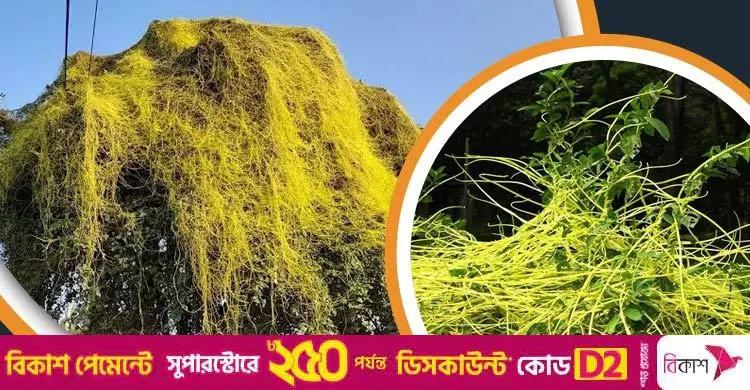
Our rural landscape holds many kinds of trees, plants and vines that help keep nature in balance and have been used in healing since ancient times. Swarnalata is one of them. Once, anyone walking along a village path would see this parasitic vine draped over tree branches. Over time, though, this useful plant, full of medicinal properties, has been vanishing from the countryside.
A parasite that lives on trees
Swarnalata is a parasitic plant: it is born on a tree, grows on it and spreads from it. Its English name is giant dodder and its scientific name Cuscuta reflexa. The Cuscuta genus has about 170 species. It is an annual, leafless plant that flowers in spring. The flowers produce fruit, and the seeds in that fruit give rise to new plants. Several species of swarnalata are found in Bangladesh.
It grows on a living tree and survives by depending on it, drawing food directly from the branches and trunk. The vine has sucking organs called haustoria, through which it takes nutrients from the host. It grows fast, soon puts out many branches and covers the host tree completely.
Swarnalata is one of the vines that add to the beauty of nature, spreading its splendour across the green Bengal countryside. It is seen in almost every part of the country, and people of all ages who live in or visit villages know it.
Bangladesh's weather is very favourable for it, so it easily takes root on suitable host trees in rural and hilly areas, most often on the trunks of jujube (boroi) trees. It is found more or less in every region, but most of all in the Barind area of Rajshahi and in Gazipur, Bhawal Gazipur, Satkhamair and Sreepur in Dhaka division.
Its bright greenish colour catches the eye from afar: it looks as if bunches of yellow thread are hanging from the branches, and in sunlight it glitters beautifully. Its main season of growth and flowering runs from the Bengali months of Poush to Chaitra, but it survives and adds beauty outside the season too.
Medicinal uses
According to Ayurveda, swarnalata has remarkable medicinal properties and has been used as a herbal remedy since ancient times. It is regarded as a remedy against phlegm, worms, scabies, impure blood, bile and wind. Its use is also notable in controlling and treating itching, high blood pressure, bone problems, diabetes, jaundice, liver disease and breathing difficulties.
Crushed swarnalata applied to a wound helps it heal quickly. It is very effective in relieving stomach pain. Gargling with water in which the vine has been boiled soon helps heal mouth sores. Its extract is also very useful against bloating and constipation. In short, it is a herbal vine of many virtues, valued in health care since ancient times.
Why it is vanishing
Swarnalata was once easy to spot along paths across the country, especially in rural areas. The jujube tree is known as its main host. But roadside jujube trees no longer grow untended or naturally in villages as they once did. Owners of the trees that remain prune them at a set time every year for planned cultivation and higher yields, so the vine loses its home. New branches grow back, but the swarnalata does not return. Where a little does grow, it is pulled out as a weed. This is how the medicinal swarnalata is slowly disappearing from our natural surroundings.
The report says that although swarnalata is not a natural plant of our environment, it is full of important medicinal properties. Its loss would threaten a large part of Ayurvedic treatment, and once this plant, widely used in home remedies, is lost, it cannot be brought back.
Steps to protect it
Action is needed now. The first step is awareness: its benefits should be publicised among ordinary people, farmers and students, and campaigns should make clear that swarnalata is not a weed but a valuable herbal resource.
The trees on which it grows should be protected and planted. Letting trees grow naturally instead of routinely pruning them could allow swarnalata to spread again. Herbal plant cultivation and conservation projects by educational institutions, social organisations, environmentalists and local administrations would help it survive for future generations. Protecting this unique gift of nature is everyone's responsibility.
Source: Jagonews24. First published in Bengali on The Agro News.

Comments
(0)