
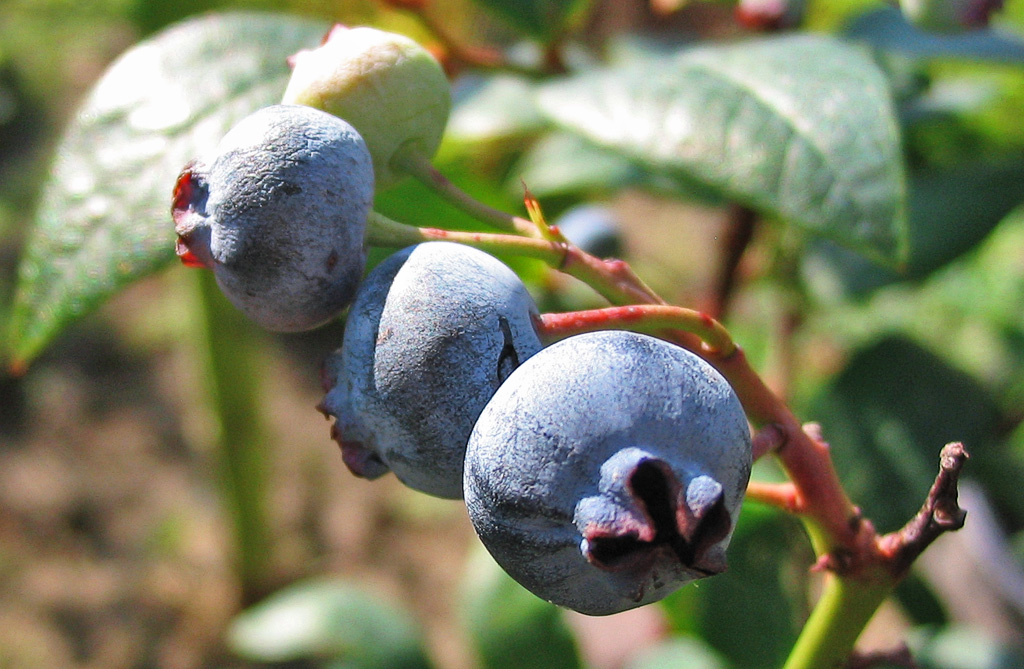
Engineers at the Georgia Institute of Technology, working with the University of Georgia and the University of Florida, have built and field-tested a robot that harvests whole clusters of fresh-market blueberries at once instead of one berry at a time. In outdoor trials it grasped clusters successfully 92% of the time. The system, called CLASP, is described in a paper posted on 16 September to the preprint server arXiv; it has not yet completed peer review.
Fresh-market blueberries, sold whole in clamshells, must be picked gently and selectively because bruised or unripe fruit loses value. Machines that shake the bush are used mostly for processing fruit, so fresh berries are still picked by hand, an increasingly costly job as farm labour tightens.
The team's gripper, the Soft Active Rolling-Band Gripper, wraps two independently driven silicone bands around a cluster and rotates them, pulling on the whole group. It relies on a measured difference: ripe berries came away at an average force of 0.66 newtons, unripe ones needed 2.47 newtons, about four times as much. Set between the two, the bands take ripe fruit and leave green berries to mature. The robot estimates the force from the current its motors draw, so it needs no separate force sensor.
The gripper rides on a six-jointed arm guided by two cameras: a wide-angle camera finds clusters and a camera inside the gripper guides the final approach. A machine-vision model trained on images from four seasons, 2023 to 2026, judges whether a cluster is mature. The work was led by Yue Chen of Georgia Tech's Institute for Robotics and Intelligent Machines and supported in part by a USDA National Institute of Food and Agriculture robotics grant.
The 92% figure comes from 25 attempts, which the researchers call a feasibility demonstration rather than a reliability figure. Both failures were positioning errors by the arm, not the gripper. Measured on its own, the gripper picked 32 berries a minute against about 55 for an experienced picker, roughly 58% of hand speed. Machine-picked fruit was about 15% softer in a firmness test, which the authors say may partly reflect the small sample. From one fixed position the camera could see only 40% of the clusters in the canopy.
A commercial machine is likely years away, but growers facing the same labour squeeze in new berry regions, from Latin America and Africa to trial plantings in India's Himachal Pradesh and Jammu and Kashmir, have reason to watch. A cluster-level approach could later extend to other small, soft fruits.
Photo: Darkone / Wikimedia Commons (CC BY-SA 2.5)
Source: Global Agriculture

Comments
(0)