
Picture a Saturday evening in the 1980s. In a village market, a single black-and-white television sits on a shelf in a tea stall, and in front of it farmers in lungis and gamchhas are packed together, some on benches, some on the ground, some standing at the back. On the screen is Mati O Manush, and the presenter is a young man talking about new rice varieties, fertiliser and irrigation. His name is Shykh Seraj. Today is the birthday of the television presenter, agricultural development campaigner and media figure.
He was born on this day, 7 September, in 1954, in Chandpur; his family home is in the district's Haimchar upazila. His certificates, however, give his date of birth as 28 June 1956. He studied at Khilgaon Government High School and Notre Dame College in Dhaka, then took a master's degree in geography at the University of Dhaka. Geography deals with soil, rivers, climate and human settlement, and the geography graduate would go on to spend his life working on soil and people. That may be more than coincidence.
Two birth dates are common among people of his generation. The date written down at school admission or exam registration stayed on the certificates, while families kept celebrating the real day. So it is with Shykh Seraj, whose birthday is marked on 7 September.
While still a student he began working with Bangladesh Television, Bangladesh Betar (the state radio) and newspapers, and his career in journalism dates from 1978. Today he is the founder-director and head of news of Impress Telefilm Limited, which runs Channel i. For four and a half decades he has used the media on behalf of the country's agriculture, its farmers and its productive economy.
A young journalist in a hungry country
When Shykh Seraj started out in journalism, Bangladesh was a newly independent country whose greatest worry was food. In the first years after independence the rice harvest was around 10 million tonnes, and the number of mouths was rising fast. Most fields still grew traditional varieties, one or at most two crops a year on the same land, and many fields lay empty through the dry season. Dependence on foreign food aid was a fact of national life.
Against that background the country's agricultural research institutes set to work. The rice research institute founded in Gazipur in 1970 became the Bangladesh Rice Research Institute after independence and began releasing high-yielding varieties one after another. A high-yielding variety gives several times the grain of a traditional one from the same land, but it needs timely irrigation, balanced fertiliser and new methods. A variety bred in a laboratory is only half the work; the real test comes when a farmer sows it in his own field. That required someone who could translate the researcher's language into the farmer's.
How a programme was born: from Amar Desh to Mati O Manush
It was presenting Mati O Manush ("Soil and People") on Bangladesh Television that won him an audience across every class and profession. He has been associated with the programme since 1982. But it began under another name and in a different shape, as he himself has described:
In the beginning the programme was called Amar Desh. It was then a fifty-minute fortnightly programme. Later I turned it into a weekly under the name Mati O Manush. I felt that the people of Bangladesh needed educational, motivational programmes more than entertainment. If farmers could be properly shown new seeds, new technology and new techniques, a great change in agriculture was possible.
For the time, the idea was bold. Television meant drama, songs and the news. Bangladesh Television was the only channel in the country; the era of private channels was still a decade and a half away. Running a weekly programme about crops, seed and soil on that single channel was a new kind of experiment. Shykh Seraj believed that television was not only a box for entertainment; used well, it could become a classroom for millions of farmers.
Shykh Seraj is often described as one of the central figures behind the great change that has come over Bangladesh's agriculture in the past few decades. As scientists released one high-yielding rice variety after another, and the government pushed new ideas and techniques in farming, Mati O Manush played a large part in spreading them across the country.
Saturday crowds around the market television
Over four decades Shykh Seraj became the main source of farming information for Bangladesh's farmers. In the 1980s, before television had reached most homes, people crowded into village markets and community centres every Saturday evening to watch Mati O Manush. Few households could afford a set of their own, so one screen served a whole village.
To grasp what that scene meant, remember how few routes new information had to a farmer at the time. There were agricultural extension officers at union level, but one officer could not regularly visit thousands of farmers. Newspapers were scarce in the villages and so was the habit of reading them. There was radio, but radio cannot show. When a farmer saw on screen that a farmer in another district had reaped a bumper crop from a new rice variety, it carried more weight than any lecture.
The role of the Department of Agricultural Extension deserves mention here. At union level its sub-assistant agriculture officers take advice straight to farmers: which variety suits which soil, when to transplant, which remedy for which disease. Television was not a rival to that work but a complement. A farmer who saw a new variety succeed on screen became curious, and took that curiosity to the local agriculture office or the field worker. Encouragement on one side, hands-on help on the other: together they changed the fields.
"We won't eat rubber rice": winning farmers over
Persuading farmers to take up new ways of farming took patience. Looking back on those years, Shykh Seraj has said:
The difference between today's farmer and the farmer of thirty years ago is the difference between heaven and earth. Back then, what an agricultural extension officer told a farmer, or what I said as a television presenter, they did not want to accept. They thought: what if the kind of farming we were talking about did not give a good crop?
Because of that doubt, farmers were slow to be persuaded and reluctant to adopt new technology. From where they stood, the caution made sense. A small farmer's food for the whole year depends on one or two harvests. If an unfamiliar seed failed, there was no way to make up the loss. The local varieties of their fathers and grandfathers yielded less, but at least they were known.
There was another objection, too: taste. In Shykh Seraj's words:
When I was talking in the eighties about new high-yielding varieties of rice, about wheat, they told me plainly: we will not eat this rubber rice. The quality of the new varieties developed up to then was not very good. The rice was like rubber; drop a grain onto a plate from above and it would bounce like rubber.
Things began to change from two directions. On one side, scientists were making progress; the Bangladesh Rice Research Institute was releasing variety after variety that gave higher yields and better eating quality than before. On the other, Shykh Seraj kept finding new ways to win farmers over through his programme. Instead of lectures from the studio, the camera went into the fields, and farmers themselves began to speak on screen.
When one farmer shows another his field and says how many maunds of paddy he harvested, the words carry a weight of their own. In this way news of new rice, wheat, vegetables, fish farming and poultry spread from village to village. A country that grew around 10 million tonnes of rice at independence more than tripled its output over the following decades. Researchers, extension workers and farmers made that possible, and the part played by the media is widely acknowledged.
Channel i and Hridoye Mati O Manush
At the end of the 1990s private television arrived in Bangladesh. Shykh Seraj was among the founders of Channel i, which began in 1999, and became its head of news. On the channel he helped run, he launched a new farm programme, Hridoye Mati O Manush ("Soil and People at Heart"). It was first broadcast on 21 February 2004 and has run weekly ever since, bringing agricultural news from Bangladesh and abroad.
Channel i was among the early private satellite channels in Bangladesh, at a time when viewers were only beginning to have a choice beyond BTV. For a new channel competing for attention with dramas, music and talk shows, giving regular airtime to farming was a statement of priorities. Hridoye Mati O Manush airs on Saturday nights, keeping alive the Saturday habit that Mati O Manush had built among rural viewers on BTV.
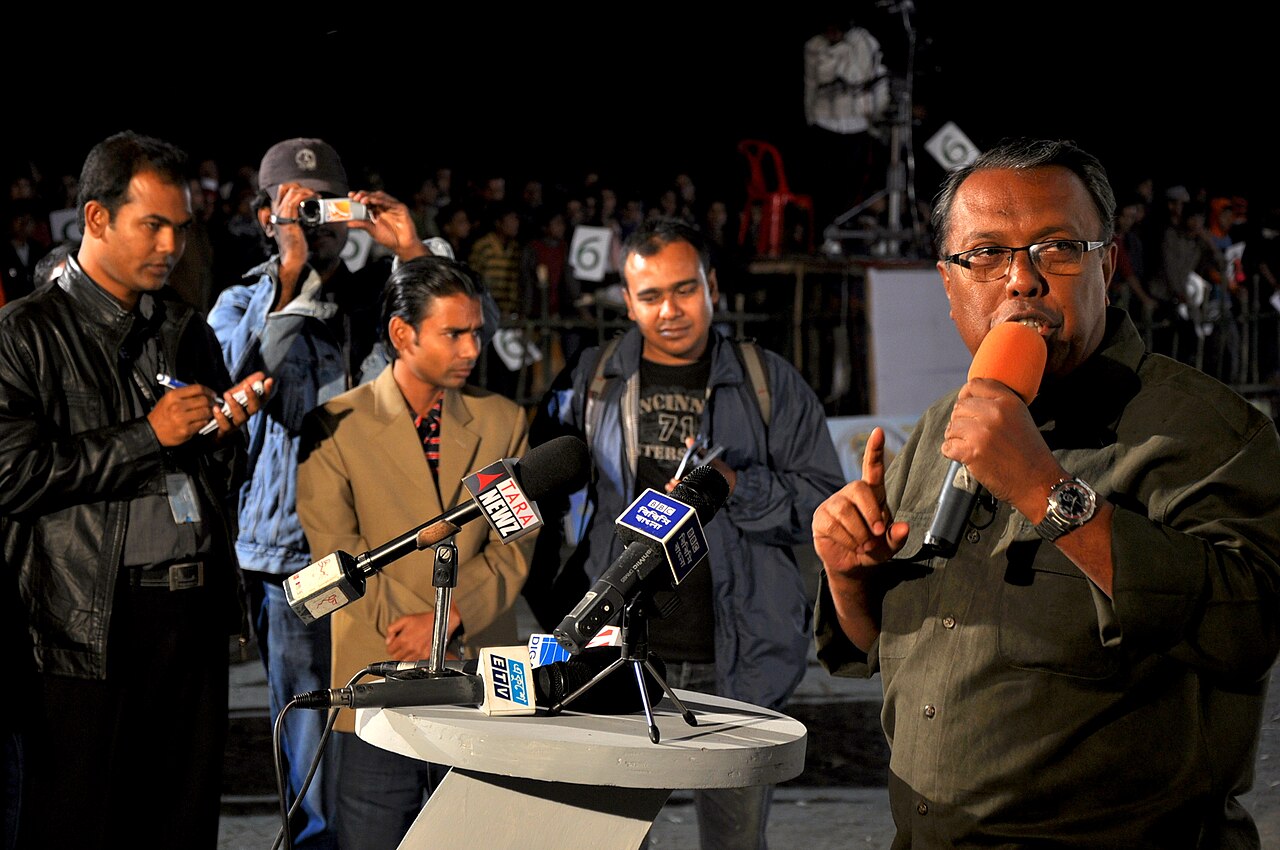
Hridoye Mati O Manush did not stay a television programme alone. Under its banner came events built around listening to farmers. Before each national budget, the Krishi Budget Krishoker Budget (Farm Budget, Farmers' Budget) dialogues put farmers face to face with ministers and policymakers to state their problems directly. In 2011 came the Farmers' World Cup Cricket, in which the players were farmers from the fields; the photograph with this piece was taken at the press briefing before it. He has also visited farms in many countries and brought their technology and experience home to Bangladeshi farmers.
The idea behind the budget dialogues is worth spelling out. Each year the national budget decides how much goes to farm subsidies, fertiliser, seed, irrigation and research, yet the voices of the farmers it is meant for rarely reach the table where it is drawn up. In these dialogues farmers from different regions raised fair crop prices, fertiliser supply, irrigation costs, farm credit and the grip of middlemen directly, and viewers across the country watched. Books under the same title, one of them edited by him, followed.
A pioneer of development journalism
Through nearly four decades of devoted work in television and the wider media, Shykh Seraj has become established as a pioneer of development journalism. Development journalism does not stop at reporting what happened; it shows people ways to improve their lives: which seed gives a bigger harvest, which remedy treats which disease, which market pays a fair price.
His media campaigns are credited with a profound change in Bangladesh's agriculture and a revolutionary rise in food production. Rural life has changed for the better in many ways. He has also turned city people towards farming; discussions of rooftop gardens and of educated young people starting farm businesses often mention the influence of his programmes. As a result, agriculture's many contributions to the economy have come into view.
Alongside his programmes on Channel i and Bangladesh Television, he writes regularly for newspapers. In a country built on agriculture, farming was once dismissed as a dull subject; he raised it to the status of lead national news. That a farmer's paddy price, a fertiliser shortage or a new variety now makes the television bulletin or a newspaper's front page owes much to his long effort.
A changed agriculture, a changed farmer
Set the 1980s beside today and the scale of change becomes clear. According to the Bangladesh Bureau of Statistics, the country produced 41 million tonnes of rice in fiscal 2023-24, crossing 40 million tonnes for the first time. Output of vegetables, fish, eggs and milk has grown a great deal as well. Farmers who once hesitated over new seed now use hybrid seed, power tillers, harvesting machines and advisory services on their mobile phones.
Agriculture is still the country's largest employer. According to the BBS Labour Force Survey 2022, 45.33 per cent of employed people work in agriculture. Nearly one working person in two earns a living from fields, farms, ponds or cattle sheds. Bringing the problems, prospects and demands of these millions into the media is the work Shykh Seraj has pursued for decades.
Interest in farming has grown noticeably in the cities too. Vegetable and fruit gardens on roofs and balconies are a familiar sight in Dhaka and other cities, so much so that in 2023 the local government minister announced a 10 per cent holding tax rebate for rooftop gardens in city corporation and municipal areas. Many educated young people now choose fish, poultry, fruit or vegetable farms over a salaried job. The part television farm programmes played in spreading the idea that farming can be a promising business, not only the occupation of the rural poor, is often discussed.
Honours at home and abroad
For development journalism Shykh Seraj has received Bangladesh's two highest state honours: the Ekushey Padak in 1995 and the Independence Award in 2018. He is an Ashoka Fellow, elected in 1992. Founded by Bill Drayton in 1980, Ashoka seeks out social entrepreneurs around the world whose new ideas are changing their societies. The fellowship recognised farm journalism as a tool for social change, three years before his Ekushey Padak.
In 2009 he received the A.H. Boerma Award of the Food and Agriculture Organization of the United Nations (FAO) for journalism on food security and poverty reduction. Named after Addeke Hendrik Boerma, a former Director-General of the FAO, the award goes to journalists who bring food and agriculture issues to the world's attention.
He has also received Asia's Gusi Peace Prize and the BCA Golden Jubilee Honour Award in Britain. The British House of Commons has given him a special honour, and a British-Bangladeshi business organisation its Green Award. At home he has received the Bangladesh Economic Association gold medal, the Dr Ibrahim Memorial gold medal and the Ranada Prasad Saha gold medal, among some fifty national and international awards and honours.
Farming on the page: his books
Away from the screen, Shykh Seraj is also a writer. He has gathered his field experience, farmers' problems and thoughts on agricultural policy into books. His published works include:
- Matsya Manual (a fish-farming manual)
- Mati O Manusher Chashbash (Farming with Mati O Manush)
- Farmers' File
- Matir Kachhe Manusher Kachhe (Close to the Soil, Close to the People)
- Bangladesher Krishi: Prekkhapot 2008 (Agriculture of Bangladesh: Context 2008)
- Krishi O Gonomadhyom (Agriculture and the Media)
- Krishi Budget Krishoker Budget (edited)
- Amar Swapner Krishi (The Agriculture of My Dreams)
- Krishi Budget Krishoker Budget (2011)
- Samakalin Krishi O Onyanya Prosongo (Contemporary Agriculture and Other Matters, 2011)
- Krishi O Unnayan Chinta (Thoughts on Agriculture and Development, 2013)
The titles show the breadth of his interests, from a hands-on guide to fish farming to the farm budget, the role of the media and ideas about development. There is something in them for the farmer in the field and for the policymaker alike.
Four decades with the soil and its people
The theme of Shykh Seraj's work is held in the name of his programme: soil and people. Soil means crops, food and nature; people means the farmer who, burnt by the sun and soaked by the rain, feeds the country. Between the two he placed a television camera, so that the farmer's voice would reach city people, researchers and government, and the new knowledge of the laboratory would reach the farmer's yard.
Perhaps the greatest lesson of his work is that a farmer's trust is earned with patience: not by instruction or sermon, but by giving farmers a chance to speak, taking their problems seriously and showing them other farmers' success. Four decades on he still goes to the fields, sits beside farmers, walks the ridges between plots and hands farmers the microphone in front of the camera. That constancy is what has made him one of their own.
The farmer who in the 1980s refused to eat "rubber rice" may today have a son or daughter who looks up farming advice on a mobile phone and watches news of drones spraying crops. Shykh Seraj has been both witness to and partner in that long transformation. On his birthday, The Agro News sends its good wishes to the farmer's friend.
Photo: Shykh Seraj at the press briefing before the Farmers' World Cup Cricket, 2011, Hridoye Mati O Manush Channel i from Bangladesh, Bangladesh / Wikimedia Commons (CC BY 2.0)
Comments
(0)