
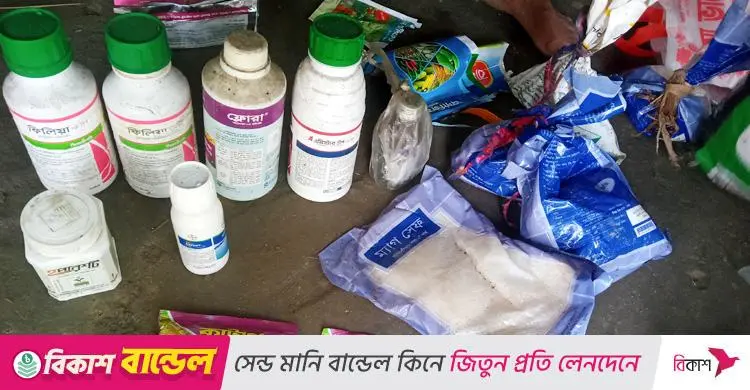
Pesticides are having a seriously harmful effect on public health and the environment. Besides the health risk, they are leaving families financially ruined. Pesticide use is causing various illnesses among farmers, and treatment can cost a farming family up to nearly a lakh taka.
If excessive and indiscriminate pesticide use is not controlled, disaster could follow for health, the environment and the socio-economic sphere. These worrying findings came from a recent exploratory field survey on the harmful effects of pesticides on public health and the environment in Shyamnagar, Satkhira. It was carried out by the private research organisation Bangladesh Resource Centre for Indigenous Knowledge (BARCIK).
Mofizur Rahman, a programme officer at BARCIK, presented the findings at a press conference at the Shyamnagar Press Club on Wednesday 6 August. BARCIK associate regional coordinator Ramkrishna Joardar was also present.
Banned products still in use
The survey said pesticides are used on farmland to control stem borers, armyworms, aphids, borers and various viral diseases. Farmers use a wide range of products, including Esatop, Cot, Bhittako, Amistar Tob, Del Expert, Incipio, Tuba, Sam, Talaf, "wheat poison", "black powder poison", Sobikrom, Antacol, Karate, Tasla, Folicur, Joas, Ripcot, Jahim, Farmcot, Mimtox, Conjaplus, Bifuran, carbendazim, mancozeb and Mortar. Of these, Farmcot, Mimtox, Conjaplus, Bifuran, carbendazim, mancozeb and Mortar are banned by the government.
Pesticide use is now a reality of technology-driven efforts to raise farm output, but its blind and uncontrolled application is having a severe impact on public health, the environment and the socio-economic fabric. The survey of 31 farmers in 14 villages of Shyamnagar upazila found that farmers apply pesticides themselves, on the basis of their own experience or on the advice of neighbouring farmers, pesticide sellers, company representatives and sub-assistant agriculture officers.
Direct contact with pesticides leaves farmers with itching, blurred vision, cataracts, breathing difficulty, dizziness, nausea, tingling in the hands and feet, weakness, liver complications, skin disease and other illnesses.
Treatment costs and wider damage
The survey found that most families had to spend between Tk 800 and Tk 90,000 on treatment, paid from their own savings and with help from relatives. Many are still under treatment.
The harm is not limited to public health; it extends to the environment and animal life. Spraying on farmland has led to the deaths of cattle, goats, ducks and chickens, and fish in ponds are dying. Children and elderly people have been harmed when pesticides were used at home to kill cockroaches.
The survey found a lack of guidance and awareness. Most farmers use pesticides without reading the label and do not know what to do after spraying. Lacking training, many apply them wrongly.
The socio-economic impact is also large. Treatment, lost work, dead livestock and ruined crops together are creating mental stress, malnutrition and falling incomes for farmers.
Recommendations
To curb uncontrolled use, the survey recommended promoting organic methods and local farmers' knowledge for safer alternative farming; hands-on training for farmers before they use pesticides; simpler language on pesticide labels and publicity in the media; free health check-ups for farmers; and rehabilitation programmes for affected and disabled farmers.
Source: Jagonews24. First published in Bengali on The Agro News.

Comments
(0)