
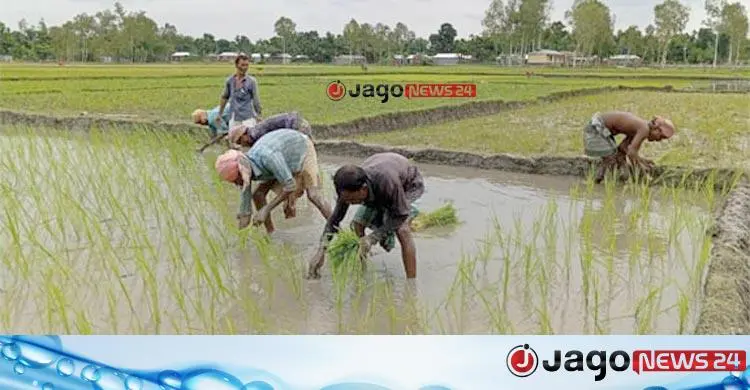
The monsoon has brought Rajshahi's farmland back to life. A few weeks ago the soil was cracking for lack of rain; now the fields are full of activity. Before dawn, farmers are out on village paths, some carrying rice seedlings on their shoulders, some preparing land with tractors, while elsewhere men and women stand waist-deep in water planting Aman seedlings in rows. Aman planting now dominates rural Rajshahi.
Visits to several upazilas and conversations with farmers show that timely rain has left enough moisture in the soil for seedlings to be planted quickly. With farmers' tireless work on one side and nature's help on the other, everyone is hoping for a good harvest.
In rural Rajshahi the Aman season is not just a farming task but an important chapter of village life. At this time of year the field ridges, canals, wetlands, irrigation channels and farmyards are all busy. Lifting seedlings from seedbeds, ploughing, transplanting and tending multiply farmers' working hours and create work for local labourers.
Targets for the season
According to the Department of Agricultural Extension (DAE) in Rajshahi, the target this season is to grow Aman on 83,600 hectares in the district, producing 3,14,336 metric tonnes of paddy. Seedlings have already been planted on 31,353 hectares. Officials hope planting on the remaining land will be finished by the middle of next month if the weather stays favourable.
By upazila and thana, Aman will be grown on 27 hectares in Motihar thana, 12 hectares in Boalia thana, 9,134 hectares in Paba, 21,980 hectares in Tanore, 4,100 hectares in Mohanpur, 3,600 hectares in Bagmara, 5,830 hectares in Durgapur, 7,395 hectares in Puthia, 23,762 hectares in Godagari, 5,445 hectares in Charghat and 2,220 hectares in Bagha.
People involved in agriculture say Aman is one of the main seasons for rice, the country's staple. Although the crop depends on monsoon rain, improved seed, modern technology, balanced fertiliser management and regular advice from the agriculture department are raising production significantly. The use of modern farm technology has grown in Rajshahi in recent years, and interest in improved rice varieties has risen with it.
Farmers' voices
Anis Ali, a farmer in Tanore, said the rain had left enough mud in the fields and everyone was planting without delay. "Most of the land in our area will be planted within a few days. If the weather stays favourable, we expect a good yield."
Shahid Hossain, a farmer in Bagmara, said he had been worried at first because there was no water. "Now it has rained and everyone has come to the fields together. With demand for labour up, workers are hard to find, but we are still trying to finish planting on time."
Abdul Kader, a farmer in Paba, said farming had changed a lot and preparing land takes less time than before. "We are trying to finish everything at the right time, because seedlings planted on time give a better yield."
Rowshan Ara, a woman farmer in Godagari, said everyone in her family farms. "Women now work equally alongside men in planting and tending the rice. A good harvest brings relief to the household."
Local people say farmers in many areas are working in groups on each other's land, which speeds up the work and eases the labour shortage somewhat. In some places relatives and neighbours are helping voluntarily, a village tradition of mutual help that survives in many areas.
Farmers say the success of Aman depends largely on timely planting, regular care and favourable weather, so they are paying special attention to weeding, irrigation and seedling care, and are ready to act quickly if disease appears.
Village markets are busier too. Demand has risen for vans, nosimons and other vehicles to carry seedlings, farmers crowd the markets from morning, and local traders have regained their energy.
According to local agriculture people, wider use of modern farm machinery has greatly increased the pace of cultivation. Many farmers now prepare land mechanically, saving both time and labour, and many young people are joining family farming, a sign of positive change in the sector.
Abu Bakar Siddique, a farmer in Durgapur, said farming is their main livelihood. "However hard it is, we have to be in the fields on time. A good harvest makes us forget all the hardship. Our only hope now is that the weather stays favourable to the end."
Rabiul Islam, a farmer in Mohanpur, said Aman is not just a crop but the family's main guarantee of food for the year, so they are farming with the utmost care.
People involved in the rural economy say the Aman season creates income not only for farmers but for labourers, transport drivers, farm machinery operators and small traders, benefiting the whole rural economy. Farmers hope that if the weather stays normal for the rest of the season and there is no major natural disaster, the fields will be full of golden paddy.
Officials expect a good harvest
Agriculture officials said that with favourable weather, farmers' hard work and close field supervision, Rajshahi could achieve new success in Aman production this season, and its farmers would play an important role in the country's overall food security.
Bagmara Upazila Agriculture Officer Abdur Razzak said conditions were favourable for Aman this season and farmers were planting in full swing after the recent rain. Upazila agriculture officials and sub-assistant agriculture officers were advising farmers regularly in the field, encouraging them to use improved seedlings, plant on time, apply balanced fertiliser, control weeds and disease, and keep adequate moisture in the fields. He said farmers were showing great interest and working hard to finish planting on time, and the agriculture department would continue all technical support and advice until the end so they could achieve the yields they hope for.
Mita Sarkar, additional deputy director (crops) of the DAE in Rajshahi, said Aman had already been planted on more than 31,000 hectares in the district, and the recent rain had quickened the pace. "We expect Aman planting to be completed according to target in all upazilas of the district by the middle of next month," she said. Officials were visiting fields regularly to give technical advice.
She added that farmers were being made aware of choosing improved seed, planting on time, applying balanced fertiliser, controlling disease and tending their land as needed. If the weather stays favourable and there is no major natural disaster, a good yield is likely, she said. If cultivation meets the target, Rajshahi will be able to meet its own food needs and produce surplus paddy, playing an important role in the district's farm economy and the country's food security.
Source: Jagonews24. First published in Bengali on The Agro News.
Comments
(0)