
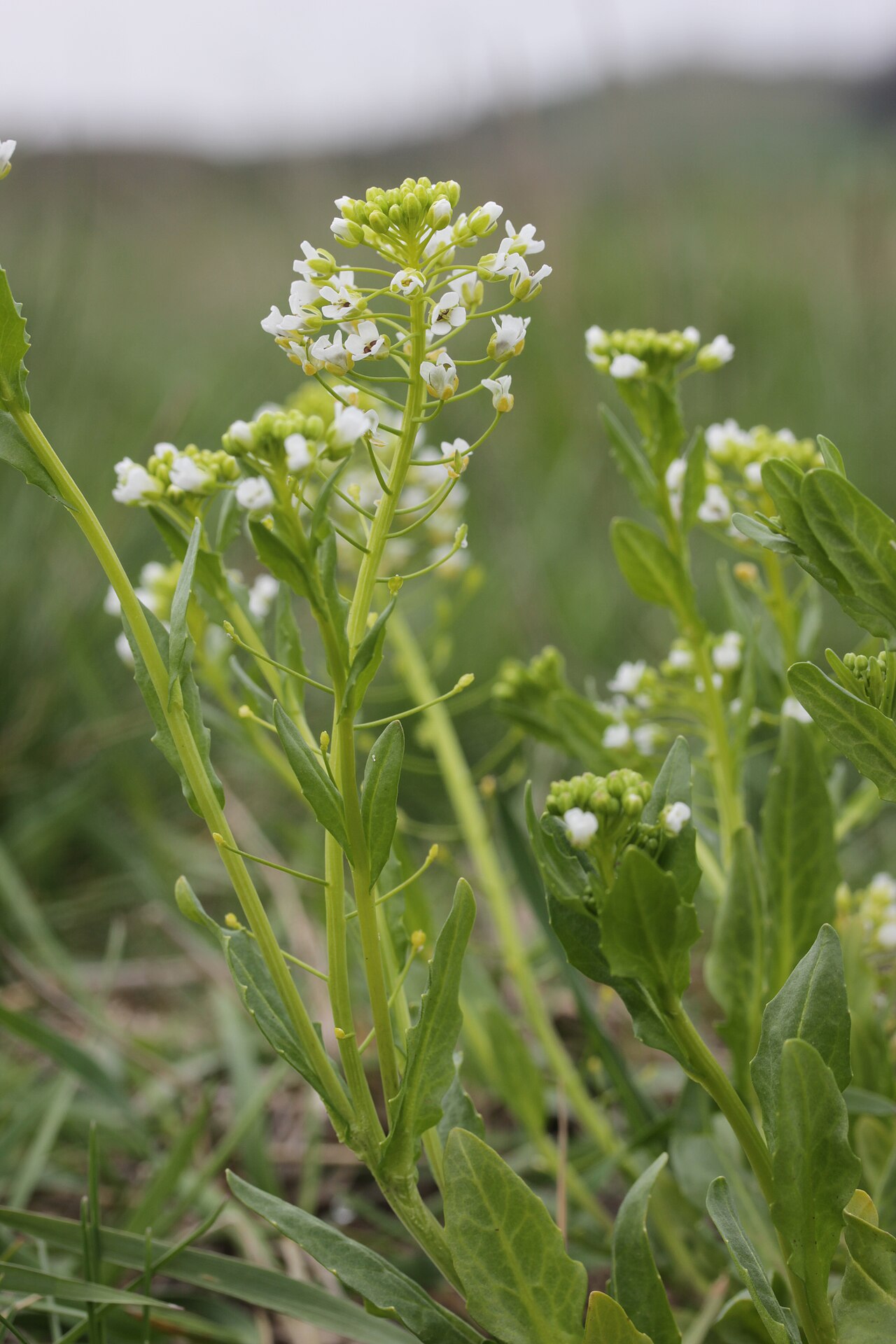
CoverCress Inc., a St. Louis, Missouri, company that has spent more than a decade turning the wild weed pennycress into a commercial winter oilseed, has used gene editing to make the plant tolerate herbicides. A study published on 6 November in Plant Biotechnology Journal, written with fellow St. Louis firm BioHeuris Inc., shows that one of the two edited traits worked and the other did not.
Pennycress (Thlaspi arvense) is a fast-growing member of the mustard family. CoverCress's domesticated version has less fibre, lower seed dormancy and lower erucic acid, so the seed meal can feed animals and the oil can go into low-carbon biofuel. It is planted after the corn or soybean harvest and taken off before the next crop, so it covers the soil over winter while also producing something to sell.
The obstacle is weed control. Midwest corn and soybean growers rely on ALS-inhibitor and HPPD-inhibitor herbicides, which break down slowly and can carry over into the next crop, and pennycress is highly sensitive to both. For ALS tolerance, the researchers treated seed with a chemical mutagen, sprayed roughly 20,000 plants with two commercial herbicides and found survivors carrying a mutation called P187S. They then used CRISPR-Cas9 to place exactly that mutation into elite breeding lines. Stunting or delayed flowering in the edited lines appeared only when herbicide rates reached eight to sixteen times normal.
The HPPD trait was harder. BioHeuris found an enzyme variant, G419A, that resisted herbicides such as mesotrione in bacterial tests, and tolerance held when the gene was overexpressed throughout the plant. But when the mutation was edited into the gene's own natural location in the pennycress genome, the plants bleached and suffered leaf damage much like unedited ones, even at a fraction of the normal rate. The authors call the behaviour "context-dependent".
Editing was also slow work: three ALS-edited survivors came from roughly 20,000 screened seeds, and one working HPPD-edited line from about 800 seedlings. For CoverCress, the outcome is one usable trait built around an already registered herbicide class, which could help fit pennycress into existing corn-soybean rotations. The wider lesson, the report notes, is that a trait proven in a lab construct may not work once installed at its natural address in the genome.
Photo: Björn S... / Wikimedia Commons (CC BY-SA 2.0)
Source: Global Agriculture


Comments
(0)