
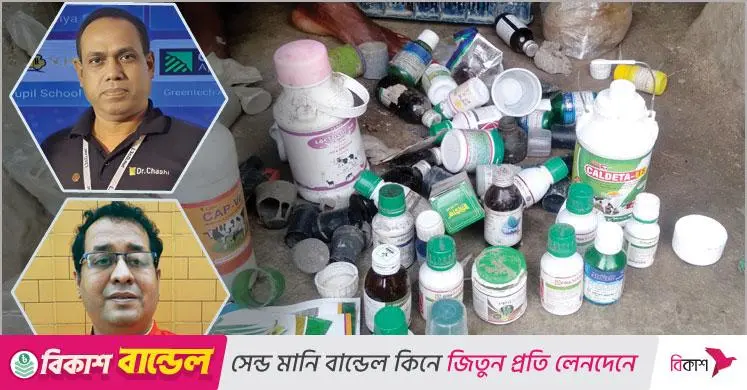
By Professor Noman Faruk and Samiran Biswas
Food security in the world is not limited to producing enough food; it also involves the quality, nutrition and safety of food. In Bangladesh and many other agriculture-dependent countries, producing safe food has become a major challenge. To raise output and protect crops from disease and pests, farmers have become excessively dependent on chemical pesticides. This uncontrolled use is damaging soil fertility on one hand and polluting water sources on the other. The greatest harm is to human health: over the long term these chemicals enter the body through food and cause cancer, kidney and liver disease, neurological problems and even reproductive complications.
Failure to maintain safe food standards is also one of the reasons Bangladesh's farm products cannot compete in international markets. Although the government and various private organisations are pushing organic fertiliser and biopesticides through good agricultural practice policies, there are still major limits in practice. Controlling pesticide use is therefore now an urgent need on the road to safe food.
From 4,000 to 40,000 tonnes
Farm production in Bangladesh has long faced many challenges, with pests and diseases a major obstacle. Pesticide use in the country began in 1953 to tackle this. At the time, officials encouraged farmers to use pesticides under the slogan "Only a fool lets insects eat his crop". The aim was to raise output and ensure food security. Use was limited at first but gradually became widespread. In 1972 total pesticide use in the country was only 4,000 tonnes. To increase production, the government ensured subsidies, training and availability in the market for farmers. This had some positive effect on crop output, but unnecessary use kept growing, and pesticide use rose rapidly after that. Over the past 50 years it has reached alarming levels: according to data, pesticide use in 2022 was about 40,000 tonnes, a tenfold increase on 1972. This rise came not only from production needs but also from farmers' lack of awareness, a shortage of alternative technologies and company promotion.
The effects of excessive pesticide use are now severe. Farmers' production costs are rising while soil fertility is being destroyed. Pesticide residues are mixing into rivers, canals and water bodies and polluting the environment, putting fish, birds and biodiversity under serious threat. Most worrying of all, these pesticides enter people's food and gradually raise the risk of many complex diseases. Bangladesh's farm sector stands at an important crossroads: demand for food is growing, while over-reliance on pesticides is pushing it towards disaster. Tackling this requires more use of organic or biopesticides, wider integrated pest management and greater farmer awareness, along with government policy support and research. In short, the journey of pesticide use that began in 1953 has reached an alarming point, and it is now time to build a sustainable farming system that gives priority to safe food and environmental protection alongside food security.
Health risks for farmers and consumers
Pesticides play an important part in modern agriculture in controlling pests and protecting crops, but their excessive and uncontrolled use poses a serious threat to human health. Various studies have found that the active chemical ingredients of pesticides enter the body through the airways, the skin and food, and in the long term cause cancer, nervous system problems, liver and kidney failure and other complex diseases.
According to a survey by the Bangladesh agricultural research organisation, about 64% of farmers with cancer in the country developed it because of regular pesticide spraying. When using pesticides in open fields, farmers do not use the necessary protective equipment such as masks, gloves or special clothing, so the toxic chemicals enter their bodies directly. Pesticide residues left in food also increase health risks for consumers, with children and pregnant women most at risk. Because of excessive pesticide use, cancer and other complex diseases are now appearing in household after household. Farmers use chemical pesticides unnecessarily to protect their crops, but this has a severe effect on food safety and public health.
Research has found that a large share of cancer patients in the country fell ill after long exposure to pesticides. Market analysis shows the country's pesticide market is now worth more than Tk 5,000 crore, clear evidence of over-reliance on the sector. The hopeful news is that the country is gradually moving towards environmentally friendly farming. So far 110 registered biopesticides, or organic pesticides, have been approved, which are comparatively safer for human health and the environment, and the government has banned 40 harmful pesticides. These are important steps for sustainable farming and safe food, but big challenges remain: raising farmers' awareness, using alternative technologies and making organic pesticides easily available in the market. If reliance on chemicals can be reduced and biopesticides and integrated pest management expanded, farming will become safe, healthy and sustainable.
According to the World Health Organization, about 3 million people worldwide are poisoned by pesticides every year, of whom about 200,000 die. The impact is growing in Bangladesh too, so adopting organic and environmentally friendly alternatives and raising farmers' awareness is now the need of the hour. Dr Saleh Ahmed, Bangladesh representative of the international organisation CABI, said: "Work is being done to limit pesticide use. New digital technologies have begun to be developed and put into practice to reduce the harmful effects of pesticides."
The role of journalists
Journalists have a very important role in reducing pesticide use and raising caution. They act as a mirror of society and can put accurate information on agriculture and food safety before the public. Reporting the harmful effects of excessive pesticide use, such as cancer, pollution and loss of soil fertility, in news reports, talk shows or features raises awareness among both farmers and consumers. Journalists can also highlight the opinions of agricultural experts, the benefits of organic and bio pesticides and how safe food can be produced, giving farmers a chance to learn about alternatives. Exposing irregularities or illegal trade by pesticide sellers and companies is also part of their job, which can make the government more careful in policymaking. Above all, a positive role by journalists builds trust in society; they can show not only the problem but the way to solve it. If accurate information and a humane perspective are spread, farmers will become aware, the public will demand safe food and the government will move on policy reform, reducing the risks of pesticide use and raising a healthy generation.
The dangers of pesticides are today a serious threat to the country's agriculture and public health. Excessive and unnecessary use is destroying soil fertility, polluting water sources and causing cancer and other complex diseases. Journalists have played a very positive role in bringing this reality to the public, regularly publishing reports in newspapers, on television and online to make farmers and ordinary people aware. They have not only highlighted the problem but also promoted the benefits of organic or bio-pesticides as an alternative. By reporting on pesticides banned by the government, irregularities by adulterators and farmers' experiences, they have drawn policymakers' attention. As a result, many farmers are now becoming aware and taking care in using pesticides. It can be said that thanks to journalists' positive role, public discussion and awareness of the dangers of pesticides are growing effectively.
Safe production, not more production
The main obstacle to safe food production is the uncontrolled use of pesticides. Until farmers turn to alternative methods, it will be hard to ensure food safety. The first need is to make farmers aware that pesticides do not only prevent crop damage but also threaten human life and future generations. Organic fertiliser, organic pesticides and integrated pest management can play an effective part in the solution, and environmentally friendly technologies should be spread through research and innovation in agriculture. The government must strictly control the pesticide market, check quality and change how subsidies are given. At the same time, expanding safe food certification is essential to keep farm products up to international standards.
Finally, agriculture is not just about producing food; it is closely tied to protecting health and life. "Safe production, not more production" should therefore be the future direction of agriculture. If safe food production is prioritised by reducing pesticides, farmers, consumers and the country's economy will all benefit.
The writers are, respectively, a professor at Sher-e-Bangla Agricultural University and registered trainer with GlobalG.A.P., and an agriculture and environment specialist in Dhaka.
Source: Jagonews24. First published in Bengali on The Agro News.

Comments
(0)