
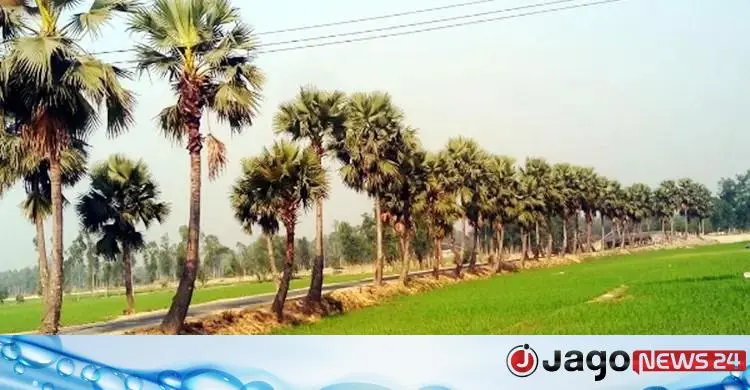
The palmyra palm (tal) is an ancient flowering plant and, as around the world, its fruit is very familiar in Bangladesh. The palm is called a kalpabriksha, a wish-fulfilling tree, because whatever is asked of it can be had. It is the national tree of Cambodia, the farming nation of South-East Asia.
A shield against lightning
The palm is a great friend of nature. Its role in coping with disasters such as drought, falling groundwater, cold waves, floods, storms, tidal surges and lightning is immense. Every year many people in Bangladesh are killed by lightning, most of them farmers, fishermen, boatmen or passers-by working in fields, haors and beels. Lightning strikes more often in open country far from shelter. Because lightning falls on high places, rows of tall palm trees along open roads act as lightning conductors and help protect people.
Home to birds and a source of timber
The tall palm has equally long list of virtues. The skilful weaver bird (baya) builds its beautiful nest at the top of the palm. Rows of palms on both sides of an open road look from afar like a palm kingdom. The trunk is made into a dugout boat (donga) that is handsome and durable, and palm timber is used for lasting roof beams. Bats hang from palm trees, and vultures, eagles, peacocks and countless other birds that roam the fields by day sleep at the top of palms at night. Parrots lay their eggs there.
Various parts of the palm are made into crafts such as hand fans, roof thatch, caps, mats, handbags, raincoats or umbrellas, mathal (farmers' hats) and palm-leaf whistles. The palm has contributed greatly to Bengali folk culture. Before paper was invented, everything was written on palm leaves, and palm-leaf manuscripts can still be seen in many museums and libraries. The palm helps meet all five basic needs: food, clothing, shelter, medicine and education. Its leaves make fans, caps, bags, raincoats, mathal and baskets, and the fibre of ripe fruit yields a rayon-like yarn that can be woven into cloth. The palm is a symbol of strength.
Fruit and juice
A palm lives for more than 100 years and grows to about 100 feet. It takes about 10 to 12 years after planting to bear fruit. A tree carries up to 300 fruits a year in six to 12 bunches. Male trees bear no fruit but produce flower spikes, which are cut to tap juice; female trees bear fruit. Palms flower and produce juice in November and December, with male inflorescences flowering for one and a half to two months, and the juice is tapped in March and April.
The fruit can be eaten unripe. The kernel of young fruit is tasty and full of nutrition and flavour, and is in great demand in the heat of Jyoishtha. It relieves fatigue. Palm is used to make payesh, gur, patali and misri. The juice relieves dehydration, improves appetite and helps with liver problems. The kernel is rich in calcium, which builds bones, and its antioxidants boost immunity. In Africa palm juice is a key ingredient in wine and beer. Each tree yields about 150 litres of juice a year.
The fruit ripens in the fierce heat of the month of Bhadra, when villages, towns and ports celebrate with palm cakes. Bengali households make many kinds of pitha and payesh from the pulp of ripe fruit. For a baked palm cake, the pulp is boiled with sugar, milk and coconut, mixed with rice flour or atta, left to rise on a banana leaf and baked on the stove. Palm roti is a popular snack, and the orange juice of ripe fruit is made into tal bora, tal pitha, tal kheer, tal patali and tal barfi. In October and November the seeds sprout and become hollow inside; oil and other foods are made from the coconut-like seed kernel, and the freshly sprouted shoot can be boiled and eaten, which is nutritious.
Health benefits
Palm helps with skin problems, boosts immunity and memory, supports physical health, speeds digestion, relieves constipation and strengthens bones. The kernel cools the body quickly.
Palm contains vitamins A, B and C, zinc, potassium, iron, calcium and many other minerals, along with antioxidant and anti-inflammatory compounds. Every 100 grams of the edible part of ripe fruit contains 87 kilocalories, 77.5 g water, 0.8 g protein, 0.1 g fat, 10.9 g carbohydrate, 1 g dietary fibre, 27 mg calcium, 30 mg phosphorus, 1 mg iron, 0.04 mg thiamine, 0.02 mg riboflavin, 0.3 mg niacin and 5 mg vitamin C. It helps prevent vitamin B deficiency diseases, and its high calcium and phosphorus help prevent tooth and bone decay.
How to plant a palm
Palms grow in all kinds of soil, though high land is best. Keep 7 metres between rows and 7 metres between plants. Pits should be about 3.25 feet wide and 3.25 feet deep. Ten to 15 days after digging, fill each pit with soil mixed with 15-20 kg of organic manure, 250 g of TSP and 20 g of MoP.
A seedbed about 10 feet long and 3 feet wide can hold a thousand palm seeds. It is better to lay a thin tin sheet or thick polythene at the bottom of the bed. The seeds will start to germinate within three to four weeks of sowing.
Source: Jagonews24. First published in Bengali on The Agro News.
Comments
(0)