
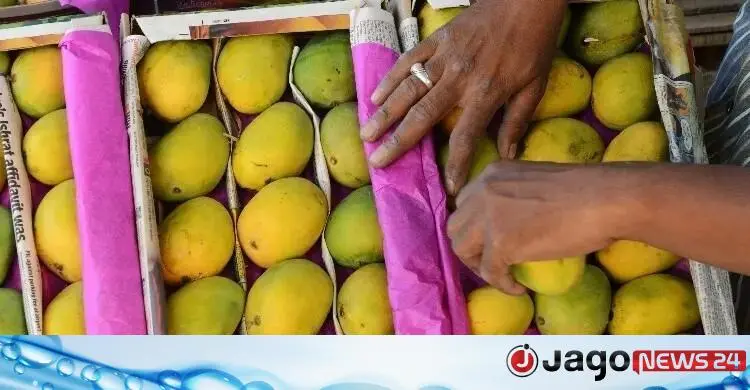
Mango picking is in full swing in the orchards of southern Pakistan. In intense heat, workers climb the trees and quickly hand the fruit down to colleagues waiting below.
But although the season is in full flow, Pakistani mango exports to lucrative international markets are expected to be well below normal this year. The effects of the conflict in the Middle East have also hit the country's farm-based economy.
An initial understanding has been reached between the warring parties through Pakistani mediation, but it came too late for the current mango season, which began in Sindh province in June.
Mango traders say exports could fall by at least 30 per cent this year because of weaker demand in the Gulf and other main markets and higher transport costs. At home, meanwhile, inflation driven by the regional crisis has made buyers reluctant to buy mangoes, so local sales have also fallen.
Orchard owners facing losses
Mohammad Shakeel runs an orchard of Sindhri mangoes in Tando Allahyar, one of the main mango-growing centres. The sweet, juicy mango is named after Sindh province.
Income this year may be so low that it will be hard even to recover the advance paid for leasing the orchard, he said. Many contractors have already abandoned their contracts. "The losses are so great that many contractors have walked away, leaving even their advance money behind," Shakeel said.
The 'king of fruits'
In South Asia mango is called the "king of fruits". Pakistan grows more than two dozen varieties and usually earns about US$110 million a year from mango exports, making it the world's fourth-largest mango exporter.
But the war in the Middle East has shown once again how dependent Pakistan's economy is on geopolitics. The farm sector, already under pressure from climate change, now faces a new crisis.
Waheed Ahmed, patron-in-chief of the All Pakistan Fruit and Vegetable Exporters' Association, said about 80 per cent of Pakistan's mango exports go to the Gulf, Iran and Afghanistan, and almost all of these areas have been caught up in conflict in recent months. He expects exports this year to fall by about 30,000 tonnes from last season, to 80,000 tonnes.
"The Afghan border is closed, there has been war in Iran, and the whole Middle East is in turmoil," he said.
Transport costs multiply
Tension with Afghanistan has also brought border trade to a standstill, with hundreds of loaded trucks stuck at the border for months. Unrest around the Strait of Hormuz has pushed up fuel prices, directly raising the cost of shipping goods by sea.
By Waheed Ahmed's estimate, shipping a container carrying 25 tonnes of mangoes cost about US$1,400 last year. This year the same container costs US$6,000 to 7,000.
Weak sales at home too
With exports down, the supply of mangoes in the local market has increased. In the markets of Karachi, Pakistan's largest city, mangoes now sell for about 200 Pakistani rupees a kilogram, roughly half last year's price.
Buyer Muhammad Ashad said mangoes are much cheaper this time than in recent years because exports have almost stopped. But while good-quality mangoes can be seen everywhere, many people still cannot afford them, he said.
According to government surveys, Pakistan's inflation rose from 5.5 per cent to 10 per cent in the three months after the Middle East conflict began, putting even cheap mangoes beyond the reach of many families.
Shakeel, a representative of the fruit exporters' body, said: "Prices in the local market are low, but not everyone can afford mangoes. Look at the state of the country: costs are rising and incomes are low. Will people buy bread first, or mangoes?"
Source: Jagonews24. First published in Bengali on The Agro News.

Comments
(0)