
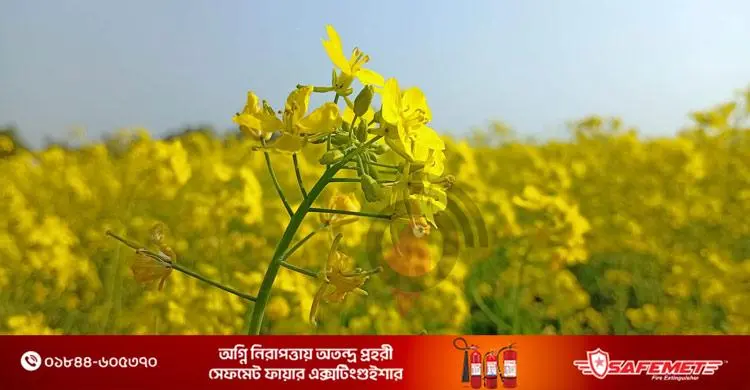
This winter, yellow mustard flowers carpet the wide fields of Pabna's nine upazilas. Nature lovers are flocking to the fields to see the lovely sight. Every year at this time the mustard flowers bring new beauty to the district's fields, with bees humming among the blossoms swaying in the cold breeze and the scent filling the air. Farmers are pleased with good yields and prices each year, and the crop is having a positive effect on the rural economy. If the weather stays favourable, they hope for a good yield again this year.
Farmers said that after good yields and prices last year, they have again sown mustard on a lot of land. Seeing the crop do well this season has brought smiles to their faces. If the weather stays kind and there is no disease or pest attack, they expect good yields and prices again.
Why farmers choose mustard
Farmers added that high-yielding mustard can be harvested just 55-60 days after sowing. Once Aman rice is cut, the seed can simply be broadcast on the land. It needs little irrigation, and after the mustard is harvested there is still time for the Boro season. That is why they are keen on mustard. Mustard leaves fall to the ground and act as organic fertiliser, increasing soil fertility, so the Boro rice planted afterwards needs much less fertiliser, cutting the cost of rice farming. With good market prices, farmers make a decent profit.
Visits to fields in Chalan Beel areas such as Chatmohar, Dilpashar in Bhangura upazila, and Sadar and other upazilas found the whole of Chalan Beel, including Chatmohar, Bhangura and Faridpur in Pabna, Singra and Gurudaspur in Natore and Tarash and Ullapara in Sirajganj, decked in beautiful yellow flowers. Travellers are coming from far and wide to enjoy the scenery. Not only Chalan Beel: fields across Pabna district are full of mustard flowers, with green pods peeping through. Farmers are happy to profit with little cost and labour.
Abdur Rahim, a farmer from Handial Paikpara village in Chatmohar upazila, said: "This season I have grown mustard on 4 bighas. With fertiliser, seed, pesticide and irrigation, it cost about Tk 9,000 a bigha. With a good yield we get 6-7 maunds a bigha. If the market price is good, a maund sells for Tk 2,800-3,000. All in all, mustard is profitable for little cost and effort."
Hasan, a farmer from Char Sadirajpur in Sadar upazila, said: "Mustard does well in char and beel soil. This year I sowed mustard on 3 bighas. The flowers and plants are good. Unless there is a disaster, the yield will be good."
Honey from the mustard fields
Alongside mustard, beekeepers are also increasingly interested in producing honey in the fields. Because the quality is good, it fetches good prices. After meeting domestic demand, the honey is also exported. Over the past few years many people have become self-reliant by collecting honey from bees kept in modern bee boxes. The bees' visits and pollination also raise yields.
Nayan, a beekeeper from Kaliganga in Satkhira who has come to collect honey in Ashtamanisha village in Bhangura, said: "In the mustard season we set up boxes beside the fields and collect honey. We sell it at Tk 400-500 a kg, and it sells for more in the market. When bees visit the mustard flowers, yields rise, so farmers help us too. This season we will be able to collect 1,590 kg of honey from 53 bee boxes."
According to the agriculture department, the target this season is to grow mustard on 49,082 hectares, of which 42,545 hectares have been sown so far. Farmers are mostly growing the high-yielding varieties BARI-14, BARI-15, BARI-18 and BINA-9. This year there is also potential to produce 110 tonnes of honey from bee boxes in the mustard fields. The honey is sold to local buyers and is also exported through various companies.
Md Jahangir Alam Pramanik, deputy director of the Department of Agricultural Extension (DAE) in Pabna, told Jago News: "Because of the health risks of imported edible oils, demand for mustard oil, which has medicinal qualities, has risen, and farmers have been making good profits for several years. To reduce dependence on oil imports and expand mustard cultivation, farmers are being given all kinds of advice. Mustard farming will be expanded further in the coming days, and farmers will profit more."
He said: "Many beekeepers are becoming self-reliant by collecting honey from bees kept in modern bee boxes in mustard fields. Many bee farmers, including those listed with the agriculture department, are now working in the fields collecting honey."
Source: Jagonews24. First published in Bengali on The Agro News.


Comments
(0)