
A childhood rhyme in a Bengali school textbook went: "O otter, turn back and look, come and see the little boy dance." The picture beside it showed two otters watching as a mother bathed her little boy, which is why the poet brought otters into the verse. The rhyme and the picture show that otters were once a common sight. They are hardly seen now.
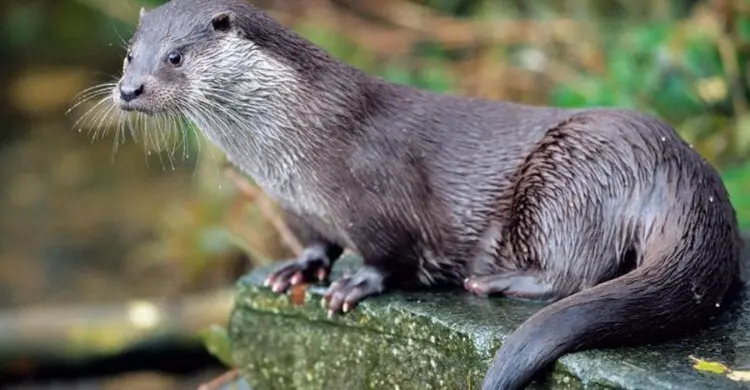
The otter, also known in Bengali as the udbiral, is a mainly fish-eating mammal. Otters belong to the subfamily Lutrinae of the family Mustelidae, which also includes weasels, mongooses and badgers. Three species of otter and one species of badger are found in Bangladesh.
Built for hunting under water
Otters have webbed feet, so they swim very well under water and can travel half a kilometre without raising their heads above the surface. Their stiff, upright whiskers are well suited to hunting under water.
They have thick tails and long bodies, and most have paws with sharp claws. When swimming, their nostrils and ear openings close. The long whisker-like bristles on the tip of the nose are sensitive and help them catch prey under water; because they stand upright, they do not stick to the body when wet, and in murky water they signal the presence of prey.
The otter's hands and feet are also very sensitive, so mussels, snails, prawns and crabs hidden in the mud cannot escape them. Their strong, pointed teeth and jaws are very effective for catching slippery prey or chewing fish heads.
Otters have two layers of fur. The first is short, soft and insulating; this underfur traps air and keeps the body warm and dry under water, and it is waterproof. The second layer is long, and it is this fur, which gets wet, that we see.
Otters have a smell that even experienced people can mistake for that of a tiger. They are very noisy when in groups, and they usually hunt with their young.
The sea otter of the North Pacific can use stones as tools. It picks up a stone with its forepaws and uses it to break the shells of snails and mussels, floating on its back with the stone on its chest like a blacksmith's anvil.
Once common in village ponds
Many older people in Bangladesh can still tell stories about otters. In many parts of the country the otter is known as the "dhere". It fished day and night in village ponds and canals, and locals, seeing it as an enemy of their fish, devised all sorts of ways to kill it. Sometimes an otter was killed, and children would carry the body around the village, showing it off to collect rice, lentils, salt and oil for a picnic.
The otter is an indicator species for aquatic ecosystems. By catching weak and diseased fish from shoals, it helps improve the health and quality of fish stocks, and it helps maintain water and soil quality, creating conditions suitable for fish to breed.
Hunting, killing, buying, selling, transporting or keeping any wild animal in Bangladesh, including otters, is a punishable offence. Even so, people's view of the otter as an enemy has wiped it out, and some otters may also have vanished for lack of suitable habitat.
Today otters survive in the wild only in a few southern districts, especially in the Sundarbans. But their habitat is being destroyed quickly for various reasons and their numbers are falling alarmingly. Unless effective steps are taken now, the otter may lose its last home too. Hence the question: will the otter return? Will it see the little boy dance?
Caught for fishing
Humayra Mahmud, assistant professor of zoology at Noakhali Science and Technology University (NSTU), said life-cycle analysis shows that although otters mainly live in forests, they depend mostly on fish from rivers and canals for food. As rivers, canals and forests have shrunk across the country, otters have lost their natural habitat, and without the right conditions to breed they have dwindled and are now on the way to extinction. They can still be seen in the Sundarbans and coastal villages, but many otters are taken from the Sundarbans to be used for fishing, so numbers there are also falling.
She said some families in several villages of Narsingdi district still use otters in the old method of fishing. After fishing they keep the otters in cages, which shortens their lives; they fall ill and die, and new otters are then caught from the Sundarbans. This is another major reason for the killing of otters.
"If we want to save the otter, we must save its habitat," Humayra Mahmud said. "All practices that use otters must also be stopped. As it is protected under the wildlife law, there is no scope for using this animal for any purpose. Alongside that, we need to protect otters by raising awareness."
Source: Jagonews24. First published in Bengali on The Agro News.



Comments
(0)