
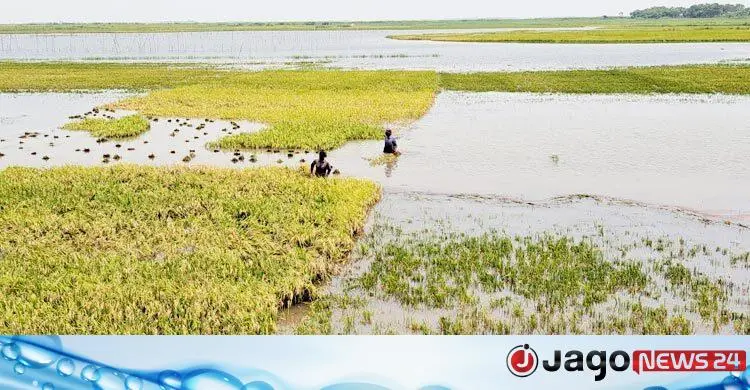
A forecast of flash floods has spread worry and fear among farmers in the haor areas of Netrokona. Despite uncertainty caused by shortages of diesel and labourers, they have begun cutting their paddy in a hurry. With only light to moderate rain forecast for the past two days, farmers were able to work in the fields without interruption.
On Sunday morning (26 April) there was mild sunshine in the district, though the sky was partly cloudy.
Md Sakhawat Hossain, executive engineer of the Bangladesh Water Development Board (BWDB) in Netrokona, said on Sunday morning that the lack of rain was a relief, but heavy rain could begin from 28 April. River levels could then rise, cross the danger mark in places and enter the haors, bringing a risk of flooding. Once 80 per cent of the paddy in a haor field is ripe, it is risky to leave it standing, he said. Netrokona has already had heavy rain and the haors are waterlogged from it; if water comes down from upstream, levels will rise further. Farmers have therefore been advised to cut ripe paddy quickly.
Half the paddy not yet ripe
Local farmers say almost half the paddy in the haors has not yet ripened. Planting was delayed because there was water in the haors at transplanting time, and low rainfall early in the season has slowed ripening. In many areas waterlogging is also making it hard to use combine harvesters, and there are shortages of diesel and labourers.
The BWDB says it has been raining in Netrokona since the start of Chaitra this year, causing waterlogging in various haors. Cherrapunji is getting heavy rain, and when it rains upstream, hill torrents come down into Netrokona, raising the Someshwari, Kangsha, Dhanu, Uddhakhali and other rivers. An early flood could hit the haor areas at any time and damage the boro crop.
According to local farmers, the upazila administration, the agriculture department and the BWDB, Khaliajuri, Mohanganj, Madan and parts of Kalmakanda are mainly haor areas. Farmers there depend on boro, the haors' only crop, for a whole year's household costs, medical care, children's education and ceremonies. Of the district's 134 large and small haors, 89 are in Khaliajuri.
To protect haor crops from early floods, 138 km of submersible (temporary) embankments were built this year at a cost of Tk 31 crore, under the supervision of the BWDB and the upazila administration. About 42,000 hectares of boro crop depend on these embankments.
Rain over the past two weeks has raised several rivers in Netrokona, including the Kangsha, Ubdakhali and Dhanu. From Tuesday morning until 1pm on Sunday, the Dhanu at Khaliajuri rose by about three feet, worrying farmers with boro still in the fields. The crop grown on about 42,000 hectares of the haor area has a market value of about Tk 700 crore.
Farmers speak of their fears
Shamsul Haque, 55, a farmer in Khaliajuri Sadar, said: "You can't tell what will happen when, so I'm worried. Paddy on the low land has been ruined by waterlogging, and I can't find labourers to cut the paddy on higher land. But not all the paddy in the haor is ripe yet. I'm very anxious. I'm cutting half-ripe paddy now."
Hashem Ali, 53, a farmer from Krishnapur, said in the local dialect: "It's clouding over (raining) every day, and I don't like it. I can't tell what will happen. It seems trouble won't leave us alone this year."
Kuddus Mia, a farmer in Gaglajur village of Mohanganj, said: "The paddy isn't ripe. There are no labourers either. We're cutting the half-ripe paddy ourselves. We don't know when a flood will come or what will happen."
Khaliajuri upazila agriculture officer Md Delwar Hossain said paddy had been grown on 20,232 hectares in the upazila, with a production target of 148,000 tonnes. Harvesting is in full swing in the haors, and farmers are being advised to cut their paddy quickly.
Upazila Nirbahi Officer (UNO) Nadir Hossain Shamim said the Dhanu had risen somewhat and water had collected in some low-lying paddy fields. Farmers have been urged by loudspeaker announcements to cut ripe haor paddy quickly, and diesel supplies are being monitored to prevent a shortage.
The weather forecast says rainfall in the north-east and upstream may be above normal over the next few days: light to moderate from 24 to 26 April, moderate to heavy on 27 April, and heavy to very heavy from 28 to 30 April. The Dhanu, Baulai and Kangsha could rise and cross the danger mark in places from 28 April.
Source: Jagonews24. First published in Bengali on The Agro News.

Comments
(0)