
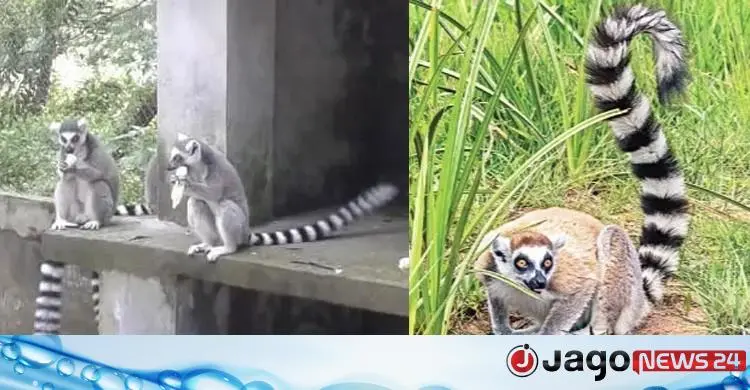
The lemur is a remarkable animal that leaps through branches from one end of the forest to the other. Its calls, once echoing through the pine and bamboo forests of Madagascar, are growing quieter by the day. The International Union for Conservation of Nature (IUCN) Red List ranks lemurs among the world's most endangered mammals. At a time when their crisis is at its peak worldwide, the sensational theft of lemurs from a government safari park in Bangladesh and their trafficking to India has revealed a deeply worrying picture.
A species on the brink
According to recent IUCN data, about 94 per cent of the world's 112 lemur species face an extreme threat of extinction, and about a third (31 per cent) have been declared critically endangered. Because they are listed in Appendix I of the international trade agreement CITES, buying and selling these animals, including ring-tailed lemurs, on the world market without special permission is entirely illegal. Even so, deforestation, shifting cultivation, poaching and illegal demand from the wealthy for luxury food or pets are driving their breeding numbers ever lower.
Madagascar is the only place in the world where lemurs live naturally. They play an essential role in keeping the environment in balance, eating forest fruits and seeds, spreading them through the forest and pollinating plants over long distances. Environmentalists therefore call lemurs "architects of the forest". Confined to this one area, they live naturally nowhere else, so losing lemurs there means losing the species from the world for ever.
The Gazipur theft
While lemurs fight for survival internationally, a grim trafficking story has come to light in Bangladesh. Two critically endangered ring-tailed lemurs stolen after the security of Gazipur's safari park was breached have been traced to Gujarat, India—to Vantara, the wildlife care centre of the wealthy Ambani family.
According to the investigating agency, the CID, late on the night of 23 March 2025, local agents of an international smuggling ring broke into the cage with the help of a contract guard at the safari park and stole a mother lemur and her two young. After the theft, videos were circulated to prospective buyers in India. Once a price was agreed with traffickers in Kolkata and Mumbai, the mother and one young lemur were smuggled into India through the Darshana border. After changing hands several times for about 48 lakh Indian rupees (about Tk 68 lakh), the two lemurs ended up at the Ambanis' Vantara shelter in Jamnagar, Gujarat. The other stolen young lemur has still not been traced. The trafficking came to light through photos posted on social media.
No microchip, no DNA record
After being seized at Dhaka airport in 2018, the lemur pair were sent to the safari park as a permanent home. Young were born there, but even after more than five years in government custody, no electronic identification microchip or DNA tracking database was set up for the animals. Under international law, a microchip or genetic code is the key condition for proving ownership of trafficked animals. Because of this negligence by the park authorities, the legal route to scientifically claim the two trafficked lemurs as Bangladesh's own with Interpol's help has become very complicated. Efforts are now under way to establish a genetic link with the two trafficked lemurs through DNA tests on the other young lemur still in Bangladesh.
According to wildlife expert Dr Md Reza Khan, existing laws alone are not enough to protect wildlife. Microchipping and DNA profiling of every endangered animal in government or private shelters must be made mandatory. Digital surveillance and CCTV must also be strengthened at sensitive border points such as Darshana to stop international trafficking, and real-time information sharing between the forest department, police and border guards must be ensured.
If lemurs cannot be given a safe home anywhere, from the forests of Madagascar to Bangladesh's protected safari park, these priceless "architects of the forest" may one day survive only in storybooks and photographs.
The writer, Sabbir Hossain, is a student at Ta'mirul Millat Kamil Madrasa, Tongi.
Source: Jagonews24. First published in Bengali on The Agro News.


Comments
(0)