
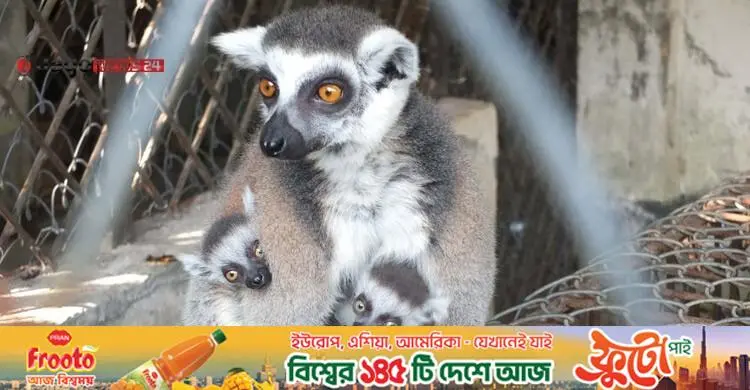
Media reports said lemurs stolen from Gazipur Safari Park had been found at a park in Gujarat, India. DNA samples were mentioned in efforts to recover them, but the authorities had no DNA profile on record. Now hope has been raised by a lemur recovered after the theft: the identity of the lemurs in India could be established through the DNA profile of the lemur still at the park.
Tarek Rahman, officer in charge of Gazipur Safari Park, said this on the morning of Thursday, 10 September. He said DNA samples of the lemur at the park have been collected and sent to a lab in Dhaka. Ownership of the lemurs in India can be confirmed once the report on the Indian lemurs' DNA samples is obtained and matched with the park lemur's report.
Background to the theft
According to park sources, on 6 August 2018 a male and a female lemur were recovered with birds and animals of various species while being smuggled to another country via Hazrat Shahjalal International Airport. They were handed over to Gazipur Safari Park, where they gave birth to two young. After one lemur died, the three at the park were stolen on the night of 22 March 2025 when the net of their enclosure was cut. A complaint was filed with the police on 24 March that year and a case was lodged on 6 April. One lemur was later recovered in a night raid in the capital's Shyambazar area and brought back to the park.
After the case was filed, the CID began investigating. They learnt that two of the three endangered ring-tailed lemurs stolen from Gazipur Safari Park had been identified at Vantara, the wildlife rescue and conservation project of billionaire Anant Ambani in Gujarat, India. The police Criminal Investigation Department (CID) said its investigation confirmed that after being smuggled across the border, the two lemurs passed through several hands and were sold there for about 48 lakh rupees.
Hope from the lemur left behind
Vantara's authorities have now asked Bangladesh for a DNA profile to confirm the animals' identity. But because Gazipur Safari Park had no DNA profile of the two lemurs, it became difficult to prove conclusively that they were the animals stolen from Bangladesh. The DNA sample of the lemur now at the park has raised hope, since the two lemurs smuggled to India belong to the same family and are related to it. The sample was collected and sent to a Dhaka lab last March. If the lab report matches DNA samples from the lemurs at Vantara, the truth will be known, Tarek Rahman said.
"We learnt from newspaper reports that two lemurs from Gazipur Safari Park had been found in Gujarat, India. But no one has been able to confirm whether the two lemurs in India are from the safari park. If there had been DNA samples, we could have said so for certain," he said. "The two lemurs rescued from the airport gave birth to two young at the safari park. Then one lemur died. Of the three lemurs stolen, one has been recovered and is at the park. We have collected its sample and sent it to the lab. We are hopeful that the DNA of the park lemur will match that of the two lemurs in India."
MKM Iqbal Hossain Chowdhury, divisional forest officer of the Dhaka Wildlife Management and Nature Conservation Division, said that after the lemurs were stolen, first the DB police and then the CID investigated. The CID said the lemurs found in Gujarat could be from Gazipur Safari Park. The lemur at the park and the two stolen lemurs are from the same family, so their DNA will be related. The park lemur's sample has been sent to the lab, and the report will be handed to the CID as soon as it arrives.
Why DNA profiles were never made
Md Sanaullah Patwary, conservator of forests of the forest department's Wildlife and Nature Conservation Circle, said: "We have the capacity to collect DNA profiles. The Wildlife Crime Control Unit also has a forensic lab, so making a DNA profile is not difficult. But perhaps the need was not felt in this way before, and there was no instruction on it from the forest department."
Several forest department officials said DNA profiles serve as important evidence in detecting wildlife smuggling and trafficking and in bringing trafficked animals back to the country.
Dr Monirul H Khan, professor of zoology at Jahangirnagar University and a wildlife expert, said DNA profiling of high-value animals is essential. "The lemur is a valuable animal. Its DNA profile should have been made," he said.
Source: Jagonews24. First published in Bengali on The Agro News.


Comments
(0)