
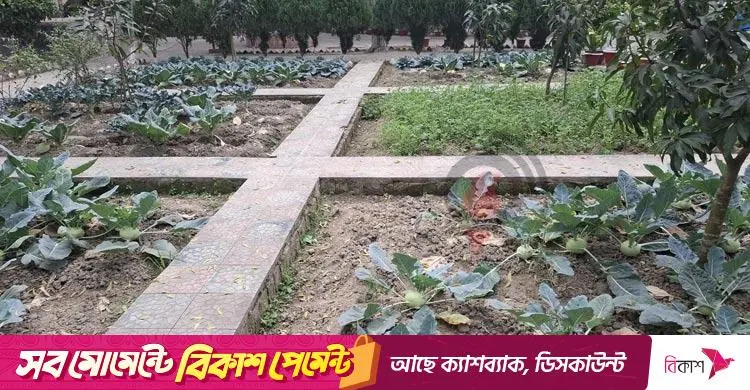
Crop production on fallow land has declined in Khulna. After the Department of Agricultural Extension (DAE) helped start cultivation at government offices, factories, schools, colleges and residential areas, output from fallow land rose, but it has since fallen again. Environmental campaigners have demanded that the initiative be revived.
According to sources, cultivation began on fallow land at 107 institutions in Khulna in late 2022, but various complications have now limited it. Crops, flowers and fruit used to be grown on 2.5 hectares of fallow land in Khulna district; this has now fallen to 1.2 hectares. At about 40 institutions at district and upazila level there is now hardly any crop production. At many institutions cultivation has stopped because the land was needed for other uses, though flowers are being grown on the land of two educational institutions in Terokhada.
Inquiries found that flowers and vegetables are now grown under the supervision of the agriculture department at only a handful of places, including the Khulna Election Commission office, Mitali Colony, the DIG's bungalow, Khulna University, Khulna Textile Mill and the Shipyard. Sunflowers are being grown in Terokhada, Dumuria and Batiaghata upazilas.
Crop production began on fallow land at office premises, schools and colleges in 2022 with the help of the agriculture department. But as the initiative has stalled, cultivation has stopped on the land of several closed jute mills in Daulatpur and Khalishpur, which has returned to its former state for the mills to reopen. In some places flower gardens have been ruined for lack of care.
Calls to revive the effort
Advocate Babul Howlader, coordinator of the Khulna branch of Bangladesh Poribesh Andolon, said everyone must take the initiative to use government fallow land. Growing something on it benefits us all, he said: we get oxygen, poor people benefit if crops are grown, and the environment is protected at least a little from the adverse effects of climate change. Taking an initiative alone is not enough, he added; ordinary people must play a role alongside the agriculture department.
Terokhada upazila agriculture officer Shiuli Majumder said they give full support to anyone who wants to grow crops or flowers on fallow land. So far they have run the programme at two educational institutions in the upazila, and advice is being given on planting sunflower gardens on fallow land.
Rafiqul Islam, additional director of the DAE's Khulna region, said the department has no separate project now, but various activities are carried out to put fallow land to use. Anyone who wants to farm fallow land at a school, college, home or office is given full support, he said.
Nazrul Islam, deputy director of the DAE in Khulna, said full support is given for crop production on fallow land at government offices, factories, roadsides and school and college premises. Any complications are resolved, and help and advice with cultivation are provided, while the use of fallow land is being encouraged.
Source: Jagonews24. First published in Bengali on The Agro News.

Comments
(0)