

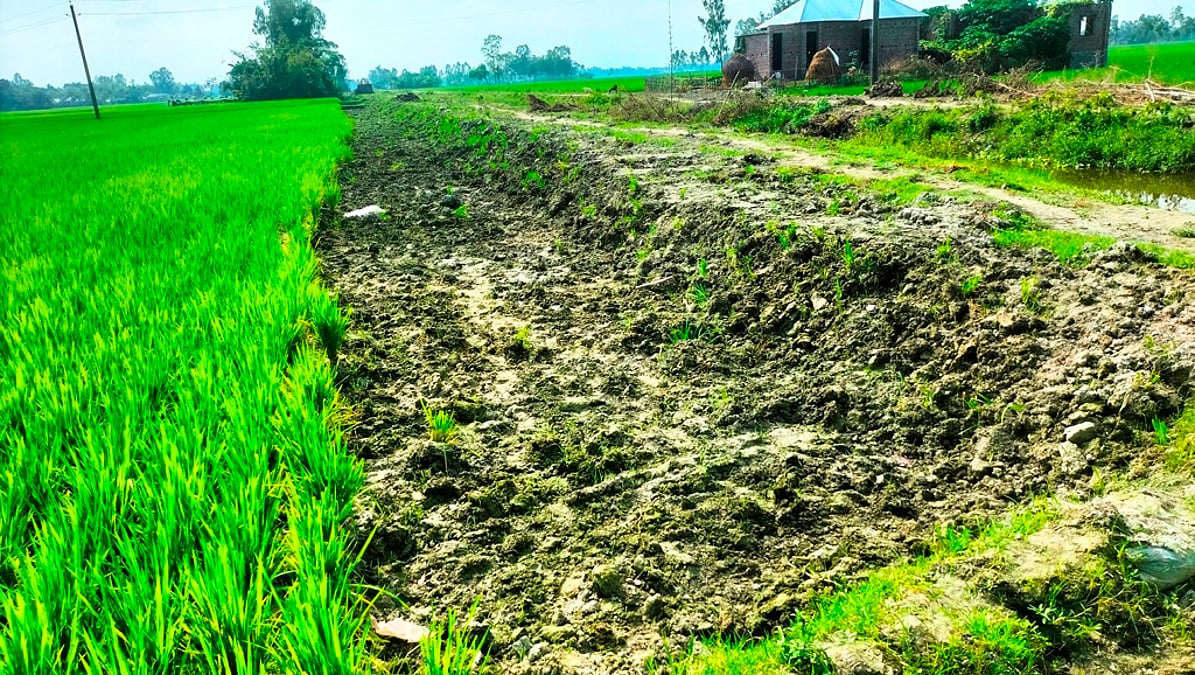
Farmers in Moulvibazar are busy growing Aman rice. But waterlogging has hit Kawadighi, one of the district's biggest haors, submerging cropland and seedbeds and leaving farmers fearful of losing their crops.
Although the Bangladesh Water Development Board keeps its pumps running day and night, the haor water is not draining into the Kushiyara river. The water board says Aman planted in the haor's low-lying areas goes under water; to plant Aman there, the haor's water level would have to be kept at 7.50, which would require a new pump house.
At Barakapan, Jagatpur, Raipur, Akhailkura, Kashimpur and other places along Kawadighi haor in Moulvibazar Sadar upazila around midday on 20 August, seedbeds were under water in some places and transplanted fields in others.
The transplanted Aman season is nearly over, yet many farmers have still not been able to plant their seedlings. Waterlogging has hit Kawadighi towards the end of the rainy season, and rain and hill runoff have left the haor's cropland under water.
Farmers blame poor drainage
Mottalib Mia, a farmer from Jagatpur village, said in the local dialect: "Every year the waterlogging takes everything from us. We lose a great deal of money. Because this water is not drained, many householders like us have been ruined. They don't drain the water properly. Why they don't, only God can say."
Shahid, a farmer from Raipur village, said: "I planted Aman in Kawadighi haor. The waterlogging has ruined my Aman. If the water is not drained within Bhadro, all the seedlings we have raised will be ruined. Drain the water at any cost."
Rezaul Karim Khosru, a farmer from Barakapan village, said: "If the eight machines here were run properly, 19,000 hectares of cultivable land would not be under water."
Farmers of Kawadighi haor are demanding that the pump house built to drain the haor be kept running on time, and that the haor's streams and rivers be dug out to increase their capacity.
Alamgir Hossain, Sadar upazila president of the Haor Rakkha Andolon, said it is now the peak Aman season on the edge of Kawadighi haor. "Many of us have prepared seedbeds, but we cannot transplant because of the waterlogging. We have applied to the authorities again and again but received no positive response, and we are suffering." He said that if the canals, drains and small rivers linked to the haor were dug out, its water capacity would increase.
Officials differ
The agriculture department says the Aman target for Moulvibazar district this year is 98,000 hectares, of which farmers have planted 80,000 hectares.
Md Jalal Uddin, deputy director of the DAE in Moulvibazar, said there would not be much waterlogging in Kawadighi or the district's other haors, because the irrigation pumps at the Kashipur point of Kawadighi haor are running 24 hours a day. "If they keep running, I don't think Aman cultivation will be disrupted. We hope 9,000 hectares will be planted in Kawadighi haor." He said Aman has been planted on 90 per cent of land this year, the season's rainfall is very good for Aman, and he hopes the target will be met.
The water board says there are eight pumps at Kashimpur to drain 24,000 hectares of Kawadighi haor, and the pump house drains the haor in the rainy season. But it says waterlogging in the low-lying areas cannot be removed without harming the haor's balance and biodiversity.
Md Khaled Bin Olid, executive engineer of the Moulvibazar water board, said the pump house was built mainly to stop ripe Boro paddy in the haor being submerged in May-June, when early floods or rain bring hill runoff down the streams. Aman is usually grown on the haor's higher margins (kandi), not in its low-lying areas, he said. Although the haor's water level is below the August design level, Aman planted in the low areas is now going under water.
He said the current pump house cannot drain the volume of water that comes down the streams in the rainy season. To plant Aman in the haor's low areas, the water level would have to be kept at 7.50, which would require a new pump house. A detailed study would also be needed to see whether keeping the level at 7.50 in the rainy season would threaten the environment and biodiversity, he said.
Source: Jagonews24. First published in Bengali on The Agro News.
Comments
(0)