
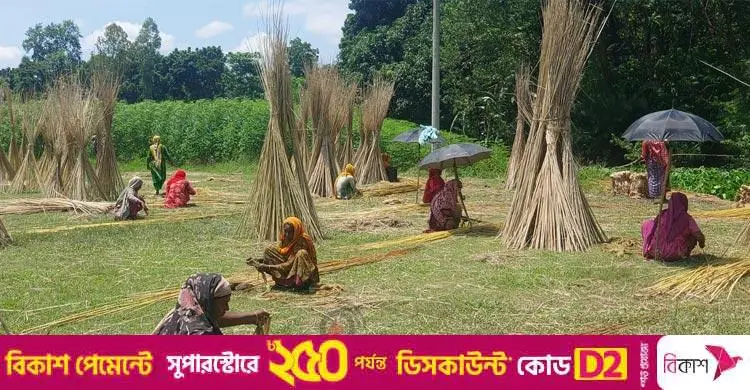
Rozina Akter Rozy (55) sits beside the highway stripping fibre from jute. She arrived at 8am and will go home at 4pm. All the jute sticks from the fibre she strips in that time are hers. After eight hours of work, the sticks she gets are worth Tk 400 to 500.
"All year I wait for the jute-stripping season," Rozy said. "If I sell the jute sticks I get from seven or eight hours of stripping, I get Tk 400 to 500. Besides selling, I use the sticks as cooking fuel all year. The work lasts a month to a month and a half, and the extra income helps the household a lot."
Like Rozy, many women have found some prosperity in these silver sticks of the golden fibre. Village women take the sticks in return for stripping other people's jute, selling them for extra household income, while many store them as fuel for the year.
Stripping in exchange for sticks
Across Saraikandi, Muladuli, Sreepur, Nikhatta, Sheikhpara, Marmi in Dashuria, Sultanpur and Degreepara in the upazila's Muladuli union, jute stripping is in full swing, with many men and women stripping, washing and drying the fibre.
Ayesha Begum was stripping jute beside the Pabna-Rajshahi highway at Saraikandi. "I am stripping jute for the jute sticks. I use them for cooking," she said.
Many here also sell them. Srabani Biswas of the same village said: "I am working only for the jute sticks. We get no daily wage. After work I will take the sticks home."
Anisa Begum of Sreepur village was stripping jute at Muladuli Joaddar Para. "About 10 to 12 women are stripping jute here. We use the sticks for cooking at home and for making trellises in our bean fields," she said.
Aklima Khatun of Sheikhpara village said: "Every year at this time we strip jute. Besides using the sticks for cooking, many sell them and earn money."
A male worker at the brick kiln area in Muladuli said: "Every year the women strip jute, and we wash the fibre they strip. We get wages, but they neither get nor ask for any. They only take the jute sticks."
Enamul Haque, a jute farmer from Muladuli who won the "country's best, gold medal 2019" award, told Jago News that the jute crop was fairly good this year. "The women are stripping the retted jute in exchange for the sticks, which they use for cooking and for bean trellises. We jute farmers do not have to pay wages, which saves us money, and the women benefit from the sticks."
Ishwardi upazila agriculture officer Abdul Momin said jute has been grown on 360 hectares in the upazila, with a very good yield. "Last time there were problems with retting because of a lack of water. This year heavy rain means there is no such problem. Women are playing a leading role in processing jute in exchange for the sticks. They are becoming financially self-reliant and can also use the sticks as fuel."
Source: Jagonews24. First published in Bengali on The Agro News.


Comments
(0)