
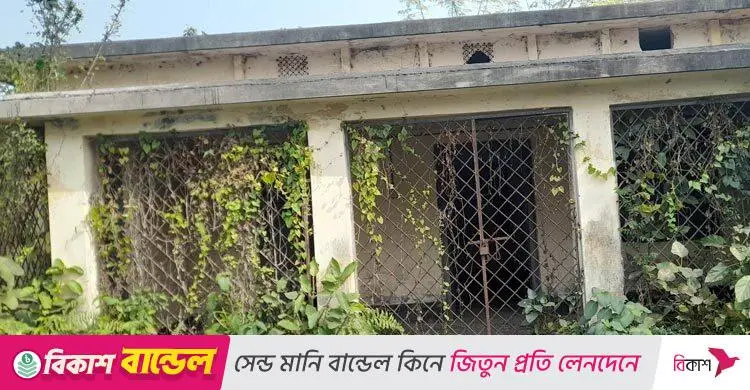
The Ishwardi silk seed farm has a proud history. All year round it used to hum with cutting mulberry leaves, rearing silkworms, producing cocoons and making silk yarn from them. Over time, though, it has taken on a ghostly air. With work halted for a long time, its large grounds are now dense jungle, the buildings are abandoned and snakes and insects have multiplied.
Of the farm's 17 approved posts, only one, the manager, is filled; the rest are vacant. Although it could employ more than a hundred workers, it has 22 daily-wage workers, two night guards and one computer operator on a monthly contract. The daily workers get only 10 to 12 days' work a month and are idle the rest, so they live in hardship.
From silk yarn to saplings only
The farm was set up in 1962 on 107 bigha 12 katha of land in Aranakola mouza on the Ishwardi-Pabna highway. It once reared silkworms, produced silkworm eggs and cocoons, and made yarn from the cocoons, while mulberry was cultivated all year. Now only mulberry saplings are produced on a small scale and all other work has stopped, leaving the once-busy farm silent.
According to the farm office, 59 bigha of the 107 bigha 12 katha is mulberry land. The remaining 38 bigha holds 19 buildings, including offices, residential buildings, silkworm-rearing houses and a loom house, and four ponds.
On the ground, silkworm rearing and cocoon and egg production have stopped. The mulberry trees remain but there are no staff to tend them, so the land has turned to jungle. There are four single-storey and two large two-storey buildings used for rearing silkworms and producing cocoons; the four single-storey buildings are abandoned. Plaster has come off the roofs, windows and doors are broken, and creepers and bushes have grown over them, giving the place an eerie feel.
Workers said the farm had a golden past. Besides producing mulberry saplings, rearing silkworms and producing eggs and cocoons, it once made yarn from cocoons that went to the Rajshahi silk factory, where world-famous silk saris and other clothes were made. Now only mulberry saplings are produced, on 29 bigha, and everything else has stopped.
Closure after a workers' protest
Workers said that on 27 June 2019 five workers were retired, and the workers began a protest against the Silk Board authorities. After a long protest, the authorities declared all the farm's activities closed. About two and a half years later, on 18 October 2021, sapling production was approved under a project of the silk development scheme, and the farm has limped on since. Sapling production and care work happen 12 to 13 days a month; the rest of the time it is shut, and the workers live in hardship.
They said that even after the farm reopened following two and a half years' closure, workers do not get a full month's work. The senior officials of the time, they said, stopped silkworm rearing and egg and cocoon production for unreasonable reasons. They are demanding that the current senior officials of the Silk Development Board restart silkworm rearing and egg and cocoon production, which would give workers a full month's employment.
Workers also complain that after 30 years' service they are sent into retirement empty-handed, leaving them to face poverty in old age.
Worker Md Badsha Sheikh told Jagonews: "This silk seed farm used to run well, with 50 to 60 workers. Now it is on the way to closing. We have no work; there is work two or three days a week. If it reopened, we would get work and could feed our families."
Worker Afzal Hossain said: "There used to be work here all 12 months. For six years almost all the work has stopped; only mulberry saplings are produced. I work here now and then on daily wages. Where would I go at this age, what would I do? We ask the government to reopen this institution fully, so that we can eat dal and rice twice a day."
Worker Monoranjan Kumar said the farm once thrived with silkworm rearing and yarn production, but that had stopped six years ago and only mulberry saplings were produced now. "We get 7 to 8 days' work a month. At one time 35 to 40 regular workers and about 100 seasonal workers worked here. The farm is surrounded by dense jungle, and the houses, rearing buildings and office are all decaying. If the government reopened it fully and quickly, the government would profit and we would have jobs."
'I open it in the morning and close it in the evening'
Md Khokon Ali, acting farm manager, said: "Of the 17 posts at the Ishwardi silk seed farm, I alone fill one. There is nobody in any other post. I open the farm alone in the morning and close it myself in the afternoon. There is no staff."
He said the whole farm had become jungle, so thick that it is hard to move around inside, and snakes and insects have made homes on the overgrown internal roads. There is no money to clear it. Silkworm rearing and egg and cocoon production have been closed for six years. Only mulberry saplings are being produced on 29 bigha under the development project for the silk industry and its expansion, and the saplings are distributed free to farmers in various areas on the Silk Development Board's instructions. Silkworm rearing and egg and cocoon production are closed because no money has been allocated for them.
Source: Jagonews24. First published in Bengali on The Agro News.
Comments
(0)