
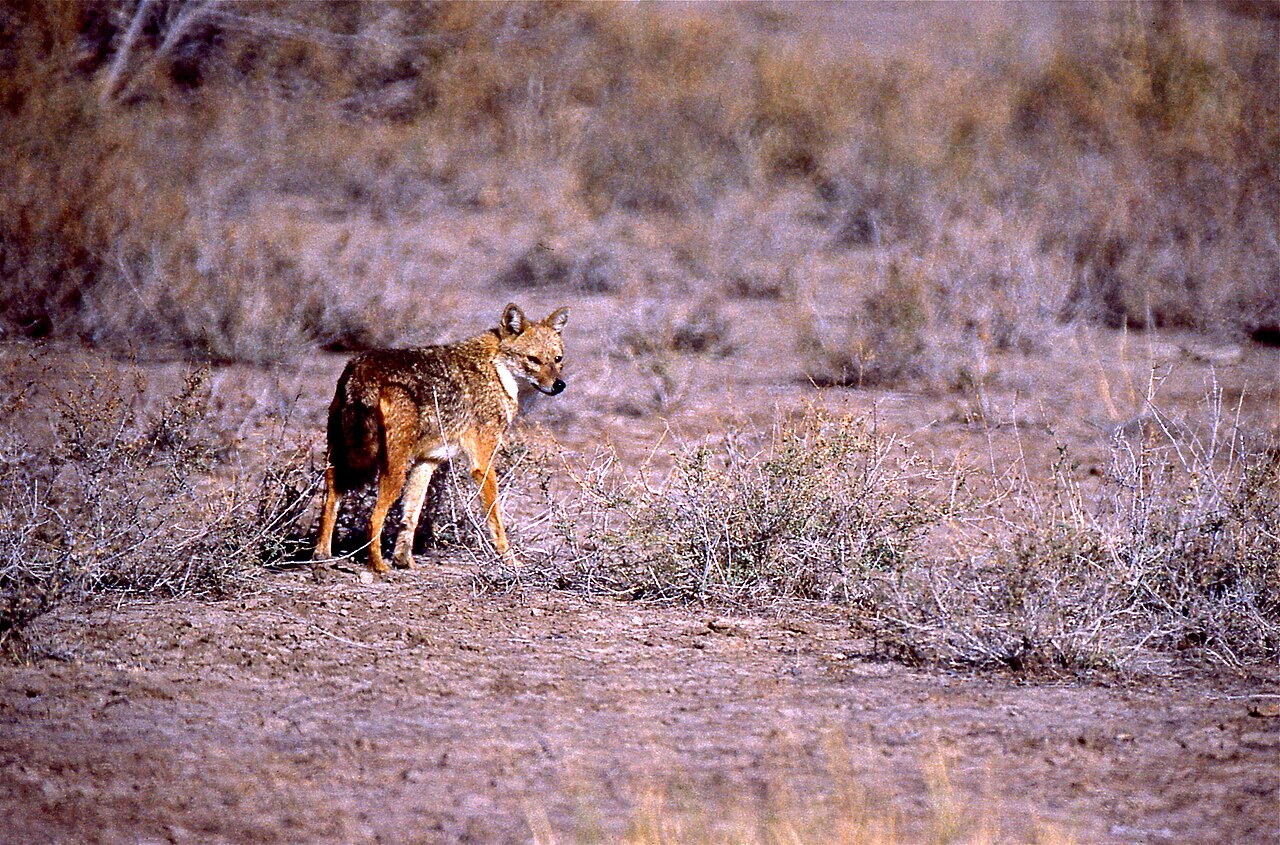
Golden jackals, animals of scrub, grassland and village edges, appear to be living on an isolated mangrove island in Gujarat's Gulf of Kachchh, researchers report in a signed article for Down To Earth. The views are the authors' own.
During field surveys on Satsaida Bet, a large tidal island, the team led by Karthikeyan Kannan repeatedly saw golden jackals (Canis aureus), mostly early in the morning, and found fresh pugmarks after high tide crossing the intertidal zone and mangrove stands. They saw no pack, but the repeated sightings and tracks point to continuous use of the island rather than occasional visits. The jackals also seemed used to approaching boat engines.
The island offers food: crabs, molluscs, stranded fish, bird eggs and chicks, small animals and carrion, with mangroves for shade and rest and mudflats as paths when the tide is out. Fishers sorting catches around the creeks may add discarded fish, and the researchers suggest the jackals' tolerance of boats may reflect a learned link with food. Jackals near Kandla's mangrove creeks reportedly take discarded catch too. Such adaptability helps wildlife persist near people, the authors note, but can also create dependence and expose animals to waste, disease and conflict.
How the animals reached an island ringed by creeks that stay flooded even at low tide is unknown: perhaps across mud at an exceptionally low tide, by swimming a narrow channel, or by temporary links. The authors call for camera traps, repeated track surveys, genetic material from scat, interviews with fishers, diet studies and stable-isotope analysis to show how many jackals are there, what they eat and whether they affect crabs, birds or rodents.
Their wider point is about how mangroves are protected. Counting planted saplings or mapping canopy cannot show that an ecosystem works, they argue; creeks, mudflats, coastal scrub and links between habitats matter as much, and mangrove monitoring should include mammals alongside trees, fish and birds.
For coastal fishing communities, the observation is a reminder that the mangroves sheltering juvenile fish and crabs, storing carbon and softening storms are also shared with land animals drawn by the same catch.
Written by Karthikeyan Kannan and colleagues for Down To Earth.
Photo: Bernard Dupont / Wikimedia Commons (CC BY-SA 2.0)
Source: Down To Earth


Comments
(0)