
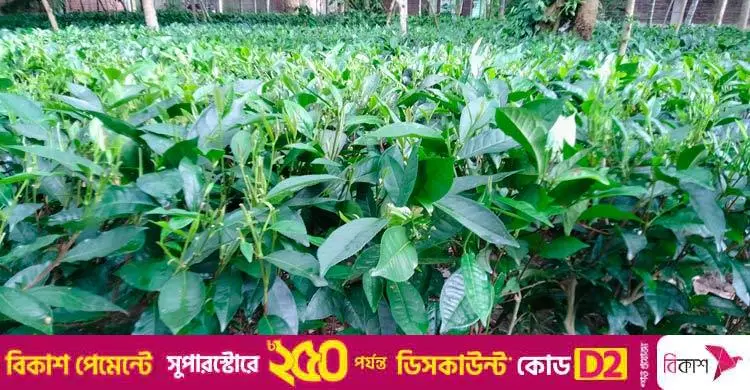
This time the tea garden is not in Sylhet but in Gazipur. Md Lutfor Rahman, a private university teacher, has amazed people by growing tea on flat land, proving that tea can be cultivated away from hills and hillocks. People come every day from different areas to see the garden, and many young people are now dreaming of growing tea.
Professor Md Lutfor Rahman has built four attractive tea gardens on about 8 bighas in Chinaduli village of Targaon union in Kapasia upazila, Gazipur. He worked tirelessly for about seven years, and for the last three years he has been picking leaves from the garden to make green tea. Buyers in Chattogram and the capital now buy his tea regularly. He hopes soon to cover the monthly costs of the garden's workers and turn a profit.
From tea estate manager to tea grower
Professor Md Lutfor Rahman teaches in the business administration department of International University of Business Agriculture and Technology, a private university in Uttara in the capital. He told Jago News: "At the start of my working life I served as a manager in 14 tea gardens in the Sylhet and Chattogram regions for about 35 years. I found the soil of those tea gardens very similar in quality to the soil of Kapasia. So the plan to grow tea on my ancestral land in Kapasia had been on my mind for a long time."
He said: "Seeing the great success of tea farming in Dinajpur, Panchagarh, Thakurgaon, Nilphamari and Jamalpur in recent years increased my interest many times over. So in 2019 I brought some seedlings from Sylhet and first planted them in flat clay soil. The results met my hopes, so I kept planting more in stages. At one point I planted seedlings in two fields of about two bighas of sandy loam soil on the bank of the Banar river, and they have grown wonderfully."
Lutfor Rahman said: "The most important thing for a tea garden is that water must not stand at the base of the plants, but the soil must be able to hold water. So I have arranged irrigation and drains for water to flow in the garden. As tea gardens are required to have timber trees, I brought these from Sylhet and planted them." He has also planted tea seedlings under ordinary timber trees with the success he hoped for, and has built large gardens.
Costs and returns
Lutfor Rahman told Jago News that although tea plants can be raised from cuttings and from seed, he brought cutting-raised seedlings from Sylhet. Each seedling is planted 2 feet apart, and he has planted 20,000 seedlings on about 8 bighas. From the first stage until production begins, the total cost is Tk 2.5 lakh to Tk 3 lakh an acre. With proper care, tea leaves can be picked for 35-40 years. Selling only the raw leaves, one acre can bring in about Tk 1 lakh a year; producing and selling tea can bring in about Tk 2.5 lakh.
He believes no other crop or fruit can be expected to give such a large profit, and that tea can be grown on any uncultivated or even fallow land, including homestead yards. For now he is making green tea from the buds in his garden. After picking, the leaves are cooled for a few hours until the moisture falls, boiled in hot water for 5 minutes, rolled by hand into round pellets and dried in the sun, which turns them into green tea.
Because the tea made this way is of very high quality, wholesalers are buying it from him at Tk 1,000 a kg. He currently produces 12-15 kg of tea a month and hopes this will soon rise to 30-35 kg. He plans eventually to produce tea commercially on a large scale using the orthodox or CTC method, and hopes that once profitable he can create jobs for unemployed local people.
Neighbours inspired
Local resident Kamal Hossain told Jago News: "This is the first time I have seen a tea garden on Kapasia soil. Many people come every day to see it. Others are being inspired by Professor Md Lutfor Rahman's initiative, and many are showing interest in growing this cash crop."
Businessman Abdul Kauyum Hossain told Jago News: "People in our area who have fallow land are being encouraged by sir's tea garden to set up tea gardens. Some are even taking training for it and making enquiries about everything involved."
Kapasia upazila agriculture officer Auliya Khatun told Jago News that she visited the tea gardens soon after joining in Kapasia recently. The success of tea farming in Kapasia is very welcome news for local farmers, she said, promising full support if others become interested. Many local young people who own land are showing interest in setting up tea gardens.
Source: Jagonews24. First published in Bengali on The Agro News.
Comments
(0)