
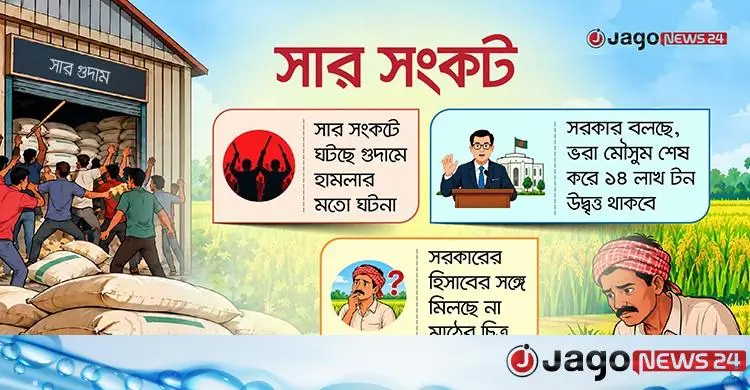
Uproar over fertiliser, attacks on warehouses and looting show no sign of stopping, and farmers' complaints about availability and price are endless. Even so, the government says there is no fertiliser shortage in the country and stocks are sufficient. It has also approved large imports so that there will be no deficit in the coming Boro season.
On Monday, 7 September, farmers in Rowmari upazila of Kurigram were accused of breaking the fence of a local dealer's warehouse and carrying off more than a hundred sacks of fertiliser. The same day in Lalmonirhat, farmers blocked a road demanding adequate supplies.
Fertiliser shortages are making headlines in the media every day. Last month a hundred sacks were looted from a warehouse in Kurigram. In some places farmers cannot get fertiliser at the government-fixed price and are forced to pay more; elsewhere supply gaps are causing shortages. Anger among farmers is growing across the country.
What the ministry's figures show
An analysis of agriculture ministry data shows no shortage until February. The ministry says there will be no crisis through the current Aman and the coming Boro season; instead, 14 lakh tonnes will be left over at the end of the peak season.
From October to next February, demand is put at 40 lakh 29 thousand tonnes against a supply of 53 lakh 71 thousand tonnes, which the government is securing through domestic production and imports.
Over the next five months, demand for urea is 17 lakh 22 thousand tonnes, DAP 11 lakh 23 thousand, MOP 6 lakh 69 thousand and TSP 5 lakh 15 thousand tonnes. Government stocks and public and private imports together will supply 20 lakh 7 thousand tonnes of urea, 13 lakh 48 thousand of DAP, 10 lakh 82 thousand of MOP and 9 lakh 32 thousand tonnes of TSP.
As of 6 September the government held 12 lakh 22 thousand tonnes in stock: 4 lakh 27 thousand tonnes of urea, 3 lakh 32 thousand of DAP, 1 lakh 17 thousand of MOP and 3 lakh 52 thousand of TSP.
A further 4 lakh 59 thousand tonnes of imported fertiliser is currently in transit. Government-to-government (G2G) and private imports of 36 lakh 83 thousand tonnes have been permitted until February next year.
Agriculture Secretary Md Selim Khan told Jago News: "In reality there is no problem with fertiliser stocks and imports. What is happening with fertiliser is being done by the old dealers. With the amount we have and have allocated, there will be no problem until February. Everyone will get fertiliser."
Farmers describe long queues and high prices
The unrest has been worst in the northern district of Kurigram. Azgar Ali, a farmer at Char Jatrapur, told Jago News that his paddy needs a second dose of fertiliser, but it cannot be found at the government price, so he is forced to buy it at a higher price on the open market, raising his production costs. Nor can he get it from the dealer when he needs it.
Tofazzal Haque, a farmer from the Pateshwari Bridge area of Bhurungamari, said farmers must wait for hours in long queues and often still go home without fertiliser. A whole day is lost buying it, at a time when a labourer's daily wage is Tk 700, so farmers lose both time and wages.
Mamun Badsha, a farmer in Durgapur union of Lalmonirhat, told Jago News: "I have planted rice on five don of land, so naturally I need a lot of fertiliser. But when I go to the shop I cannot get as much as I need. After standing in line for a long time, by the time my turn comes the shop often has no fertiliser left." He urged the government to make sure farmers can buy fertiliser as and when they need it.
Firoz Ali, a farmer in Meherpur, is preparing to grow onions on seven bighas and cabbage and cauliflower on five bighas this year. He said he ran into trouble collecting fertiliser while preparing his land: dealers do not supply the amount needed, so he has to pay extra on the open market, and his costs are rising before the crop is even grown. Farmers fear that, with costs rising this way, getting a fair price for their crops will become even more important.
Mega Khan, another farmer in the same district, said that because the dealer did not have enough, he had to buy on the open market and pay Tk 300 to Tk 400 more per sack.
Dealers blame low allocation
Dealers, however, say that although the new policy has caused some problems, supply and allocation are in fact low. Shamsul Islam Mondal, president of the Kurigram Fertiliser Association and a fertiliser dealer, recently told Jago News that allocations are lower than demand. M M Babul, general secretary of the Mymensingh District Fertiliser Association, also said supply and allocation are low. Taken together, the decision to implement the policy in the middle of the production season and the inadequate allocation have become a challenge for the government.
Last month the agriculture ministry and the Prime Minister's Office each set up a committee to monitor the fertiliser situation, and these are overseeing it across the country.
One official on the committee, speaking on condition of anonymity, said: "A syndicate of dealers from the Awami League era is stirring up more unrest across the country to put the government in a difficult position. Apart from that there is no problem."
He also alleged that a faction within the agriculture ministry, bureaucrats and officials of the ousted government, had influenced and delayed past import decisions, which caused the shortage. He said private importers whose tenders from last August had not received final approval could not start opening letters of credit for DAP, MOP and TSP, and private imports started very late. In the past, tenders were invited between April and May each year and work orders issued by June; this time, he said, that was deliberately delayed.
Asked about these claims, the agriculture secretary made no comment.
Source: Jagonews24. First published in Bengali on The Agro News.

Comments
(0)