
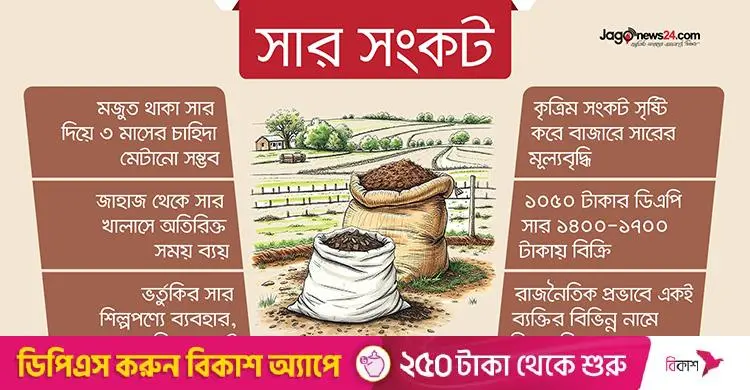
Even under the interim government, the fertiliser market has not been freed from the syndicate of transport contractors and dealers. Transport contractors and dealers are illegally hoarding fertiliser to create an artificial crisis, forcing farmers to pay extra. This is undermining the current government's best efforts for agricultural development and damaging its image.
This is stated in a report by a government intelligence agency. According to the report, a 50 kg bag of DAP fertiliser priced at Tk 1,050 is selling for Tk 1,400 to Tk 1,700. Local farmers are angry at the price rise and at not getting enough fertiliser.
The report sets out the agency's observations and recommendations and has been sent to the ministries of agriculture, commerce and industries.
Seasonal demand and the syndicate
The report says the country's annual fertiliser demand is divided across three seasons. The most is needed in the rabi season, from November to March (Kartik to Falgun), which accounts for 40 per cent of total demand. Next comes the aus season, from April to July (Chaitra to Asharh), needing 30 per cent, and the aman season, from September to December (Ashwin to Magh), needs the remaining 30 per cent. Although fertiliser is distributed to dealers in every district according to seasonal demand, transport traders and dealers form syndicates to show an artificial shortage in supply and charge farmers more than the fixed price.
In this situation, there are fears of a crisis over fertiliser supply and prices in the coming season (November-March) as well. Dealers are forming syndicates and creating supply shortfalls by not lifting fertiliser from warehouses.
This year the country's demand for chemical fertiliser is 57 lakh 85 thousand tonnes. About 80 per cent of this is imported by the government from various countries, and the remaining 20 per cent is met from the country's own fertiliser factories. Supply is ensured by the Bangladesh Chemical Industries Corporation (BCIC) and the Bangladesh Agricultural Development Corporation (BADC), which handle storage and supply after production or import through the transport contractors and dealers they appoint.
The intelligence report says dealers store the fertiliser they receive from the government in their own warehouses and sell it from there to farmers at the government-fixed price. But some profiteering dealers secretly hoard fertiliser to create an artificial crisis in the market and sell it to farmers at higher prices.
Stocks enough for three months
According to BADC figures, even after supplying dealers across the country in line with July's demand in the 2025-26 fiscal year, 6 lakh 30 thousand 613 tonnes of urea are now stocked in various warehouses. There are also 2 lakh 17 thousand tonnes of TSP, 2 lakh 73 thousand tonnes of DAP and 2 lakh 81 thousand tonnes of MOP in stock, enough to meet three months' demand. In addition, 25 thousand tonnes of TSP, 1 lakh 10 thousand tonnes of MOP and 1 lakh 20 thousand tonnes of DAP are on ships on their way to the country.
The intelligence report says that although by BADC and BCIC's accounts there should be no shortage of fertiliser in the country, prices have risen because syndicates of dishonest dealers and transport firms in some districts have created an artificial crisis.
On imports, the report says the import process takes six to eight months. Most imported fertiliser comes by water, and unloading takes a long time. In some cases traders deliberately take longer to unload fertiliser from ships, creating shortages in the market and pushing up prices. Late delivery to warehouses is also causing shortages, and at the supply stage many dealers are not lifting fertiliser regularly.
BADC and BCIC currently have 7,150 dealers between them: 5,022 approved by BADC and 2,128 by BCIC. Most were appointed during the Awami League era. Many dealers are the same person holding several dealerships under different names, keeping the sector in their grip.
Dealer appointment policy to change
Confirming the report, Ahmed Faisal Imam, additional secretary and head of the Ministry of Agriculture's fertiliser management and inputs wing, told Jagonews: "Following that intelligence report, we are changing the fertiliser dealer appointment policy. We are looking at who was appointed through irregularities in the past and who is committing irregularities. We are collecting information on them at field level and have already received a lot."
He said all those involved in irregularities or appointed through irregularities would have their dealer licences cancelled, and would be brought under the law if necessary.
'Forced to buy fertiliser at higher prices'
Farmers also blame dealers for the fertiliser crisis. They allege that, unable to get fertiliser at the fixed price from government-approved dealers, they are forced to buy it from retail shops at extra cost. In their view, prices are being pushed up by an organised syndicate creating an artificial crisis in the market.
Minarul Islam, a farmer of Pirpur village in Chuadanga Sadar upazila, said: "When I show my card to the dealer, he gives only 10 kg of fertiliser per bigha. For my six bighas I need 180 kg, but I got only 60 kg. I was forced to buy fertiliser from the market at a higher price."
Abul Kalam Azad, a farmer of Ibrahimpur village in Damurhuda upazila of Chuadanga, said: "It's the same problem every season. If we don't get fertiliser on time, how will we farm? This is a planned crisis. It isn't possible without a syndicate."
What traders and dealers say
Retail fertiliser trader Alamgir Hasan said: "To meet farmers' demand we have to bring fertiliser from sources outside the district and sell it. That is why the price is somewhat higher, and farmers have to pay more for it." Enamul Haque, a BCIC dealer, said: "There is no fertiliser crisis in our Chuadanga. But I have heard there is a crisis in many places. Because many dealers are not lifting fertiliser properly, government stocks may be higher."
A BCIC dealer who did not want to be named said: "Fertiliser supply is somewhat low, and all the farmers want to take it at the same time. So we have to give everyone less."
The manager of another dealer said: "The dealer I work for is a relative of a former Awami League MP and was himself an Awami League leader. Since 5 August he does not lift much fertiliser."
Recommendations to end the crisis
The intelligence report ends with 12 recommendations. They include:
- ensuring fertiliser supply in line with government allocations;
- stepping up monitoring by the relevant authorities to prevent syndicates of dealers and transport companies, and enforcing the law if necessary;
- taking proper steps so that one person cannot get several dealerships under different names;
- taking measures so that dealers cannot sell fertiliser above the government-fixed price;
- keeping a close watch so that dealer and transport syndicates cannot delay unloading fertiliser from mother vessels;
- being more careful, free of political influence, in appointing dealers and transport companies;
- arranging special allocations for districts where fertiliser demand is high.
Source: Jagonews24. First published in Bengali on The Agro News.
Comments
(0)