
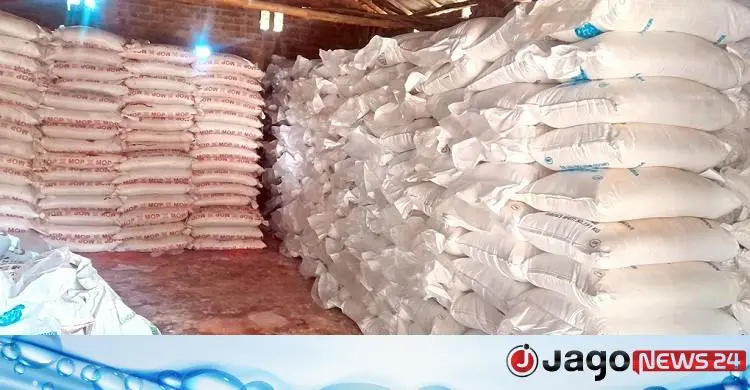
There is enough fertiliser in stock and no shortage in the country, the Prime Minister's adviser on information and broadcasting, Dr Zahed Ur Rahman, has said.
Where problems do exist, he said, they lie mainly in distribution. As the government is changing the distribution system, some instability has arisen while people adjust to the new process. He was speaking at a press conference at the Secretariat on Tuesday, 25 August, on the progress of various government activities. Information and Broadcasting Minister Andaleeve Rahman and Yasser Khan Chowdhury were present.
Dealers not lifting allocations
Describing the distribution situation, Zahed Ur Rahman said some dealers were not lifting the fertiliser allocated to them, causing temporary problems in some areas. He expressed hope that this would not last long, and said dealers had been given strict instructions to lift their allocations and distribute them properly.
To prevent any shortage, he said, the government purchase committee approved the import of 3.65 lakh tonnes of fertiliser at its meeting on 24 August. A week earlier, imports of another 1.15 lakh tonnes from Canada, Russia and Saudi Arabia had been approved.
As of 24 August, he said, stocks stood at:
- urea: 4,82,200 tonnes
- TSP: 3,69,000 tonnes
- DAP: 3,68,000 tonnes
- MOP: 1,46,000 tonnes
Total stocks come to 13.65 lakh tonnes. A further 2.10 lakh tonnes of TSP, 2.80 lakh tonnes of DAP and 3.75 lakh tonnes of MOP are in the import pipeline. Newly approved imports are 60,000 tonnes of TSP, 1.20 lakh tonnes of DAP and 1.15 lakh tonnes of MOP.
Watching the Strait of Hormuz and El Nino
Zahed Ur Rahman said the government was also alert to fertiliser supply because of the ongoing crisis in the Middle East. When the Strait of Hormuz is discussed, fuel usually gets the attention, he said, but about 25 per cent of the world's fertiliser also moves through that sea route. Giving food security top priority, the government is working carefully on these issues.
Noting that uncertainty over future food production is growing worldwide, he also pointed to the possible effects of El Nino, and said the government was preparing in advance with these uncertainties in mind.
Gas and power
On power and energy, he said gas supply had not yet fully returned to normal. The recently damaged FSRU (floating storage and regasification unit) has been repaired, but there is some trouble supplying the current gas cargo. He hoped the situation would normalise soon.
To keep factories running, the government plans to let them pay gas and electricity bills in 12 monthly instalments instead of a lump sum. He said regular government briefings were being held to dispel businesses' fears and rumours. To ease pressure on gas, instructions have been given to save natural gas used in industry and to run coal-fired power plants at maximum output.
The feasibility study for an emergency pipeline, costing about Tk 500 crore, to bring gas from Bhola's new gas field quickly into the national grid has been completed, he said. Bhola has commercially usable gas reserves; there had been discussion over whether to bring the gas by pipeline or convert it to LNG, but steps have now been taken to implement it quickly.
To reduce dependence on imported gas, instructions have been given to drill and re-drill 150 wells with the aim of producing 1,750 mmcfd of gas from domestic sources.
Gas reserves and LNG prices
Pointing to the country's large potential gas reserves, Zahed Ur Rahman said various surveys suggest Bangladesh may hold 40 to 50 trillion cubic feet of gas. Annual demand is now about 1.3 to 1.4 trillion cubic feet, and it will grow as the economy grows.
Criticising the long halt to onshore gas exploration, he said the current crisis was a problem accumulated over many years. Even under the interim government, the expected steps were not taken for onshore exploration.
LNG prices on the international market have risen sharply, he said: a year ago a unit cost $12 to $14, and it has now risen to about $24, with fears it could reach $30 or more. The Middle East crisis and global market conditions mean LNG has to be bought at higher prices, while Europe has become a major LNG buyer since the Ukraine war and European countries are trying to build up gas stocks ahead of winter.
In this situation, he said, the government faces a hard choice between importing gas at high prices with large subsidies and accepting some load-shedding in the short term.
Diplomacy for gas supply
He also described the government's diplomatic efforts to secure gas. The Prime Minister has spoken to the Prime Minister of Malaysia by phone, talks have been held with Qatar, and discussions are under way to obtain more gas from Qatar and Oman under long-term contracts.
The government hopes the situation will gradually become bearable, he said. By the finance minister's estimate, it could take about two years to reach a good position, "but that does not mean the situation will be bad for that whole time. Rather, we hope it will improve gradually."
Daily gas demand is about 4,000 million cubic feet, but supply has long been between 2,700 and 2,800 million cubic feet, he said. There was a shortfall before too, and energy demand is now rising as the economy grows.
It would not be right to blame the recent gas crisis only on the current government's management, he said. A few days of crisis after the FSRU accident were unavoidable, and higher gas prices on the international market made things harder. He admitted there may be some inefficiencies or problems in the government's management, which are being examined. Where irregularities come to light, swift action is being taken, and officials in charge have been transferred and new people given responsibility.
He urged people to see the crisis as the combined result of the global situation, long-standing weaknesses in domestic energy management and the extra demand of a growing economy. Asking the public to be patient, he said the government was doing its utmost and was hopeful the situation would improve gradually.
Source: Jagonews24. First published in Bengali on The Agro News.

Comments
(0)