

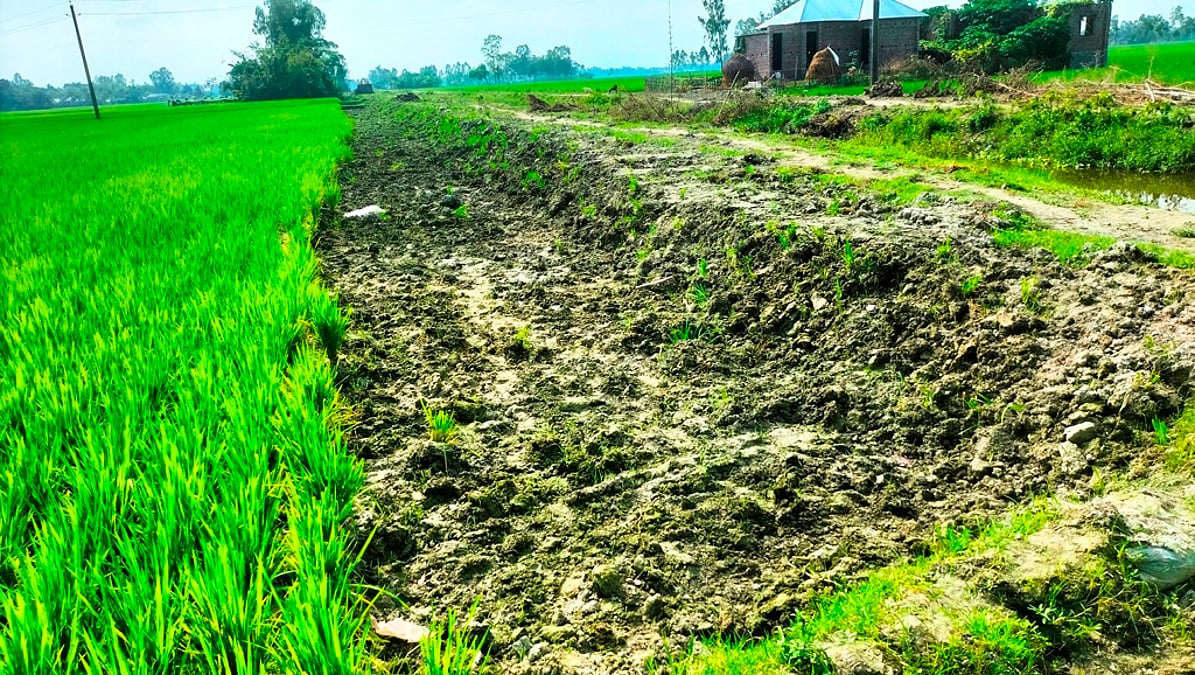
Bangladesh's economy is mainly agricultural. Population pressure, industrialisation and urbanisation are increasingly threatening farmland. Ensuring that not one inch of farmland is left fallow or needlessly lost is the demand of the times. The government has already taken effective steps to protect farmland and has begun drafting a new law.
What the planned law covers
First, no industry may be built by destroying farmland. The Ministry of Agriculture has said the coming law will protect farmland, so that fertile land is not lost to unregulated industrialisation and urban expansion. This will safeguard the country's food security and farmers' future.
Second, to tackle the risks of climate change, low-cost mini cold storage technology will be expanded for farmers. There are plans to set up a hundred mini cold stores across the country in phases. Farmers will be able to store their crops easily and avoid losses when prices fall in season, while consumers will get produce at fair prices all year round.
Third, if the Local Government Engineering Department (LGED) builds new roads across farmers' land, the farmers will be paid a proper price for it. And if the Roads and Highways Department acquires land, farmers will receive three times its value. So even if farmers lose land, their economic security will be ensured.
Most importantly, once the law is in force, farmers will no longer depend on middlemen. With more cold storage and preservation facilities, they will be able to market their produce directly. Above all, protecting farmland is essential not only for farmers but for the country's food security, economic stability and the survival of future generations. That goal can be achieved through proper enforcement of the law, modern technology and farmer-friendly policies.
How much farmland is lost each day
There is no simple, single official figure for how much farmland Bangladesh loses each day. Rates differ because of differences in method and scope among agencies and studies. The most widely used and recent sources give the following:
- Prothom Alo (analysis, 2014): 692 acres of farmland go to non-farm uses every day, about 280 hectares a day.
- Soil Resource Development Institute (SRDI), as cited in an article: 69,760 hectares a year converted to non-farm use, about 191 hectares a day.
- Department of Agricultural Extension (DAE): 2,500 hectares of cropland lost a year, about 6.8 hectares a day.
Depending on the source, the daily loss ranges from 7 hectares a day (a very limited count) to 280 hectares a day (a broad conversion rate). In policy discussion and long-term planning, the two higher estimates, SRDI (191 hectares a day) and Prothom Alo (280 hectares a day), are used more. The most common range is about 190 to 280 hectares of farmland lost each day, calculated from the SRDI citation and Prothom Alo's analysis. A recent DAE report puts the figure much lower, at about 7 hectares a day.
The causes are urbanisation and infrastructure (housing, roads and commercial buildings); industrialisation and brick kilns, a major driver of farmland conversion; and river erosion and climate risk, causing permanent loss in coastal and riverside areas.
Food security at stake
Ours is an agricultural country, and our economy, culture and way of life are closely tied to farming. But one of the biggest crises today is the rapid loss of farmland. Industrialisation, urbanisation, housing projects, brick kilns and infrastructure are steadily eating into fertile land, threatening not only farm output but the country's food security. Losing farmland directly cuts grain production. Bangladesh's population keeps growing, and with it the demand for food; with less land it becomes hard to balance production and demand. This leads to food shortages, greater dependence on imports and economic strain. Climate change and natural disasters such as drought, floods and salinity are making farm output even more uncertain.
Some effective steps are urgently needed. First, strict laws must be enforced to protect farmland, so that land is not grabbed or destroyed needlessly for industry.
Second, production on limited land must be raised through modern technology and sustainable farming. Third, introducing innovations such as rooftop farming, vertical farming and aquaculture will ease pressure on land. Farmers' training, fair market prices and government support must also be ensured.
Farmland matters not only for food production but for protecting the environment and biodiversity. So protecting it must be given top priority in development work; otherwise the food crisis will grow worse. Protecting farmland means ensuring food security, and only the combined efforts of the government, farmers and the public can build a sustainable farming system to meet this challenge.
Source: Jagonews24. First published in Bengali on The Agro News.


Comments
(0)