
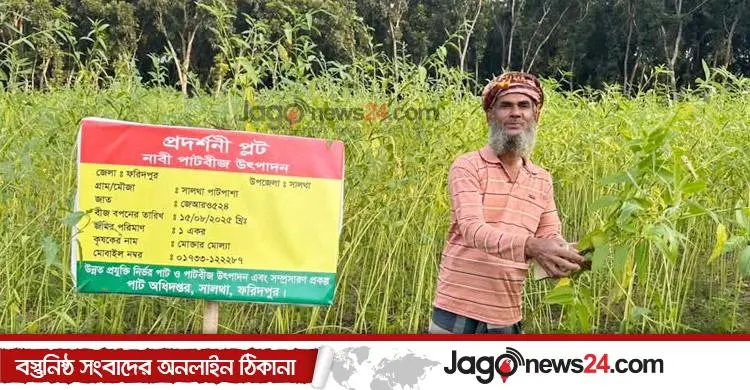
Farmers in Faridpur have found success growing jute seed. They expect to earn more per decimal of land than they spent on the crop. This year they have grown jute seed on 5 hectares in the district in the hope of profit. If jute seed is grown widely across the district, farmers believe it could meet local demand and be sold elsewhere too.
Faridpur is the country's top jute-producing district. In the season, jute is grown on at least 80 to 90 per cent of the total cultivable land. But all the seed has to be bought from elsewhere, which costs a lot of money and time and carries risk; many farmers are cheated with low-quality seed. Most imported jute seed comes from India, so the Department of Jute has taken various steps to reduce imports.
According to the Department of Jute, late (nabi) jute seed has been grown on 5 hectares in nine upazilas this year to produce local seed, using the JRO 524 and Sabuj Sona varieties. If the weather stays favourable, the seed yield will be good.
Farmers' first attempt
Jute seed growers in various upazilas said they had never even thought of growing seed before. This is the first year they have grown late jute seed, and they will be able to harvest it in a few days.
Jute seed grower Miraj Mollah said: "If the weather stays favourable, all things considered, it looks like we will profit from jute seed. This year the office of the sub-assistant jute development officer gave us only seed as an incentive. If they also gave incentives for fertiliser, pesticide and care costs, we could meet our own needs and even export."
Muktar Hossain Mollah told Jago News: "With help and advice from our upazila jute office I have grown jute seed on a little over an acre. The yield is plentiful. I hope to produce 10-12 maunds of jute seed."
He said: "Seed, fertiliser, medicine and labour cost Tk 700 in all per decimal. That will give about five kg of seed, worth Tk 1,000. Apart from the seed, each decimal will produce 10 kg of jute, worth about Tk 700. Altogether the jute seed crop will come to Tk 1,700, and after costs there will be a profit of about Tk 1,000 per decimal."
Officials' views differ
Dr Md Mojibar Rahman, chief scientific officer of the Jute Research Institute in Faridpur, told Jago News: "All the support received as government grants from the Jute Research Institute has been given to the farmers."
Jute Development Officer Tarek Mohammad Lutful Amin told Jago News: "Given the weather, growing jute seed in Faridpur is not very profitable. Winter vegetables are more profitable. This time rain at the start damaged the crops of about half the farmers. About 2 to 3 kg of seed is produced per decimal."
He said: "Of the nine upazilas, jute seed has been grown on 30 acres in Sadar, Boalmari, Alfadanga, Sadarpur and Charbhadrasan upazilas and on 10 acres in Nagarkanda, Bhanga and Saltha upazilas. This time each farmer was given 200 grams of jute seed for every 10 decimals."
Agriculturist Md Shahaduzzaman, deputy director of the Department of Agricultural Extension (DAE) in Faridpur, told Jago News: "Jute seed has been grown on a total of 5 hectares in Faridpur's nine districts this year. So far the crop looks good."
Source: Jagonews24. First published in Bengali on The Agro News.


Comments
(0)