
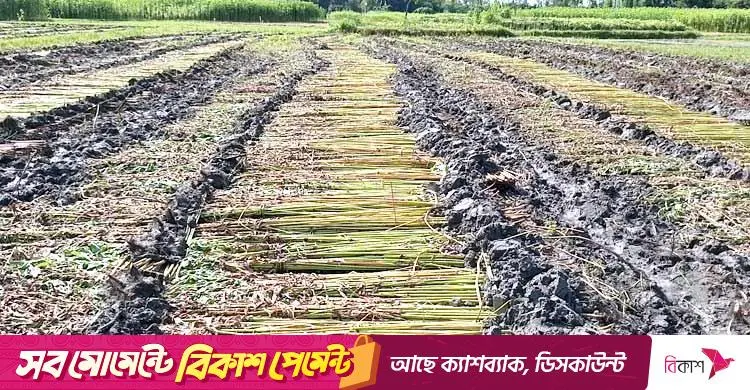
Asharh is over and Shrabon has begun, but Dinajpur has not had the rain it needs. There is no water in canals, beels, ditches or the low land beside homesteads. Unable to ret their jute, the district's jute farmers are worried, and the golden fibre they worked hard to grow has become a noose around their necks.
For generations farmers have cut jute in the rainy season and retted it in such places. This year, although Asharh, the main month of the monsoon, has passed and Shrabon has begun, there has not been enough rain, and farmers cannot ret their jute. There is no good news from the district meteorological office either.
According to the Department of Agricultural Extension (DAE) in Dinajpur, jute was grown on 4,372 hectares across the district's 13 upazilas this season, with a production target of 9,000 tonnes. Jute has been cut on 60 per cent of the land. In many places farmers are cutting jute; elsewhere they are waiting in hope of rain.
Crop yellowing in the field
Most jute is grown in Ulipur, Mohabbatpur, Kharipara and Ghughudanga in Dinajpur Sadar upazila and other areas along the Punarbhaba river. On Wednesday (16 July), most farmers there had not cut their jute, and the plants were turning yellow in the fields.
Mahidul Islam Chowdhury, a farmer in Mohabbatpur village, said the land had dried up for lack of rain and farmers could not even transplant Aman seedlings. "How will they cut jute? If you cut it, you have to ret it in canals, beels or low land, but there is no water anywhere. So farmers here cannot cut their jute."
Shahidullah, a farmer in Ghughudanga village, said farmers usually ret jute in the canals along both sides of government roads in the rainy season. "This year Asharh has gone and it is not raining. Farmers who own shallow pumps are irrigating to ret their jute, but the pumped water is not enough and the canals dry up within two days."
Retting in mud and pumped water
In Nasratpur, Satnala, Tetulia, Alokdihi, Debiganj, Dangarhat, Ghantaghar, Binyakuri, Sukhipir and Beltali in Chirirbandar upazila, farmers were suffering badly. With too little water in rivers, ponds, canals and beels, they cannot ret their jute. Many had cut jute and left it lying in the fields; many others had left it uncut in hope of rain, and some were retting it in the muddy water left in low-lying areas. Farmers fear they will not get the price they want if they cannot ret the jute in enough water and strip clean fibre.
Jamil Hossain, a farmer in Nasratpur union of the upazila, said almost all of Asharh passed without rain and there has been little since Shrabon began. "There is no water in any field here. Many are retting jute in canals where a little rainwater has gathered. Many are forced to set up shallow machines and motors to lift water from ponds and ditches, or groundwater, to ret jute. That costs extra money."
Aminul Islam, a farmer in Alokdihi union of Khansama upazila, said: "I grew jute on three bighas this year. I have cut the jute on one bigha and left it lying, because I cannot ret it without water. The jute on the other two bighas is still standing in the field."
Jabbar Hossain, Solaiman Ali, Ramanath Saha and many other farmers in the Pakerhat area of Khansama upazila said jute had grown better this year than in the past few years. "We have cut the jute and stacked it in the fields. Some have laid it out on dry land as if for retting, hoping for rainwater. There is not enough water in canals, beels, ponds, ditches or low land, so we cannot ret it. The stacks are drying in the harsh sun."
Officials hope for rain
Md Anisuzzaman, additional deputy director of the DAE in Dinajpur, said there is still Shrabon left and the crisis should end if it rains. Many have retted jute using water from shallow machines. "But farmers are not sitting idle. Most are retting their jute by arranging irrigation on their own."
Tofazzal Hossain, officer in charge of the Dinajpur meteorological office, said 378 millimetres of rain was recorded in the district in June this monsoon. Monsoon winds are blowing over the district and rain is expected. If this month's rainfall matches June's, the crisis will be over.
Source: Jagonews24. First published in Bengali on The Agro News.
Comments
(0)