
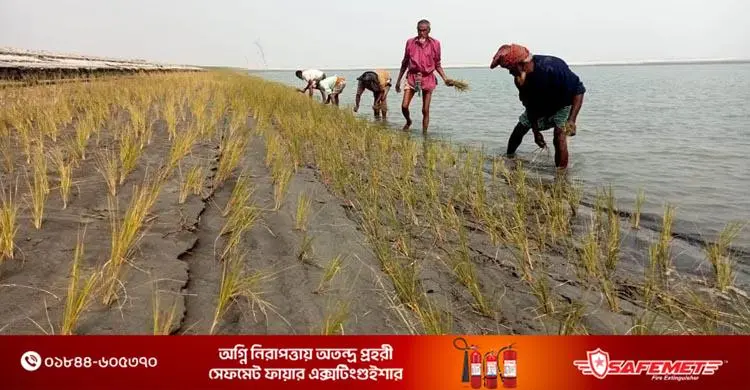
In Dhunat upazila of Bogura, the once turbulent Jamuna is now a dead river, and a vast char has risen along its banks. In places the char is flat, elsewhere uneven, with small hollows where patches of water have collected. Farmers are busy planting boro rice in the water standing in these hollows. The land needs no ploughing for this rice, so there is almost no production cost, and the Jamuna bank farmers are profiting from it.
Locals said hundreds of farmers have grown boro rice this dry season on the chars along the Jamuna. Every year the river runs dry in the dry season, but landless people on the banks grow boro rice using the little water that comes down from upstream, and they have kept up that practice. Most have been growing boro on these chars for 8-10 years. When the water drops at the start of the dry season, they take over stretches of sandbank and set about making them fit for boro.
Planted without ploughing
Talking to the farmers, it emerged that having no land of their own, they cannot grow any other crop. Growing boro with water seeping from the river is also far better than using irrigation water, so the rice is planted in the soft silt of the chars. This saves them money on everything, fertiliser and irrigation included. This variety yields about 8-9 maunds per bigha.
Char farmers prepare black boro seedbeds in early November. When the seedlings are 25-30 days old, they transplant them on the chars without tilling. The crop needs no ploughing and little chemical fertiliser, and it is harvested towards the end of March.
Sabur Mia, who lives on the Jamuna embankment, said he has lived there for about 10 years with his wife, two sons and a daughter. Having no land of his own, he has for several years grown boro rice on about 1 bigha of char that has surfaced in the Jamuna beside his home. The rice from this land feeds his family for several months.
Dhunat upazila agriculture officer Chhamidul Islam said the poor communities along the river are growing black boro rice. These sandbanks used to lie fallow, and by growing boro on them farmers are becoming better off. The boro grown by Jamuna bank farmers helps meet production targets, eases the financial hardship of the landless, and plays an important part in meeting the area's food needs.
Source: Jagonews24. First published in Bengali on The Agro News.
Comments
(0)