
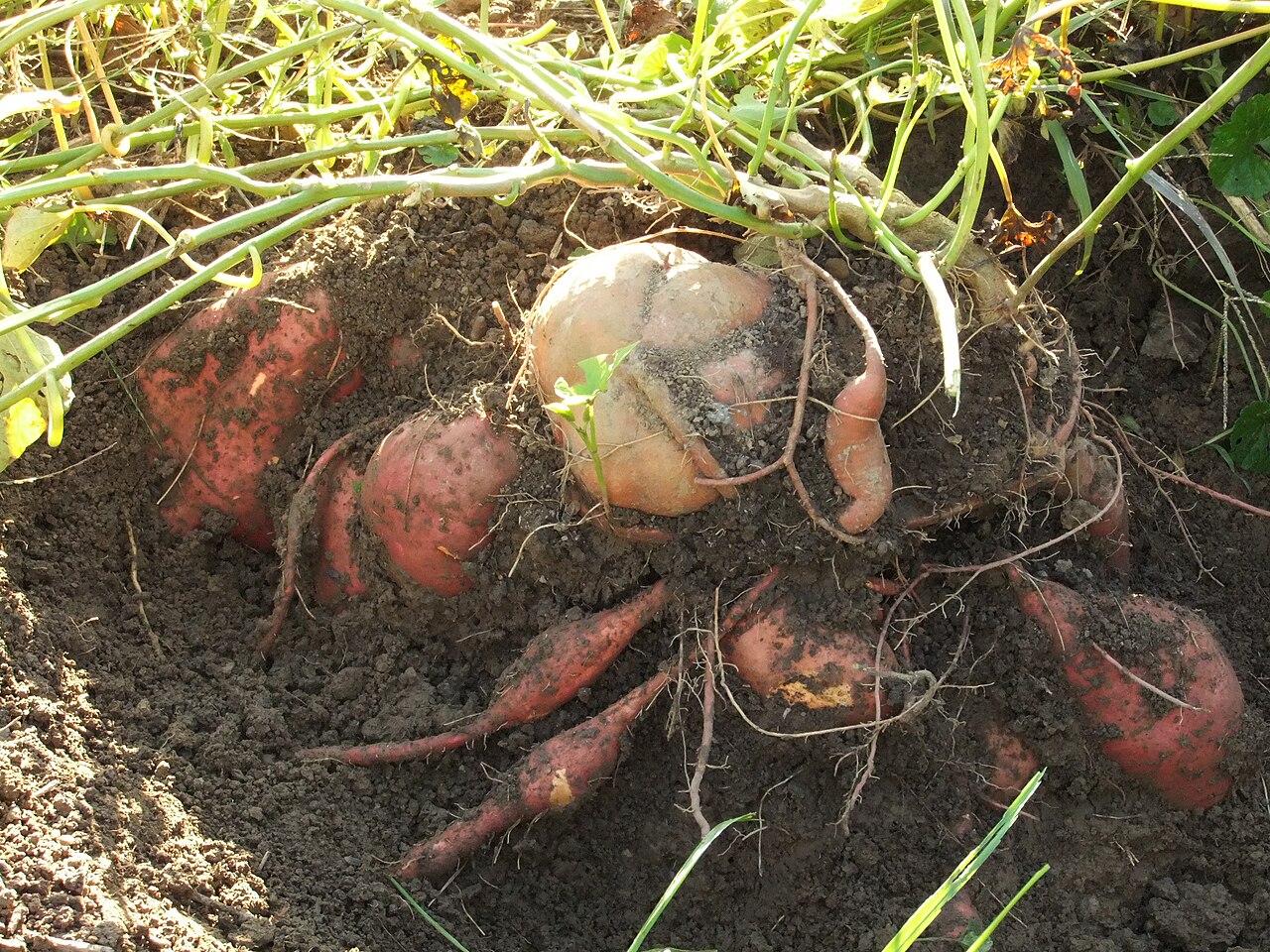
Researchers at China Agricultural University in Beijing have found that turning up a single gene with a CRISPR-based tool helps sweet potato withstand saline-alkali soil, land that combines high salt with high pH and keeps large areas of farmland out of production. The study was published on 28 October in the journal Horticulture Research.
The team, led by corresponding author Shaopei Gao at the university's Key Laboratory of Sweet Potato Biology and Biotechnology, used CRISPR activation, which does not cut DNA. A modified, non-cutting Cas9 protein is paired with activator proteins to switch a target gene on more strongly; a companion tool, CRISPR interference, pairs the same Cas9 with repressor proteins to turn a gene down. That suits sweet potato, a hexaploid crop carrying six copies of each chromosome, where knocking out one copy of a gene usually leaves others working.
The target was IbbZIP11, a transcription factor strongly expressed in sweet potato roots and triggered by several kinds of stress. Plants with the gene turned up grew better and produced more biomass under saline-alkali stress in both hydroponic and soil trials, with better photosynthesis in soil. Plants with it turned down became more sensitive, showing premature yellowing of leaves and slower growth.
The gene works by switching on a second gene, IbCAT1, which makes the enzyme catalase. Catalase breaks down hydrogen peroxide and other reactive oxygen species that build up in stressed cells and damage proteins, membranes and DNA. Plants engineered to overproduce IbCAT1 showed the same improved tolerance, and plants with it suppressed the same sensitivity, confirming the pathway. The protection comes mainly from clearing reactive oxygen rather than from blocking salt uptake at the root.
The paper's abstract does not give percentage gains in biomass, growth or yield. Saline-alkali soil limits crops in northern and coastal China, Central Asia, parts of Africa and elsewhere, and the affected area is expected to grow as irrigation and climate pressures push more land towards salinisation. Sweet potato already grows on poorer land than staple cereals, which makes it a practical crop in which to breed extra stress tolerance.
The finding gives breeders a named target, IbbZIP11, for engineering or screening sweet potato for saline-alkali tolerance, and shows that CRISPR activation and interference can serve as research and possible breeding tools in polyploid crops where conventional gene knockouts are hard to achieve. The laboratory, run with the university's College of Agronomy and Biotechnology, lists the crop's resilience on marginal and saline land as an ongoing focus.
Photo: Vmenkov / Wikimedia Commons (CC BY-SA 3.0)
Source: Global Agriculture


Comments
(0)