
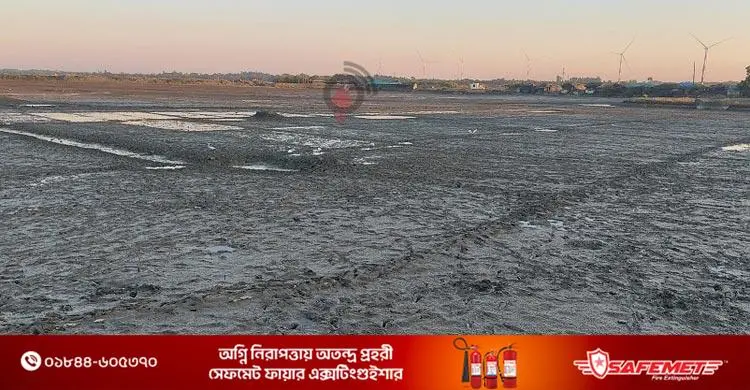
- The season has begun but farmers are not in the fields
- Around 20 per cent of salt fields may stay empty
- Production costs are not being recovered
- 3.5 lakh metric tonnes of last year's salt lie stored in pits
All of the country's salt demand is produced in fields along the coasts of Cox's Bazar and Chattogram. But although the country is self-sufficient, farmers have not been getting a fair price for several years and cannot recover their production costs. So although the salt season has begun, there is no rush to return to the fields. Some 3.5 lakh metric tonnes of salt are still lying in pits in the fields. Farmers say they will not go back to the fields unless a fair price is guaranteed.
People in the trade say that with income and costs out of balance and farmers undecided, around 20 per cent of salt fields may stay empty this year.
Meanwhile, the salt factories set up in Islampur, Cox's Bazar, after independence are also at a standstill. Here too, because of the price problem, less of the stored salt is being refined. Lakhs of families involved in salt production, refining and trade could face a livelihood crisis, and people in the sector see this as a warning sign for the salt industry.
Those in the salt production wing of the Bangladesh Small and Cottage Industries Corporation (BSCIC), however, hope farmers will soon return to salt production and a fair price for salt will be set.
Farmers count their losses
Harun Rashid, a farmer from Khamarpara in Chowfaldandi, Cox's Bazar Sadar, said the salt season starts in November. At this time last year (the first week of December) farmers were busy producing salt; this year, far from producing, the fields have not even been prepared.
Ali Akbar, a salt farmer from Rastarpara village in Khurushkul union, said he farmed two acres last year and produced 1,200 maunds of salt. "Producing a maund of salt in the field cost Tk 350 to 400, but I sold it for Tk 200 to 250. Because I did not get a fair price, I am Tk 2.5 lakh short. Knowing I will make a loss instead of a profit, how can I go back to the fields?"
Riduanul Haque, a salt farmer and trader from Gomatoli in Eidgaon, said that after spending on field leases, labour, polythene and everything else, many have stored their salt in pits rather than sell it at half its value. With a good price, farmers would have quickly dried out their shrimp enclosures and gone back to the fields. "But a month into the season, many fields have not even been dried. Because costs are not recovered, many fields have not even been leased. This time about 20 per cent of fields could stay out of cultivation. If this goes on a few more years, many will gradually pull out of salt farming."
It is not only Sadar upazila and Eidgaon: farmers in Teknaf, Moheshkhali, Chakaria and Pekua have not gone back to the fields either. They all demand a guaranteed fair price for salt and lower land lease rates, without which they say there is no prospect of returning.
Muhammad Islam, a salt farmer from Rajakhali in Pekua, said about 1,500 maunds of salt from the past two years were still stored in pits because production costs were not being recovered. Farmers could survive if they got Tk 400 to 500 a maund, he said, but for two years the price has held at Tk 200 to 220. "How will we run our households like this? I can't bear continuous losses, so I don't feel like going back to the field."
Mukchhud Ahmad, a farmer from Ali Akbar Deil in Kutubdia, said angrily that the domestic salt industry is on the brink of ruin. "The country produces about as much salt as it needs, and in some years more, so why must salt be imported? Why is there no fair price for salt produced by our sweat?"
Moheshkhali farmer Joynal Abedin said: "We can't bear any more losses. The government buys paddy and rice at fair prices from the field level. Why can't it guarantee a fair price for salt?"
What BSCIC says
Md Idris Ali, field inspector for BSCIC in the Cox's Bazar region, said the country's salt season runs from November to May, around the winter. During this time fields are prepared in Cox's Bazar and the Banshkhali coast of Chattogram and salt is produced by drying seawater. Most of the target is harvested in the heat of March, April and May. In the past salt was harvested in almost every area by mid-December, but this year is different. Only a small number of farmers have gone back to the fields in Kutubdia and Chhanua in Banshkhali. "From every area we hear of farmers being denied a fair price. We have informed the government and hope some solution on fair prices will come."
Soyaibul Islam Sabuj, organising secretary of the Cox's Bazar Salt Farmers and Traders Sangram Parishad, said there are more than 40,000 salt farmers in Cox's Bazar. Although the season began on 1 November, only some farmers in Kutubdia and Chhanua have gone back to the fields. Word has spread in the market that industrial salt has been imported, and because of this 35,000 to 38,000 farmers have not gone to the fields, he said. If the government does not step in to resolve problems including a mill owners' syndicate, land lease rates, excessive labour wages and the dominance of middlemen, the sector will suffer heavy losses. If a fair price is guaranteed, everyone will return to the fields with enthusiasm, he said.
Md Zafar Iqbal Bhuiyan, deputy general manager of the BSCIC office in Cox's Bazar, said the salt season has already begun and many farmers have gone back to the fields in Kutubdia and Chhanua in Banshkhali. He hopes farmers in other areas will do so soon. The monsoon ended late this year, so the enclosures are also being dried late. Farmers are currently getting Tk 240 a maund, which is the reason for their frustration, he said, but BSCIC is optimistic that salt prices will rise. In mid-November the BSCIC chairman visited Cox's Bazar, inspected salt fields and spoke to farmers to encourage them.
Zafar Iqbal added that farmers in areas where they have not yet started are expected to return soon. "New salt will be available in Chhanua in Banshkhali and in Kutubdia by mid-December. About 3.5 lakh metric tonnes of last year's salt are stocked in the fields. The government has not yet taken any decision on importing salt."
Government review
At an annual review meeting with local salt mill owners at the Cox's Bazar Deputy Commissioner's office on 11 November, salt stocks, setting a fair price, the problems of mill owners and marginal farmers, and the prospects of the salt industry were discussed.
After the meeting, Industries Secretary Obaidur Rahman said edible salt would not be allowed to be imported on any pretext under cover of industrial salt, and that the ministry would take strict action on this. The proposals raised would be reviewed at the highest level of government to set a fair price for salt, and a salt storage facility would be built in Cox's Bazar if land is found.
Last year more than 41,000 farmers produced salt on 69,000 acres. Demand was put at 25 lakh 28 thousand metric tonnes. Production, the highest in 64 years, is given in the report as 24 lakh 38 metric tonnes. The year before, the full target was met with stocked salt. This year's salt production target has been set at 26 lakh 18 thousand metric tonnes.
Source: Jagonews24. First published in Bengali on The Agro News.


Comments
(0)