

By Sanjana Rahman Juthi
Cotton is one of the cash crops grown in Bangladesh. In rural areas "cotton" first brings to mind shimul cotton, but there are other kinds of cotton plants too, such as karpas, phuti karpas and silk cotton, which have to be cultivated. Cotton can be grown in Bangladesh as well; here is how.
The cotton plant
Cotton generally grows well in a hot, dry season. In the past mainly local species were grown in Bangladesh, but high-yielding hybrid and Bt cotton are now becoming popular. The cotton plant is usually an annual, with an average height of 1 to 2 metres.
The stem is hard and the leaves spread out like palm leaves. The flowers are usually pale yellow to pink. Once the flowers drop, the cotton bolls begin to form, and when mature they burst open to release white cotton fibre. There are more than 50 species worldwide, but only 4 are used commercially to produce cotton.
Each species differs somewhat in structure, but the basic form of the plant is much the same. The leaves are lobed, green and slightly rough. The flowers have no scent and after blooming slowly turn into bolls, which split to release the white fibre.
Soil and land preparation
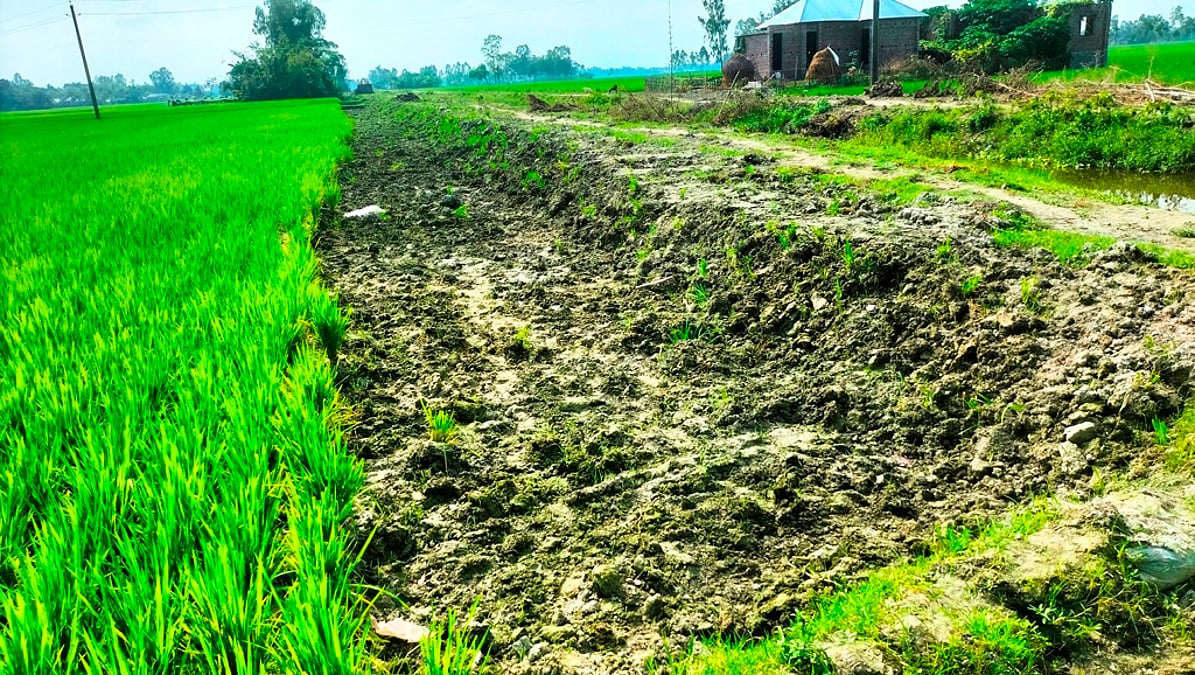
Cotton grows well in loam and sandy loam, though it can be grown in any soil rich enough in organic matter. Very sandy or clay-rich soil is not suitable. Land where rainwater does not stand and normal floods do not reach is best. Land that is damp, shaded or where rainwater does not drain within 2 to 6 hours should not be chosen. A soil pH of 6.0 to 7.5 is best; if the soil is too acidic, lime should be applied.
Before ploughing, 1.0 to 1.5 tonnes of cow dung or compost per bigha should be spread on the land. Then, between rains and when the soil is workable, plough and harrow 3 to 4 times to make the land level and friable, clearing rubbish and weeds thoroughly. In unfavourable conditions, cotton seed can be sown without tillage by the dibbling method and still yield a crop.
Sowing time and seed
Seedlings can be raised in paper or polythene packets under a shade and transplanted to the main field at 10 to 12 days old. In this way cotton can be sown late, after jute and Aus rice have been harvested from the same land, and still give a crop. Depending on the variety, the best time to sow cotton seed is from 1 Asharh to 15 Srabon, though seed can be sown up to 30 Srabon.
Hybrid varieties are best sown early. If seed is sown at the right time, after the cotton is picked the same land can easily be used for high-value crops such as Boro rice, potatoes, wheat, maize and vegetables. The Cotton Development Board's own high-yielding open-pollinated varieties need 1.0 kg of seed per bigha and hybrids 500 to 600 grams. Before sowing, it is best to soak the seed in water for 3 to 4 hours and rub it with dry soil or ash. Remember that at least 3,000 plants per bigha are needed for a high yield.
Before sowing, put the seed in a container and mix in 5 grams of Gaucho, Confidor or Ektara insecticide per kg of seed with a little water so it coats the seed, leaving no excess water. Then dry the seed in the shade for 40 to 50 minutes before sowing.
Spacing and fertiliser
Cotton seed must be sown in rows running lengthwise north to south. If sown at the right time, all varieties should be spaced 90 cm (3 feet, or 2 haat) between rows and 45 cm (1.5 feet, or 1 haat) between plants. It is best to raise the soil along the row and sow on top, as this makes drainage easier and protects seedlings from waterlogging, so they grow better. At each spot along the row, sow 2 to 3 seeds half an inch deep and cover them lightly with a little soil. Packing the soil hard over the seed or sowing too deep in a hole can make germination difficult.
For a good yield the right fertilisers must be used in the right amounts and in the proper way. Both organic and chemical fertilisers are needed. Organic fertiliser raises the soil's organic matter, which increases its water-holding capacity, boosts microbial activity and adds micronutrients.
Cotton is useful not only to the textile industry but also has medicinal value, and many people depend on cotton farming for their livelihood. The Cotton Development Board should therefore take more effective steps to increase cotton production in Bangladesh.
Source: Jagonews24. First published in Bengali on The Agro News.
Comments
(0)