
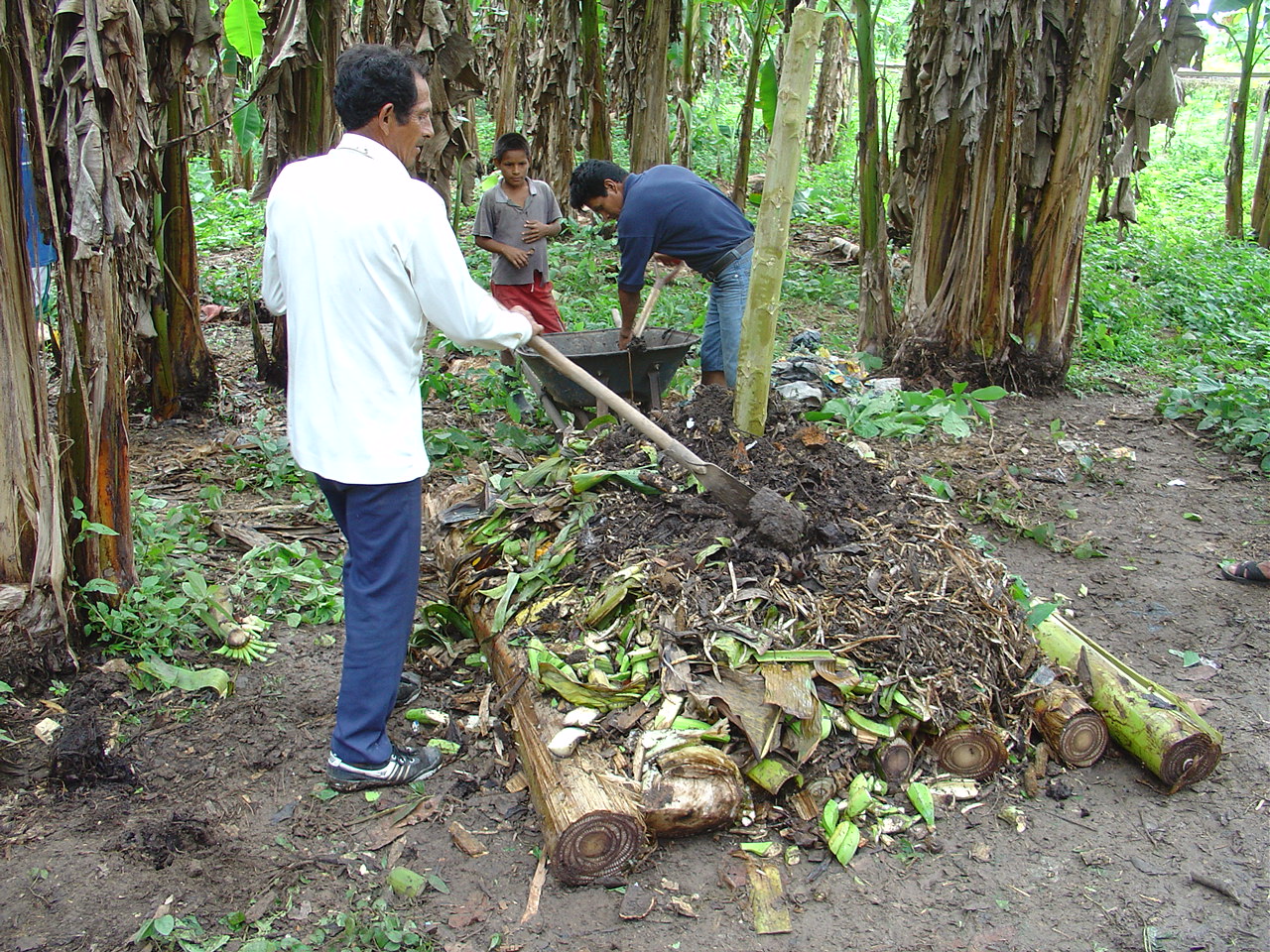
A research project on 36 plantain and banana farms in Quindío, Colombia, has built 72 compost piles over two production cycles to follow what happens between a farmer's compost recipe and the material that finally goes on the field. The project is led by the Armenia campus of Universidad La Gran Colombia as part of its Regenerative Agriculture work.
The farms compost what they have: plantain and banana pseudostems, leaves and fruit-bunch stalks, and on some farms coffee pulp and livestock residues, while others rely more on crop residues and leaf litter. Each farm produced one formulation, combining four to twelve materials. Their starting carbon-to-nitrogen ratios were estimated from the quantities and technical data on the materials, not measured in each batch. Twenty-seven of the 36 fell within the project's reference range of 25:1 to 35:1; nine fell outside it because the right residues were not available in the needed amounts.
The piles were weighed and built with perforated pipes at the base for air. By October 2026 field monitoring had produced 932 temperature readings, from 20.4°C to 75°C, with an overall mean of 38.2°C. The authors caution that this range does not show that every pile reached the same temperature, so the mean cannot prove that a given batch completed a particular treatment. Of 935 moisture observations, 90.9 per cent were classed as adequate; the rest recorded dry or saturated material.
First laboratory results from 19 mature compost samples showed a wide spread. pH ran from 7.78 to 9.40, and electrical conductivity, a measure of soluble salts, from 3.58 to 22.40 dS/m. Composts made within the same project therefore cannot be assumed to be alike, the authors write: where conductivity is high, the amount applied, the soil and the crop's sensitivity need particular attention. Microbiological analyses are still to come, and the results are not evidence of better plant performance.
Participatory mapping with the farmers documented 525 land-use areas covering about 424 hectares and more than 1,300 qualitative records. About 51 per cent of the mapped area was classified as overutilised, a diagnostic label rather than a measurement of soil degradation. A sustainability baseline placed more than half the farms in the lower category, and follow-up work is needed before any effect of compost use or on farm income can be shown.
The lesson the researchers draw is practical: choose a formulation from the materials at hand, follow how the pile develops, test the finished compost, and only then decide how much to use on a particular soil. The account was written by Clementino Lara Grajales and Juan Felipe Peña Mojica of the project.
Photo: Jan Banout / Wikimedia Commons (CC BY-SA 3.0)
Source: Global Agriculture

Comments
(0)