
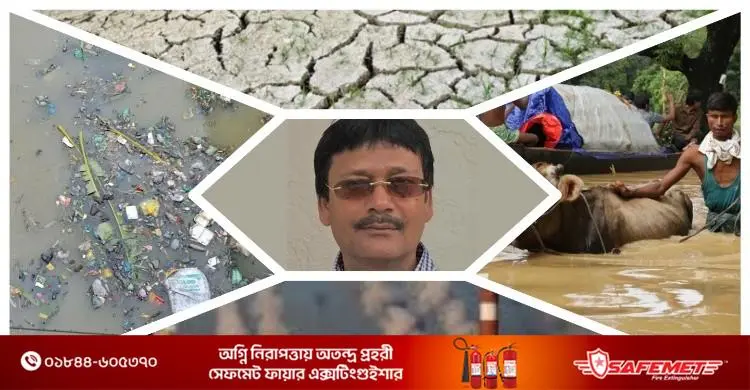
By Hasan Zahid
By any measure, climate change is the biggest threat facing humankind. The effects of climate change and environmental pollution are already striking directly at human health. Air pollution, disease, extreme weather events, climate refugees and pressure on mental health keep increasing. Extreme weather is also damaging crops, land, trees, water, animals and ecosystems.
Many effects of climate change were already seen in the first few decades of the 21st century. Of these, 2024 was the warmest year on record, with average temperatures 1.60 degrees Celsius (2.88 degrees Fahrenheit) higher than when regular record-keeping began in 1850. Additional warming will intensify these effects and could trigger tipping points, such as the possible melting of the entire Greenland ice sheet.
Bangladesh pays the price
In recent times we have seen many COPs (the UN Conference of the Parties). Their main aim should be to cut carbon and other greenhouse gas emissions to reduce global warming. But we see something else. The main agenda becomes argument and disagreement over who will cut and who will not. The victims are geographically vulnerable Bangladesh and island nations.
Bangladesh's internal problems and global harms have pushed the country into extreme uncertainty. Since the Industrial Revolution, excess carbon dioxide and other greenhouse gases have warmed the atmosphere. As a result, ice, ice caps and glaciers are melting and sea levels are rising, putting the south of Bangladesh, the coastal region, under grave threat. Much of the south faces the threat of being submerged by the sea. Unfortunately, Bangladesh is a victim of global warming without emitting excess carbon dioxide.
The reality is that without releasing harmful greenhouse gases in excess, Bangladesh's nature, biodiversity, ecosystems, forests, rivers, air, water and soil are suffering from global effects. The coastal region is a victim of global weather change. Added to this is an unprecedented race among people in Bangladesh to destroy natural resources. Deforestation, shrinking wetlands, river pollution and habitat destruction, hill cutting and many kinds of pollution have squeezed nature. As a result, weather is becoming more extreme, natural disasters are growing and biodiversity is under threat.
What has been destroyed over a hundred years cannot be restored. The only remedy now is to prevent the destruction of nature and for the roughly three and a half crore people of the coastal region to adapt to changed circumstances. Climate refugees have already appeared in Bangladesh, which is now known to the world as a "poster child". Countless people who have lost their homes to river erosion are moving to cities.
COP30 and its limits
At home and abroad, Bangladesh's goal will be adaptation, adjusting to changed and adverse conditions. It is now clear that rich and powerful countries will not cut carbon emissions. The UN Conference of the Parties on climate change, COP30, ran from 10 to 21 November in Belém, a Brazilian city on the edge of the Amazon rainforest. The aim was to stop deforestation around the world.
We know the outcome. The powerful countries say the same thing, all jackals howling the same tune. They advise us: you increase your sinks and we will give money. Broadly speaking, we must go into strong negotiations in world forums, secure funds, and make sure those funds are properly used to protect the country. Tree planting is one of the key ways to create sinks, along with conserving forests, protecting ecosystems and speeding up new afforestation. Indiscriminate tree felling leaves soil bare and eroded, weakens it, and wipes out biodiversity and animal habitats.
Among COP30's decisions, the good points are that a package of 29 decisions, called the "Belém Political Package", was passed. Its important decisions include:
- global climate solidarity based on tropical forests and indigenous rights;
- speeding up implementation of the Paris Agreement;
- a commitment to increase adaptation finance;
- strengthening the framework for transparency and accountability;
- gender equality measures in climate policy; and
- a policy of transition towards climate-friendly fair trade and a green economy.
But once again there was no decision on cutting carbon emissions, and whether there will be one in the near future is hard to say. Under the 2015 Paris Agreement, countries jointly pledged to keep warming below 2 degrees Celsius. But under the pledges made in that agreement, global warming could reach about 2.8 degrees Celsius (5.0 degrees Fahrenheit) by the end of the century. To limit warming to 1.5 degrees Celsius, carbon emissions must be roughly halved by 2030 and net zero reached by 2050.
As global warming melts polar ice and raises sea levels, Bangladesh is at risk of suffering the most. That warming is man-made and not a trick of nature is now an established fact around the world. For many years a few industrialised countries tried to hush up this inescapable truth. The earth's temperature has been rising since the Industrial Revolution. The whole world is now the victim of the unbridled carbon emissions of the developed, industrialised world, because warming is melting ice and swelling the seas and oceans. The worst sufferers will be island nations and low-lying, vulnerable, disaster-prone countries such as Bangladesh.
What needs to be done
Reduce the use of fossil fuels: Burning fossil fuels releases large amounts of carbon dioxide. We constantly use oil, gas and especially coal as fossil fuels. Carbon dioxide released into the atmosphere traps heat from the sun and raises the temperature of the atmosphere. Fossil fuels are a key issue in keeping global warming below 1.5 degrees Celsius, and countries must cut their use to stop warming. But the leading fossil fuel producers (Australia, the United States, China and India) oppose cutting their use.
Reduce methane emissions: Recent UN research shows that cutting methane emissions could largely curb climate change. Methane plays a big part in raising temperatures. Natural gas is burned during oil extraction, releasing large amounts of methane. Alternative, environment-friendly ways to burning natural gas must be found, which will reduce methane emissions.
Increase the use of renewable energy: The energy sector plays a huge part in global climate change. Electricity and heat generation affects climate change more than any other sector of the global economy. There is no alternative to renewable energy in stopping climate change, and world leaders must work together towards it. As civilisation advances, the use of electricity and heat will keep growing, but more renewable energy would meet that demand without harming the environment. Given recent global targets and demand, however, such steps will be hard.
Wind and solar power, meanwhile, could meet energy demand. There is no alternative to renewables, namely wind and solar, for achieving the net zero by 2050 proposed by world leaders. But the road is not smooth: when wind speeds are low, less electricity is generated. Better batteries must be developed so that power can be stored and used when needed.
Petrol and diesel use: Transport has grown with the advance of civilisation, and new vehicles are constantly being added on roads, waterways and in the air, running on fuels such as petrol, diesel and octane. To stop climate change, the use of diesel and petrol in vehicles must be cut. Increasing the number of electric vehicles could be one solution, though that is quite a complex task. Hydrogen could be an excellent vehicle fuel here: hydrogen produced with renewable energy could hold out the promise of an environment-friendly transport sector.
Plant more trees: There is no alternative to tree planting in stopping climate change, and no method more effective in checking the rise in the earth's temperature. Even if trees must be cut out of need, the rate of planting must rise. In a 2018 report the UN said: "To keep global warming below 1.5 degrees Celsius, carbon dioxide must be removed from the air." There is no alternative to trees for removing carbon dioxide from the air, and trees also play an important role in protecting biodiversity, for which there is no substitute for trees and wetlands. Sadly, in our country, trees and forests are being cleared, and brick kilns, heavily polluting dyeing factories and composite mills are being built even on cropland. These are seriously damaging the country's internal environmental balance.
Remove greenhouse gases from the air: Greenhouse gases block the heat that reaches the earth from the sun from escaping back into space after it is reflected from the surface, which keeps the earth warm. When greenhouse gas levels are high, the earth becomes much hotter.
The problem is that the world's powerful and influential countries want to raise their own industrial and production rates. So instead of cutting their own carbon emissions, they want to turn other countries into sinks and reduce pollution by providing funds and green technology. This will bring no lasting result. At almost every COP (UN Conference of the Parties), the decisions are about providing funds and technology transfer.
If carbon dioxide or other greenhouse gases could be removed artificially from the atmosphere, climate change could be controlled. Or, if greenhouse gases could be stopped from spreading from their source once produced, their effect on the environment could be greatly reduced.
Some organisations in a few developed countries have already developed technology to remove greenhouse gases from the atmosphere, notably "Carbon Engineering" in Texas and "Climeworks" in Switzerland. They use huge fans to pass air through a chemical filter that absorbs carbon dioxide from the atmosphere. Another method is carbon capture and storage. But these technologies are quite complex and costly.
Funds instead of cuts
At various climate conferences, financial help for poor countries and creating funds for less developed countries are always given priority, but the problem is that no commitment to cut emissions can be won from the developed countries that emit the most greenhouse gases. Poor countries also have to go through very complex mechanisms to get the funds.
The things that need doing are not being done properly. Globally, the greatest emphasis in stopping climate change should be on cutting carbon emissions. That is exactly what world leaders have failed to agree on at the various COPs and climate conferences. They sign agreements approving funds or grants but hesitate to commit their own countries to cutting carbon. This global problem will not only add to the suffering of poor countries; its harm will fall, more or less, on every country. Yet it remains hanging at COP conferences. It is like taking painkillers without identifying the source of the pain.
The 29th UN climate conference (COP29) was held in Baku, the capital of Azerbaijan, in November 2024. Heads of state, scientists, policymakers, business people and entrepreneurs took part, although the heads of state of major carbon emitters such as the United States, China, India and France were absent, whose presence would have carried special weight.
Experts say that to keep global warming below 2 degrees Celsius, greenhouse gas emissions must be cut by 43 per cent by 2030. At this conference, after 33 long hours of talks, rich countries pledged US$300 billion to help developing countries cope with the effects of climate change.
COP26 was held in Glasgow, Scotland, to carry out various actions to meet the goals of the Paris conference. The countries that signed the Paris Agreement in 2015 had agreed to take steps to ensure global warming does not rise more than 2 degrees Celsius above pre-industrial levels.
It was the first in-person world climate conference since the coronavirus pandemic emerged in late 2019. Four goals were given priority:
- sharply reducing carbon emissions by 2030 in order to bring global carbon emissions to zero by 2050;
- taking effective steps to protect and restore ecosystems for people hit by climate disasters, put protection and warning systems in place, build infrastructure and make agriculture resilient;
- developed countries playing their part in creating a fund of US$100 billion a year to carry out this work; and
- everyone working together to tackle the risks of climate change.
The conference established the "Glasgow–Sharm el-Sheikh Work Programme on the Global Goal on Adaptation" to set a global goal on adaptation, which various quarters hope will speed up Bangladesh's future adaptation work. Adaptation keeps coming up again and again; it is Bangladesh's only option. Where and how so many people in a small country like Bangladesh will adapt depends on how badly climate change damages the country in the near future. Long-term planning for the plans, money and technology needed for adaptation must become our mission and vision.
A rule book for implementing the Paris Agreement was drawn up at the conference, under which experts would review the pledges of different countries to cut carbon emissions. COP26's main aim was to keep alive the hope of limiting warming to 1.5 degrees Celsius. That aim was achieved, but how it will be fully realised is far from settled. In the words of COP26 president Alok Sharma himself: "We have kept the hope of the 1.5-degree target alive, but its pulse is very weak."
It is undeniable that since the Industrial Revolution, imperialist and superpower countries, living in luxury and comfort, have put most of the world in grave danger by giving birth to the monster called climate change. They were awake but pretended to be asleep. They knew this earth is not ours; we have only borrowed it from the next generation.
Phasing out fossil fuels is possible if energy is saved and we switch to energy sources that do not cause significant carbon pollution. These clean sources include wind, sun, hydropower and nuclear power. Clean electricity from these sources can replace fossil fuels for transport, heating buildings and running industrial processes. Carbon can also be removed from the atmosphere, for example by increasing forest cover and using farming methods that store carbon in the soil.
What people can do
- Rely less on cars and use bicycles or environment-friendly public transport more.
- Take steps to keep less heat or cold getting into the home.
- Eat less meat and dairy.
- Fly less.
At the next COP, efforts must be made to secure commitments from developed countries to cut carbon emissions, which will be the most urgent step in stopping climate change. There is no alternative. Technology transfer, renewable energy and solar power are temporary solutions, and for LDCs, the least developed countries, they are still largely beyond reach. So instead of focusing only on creating funds, the main job of the least developed countries' representatives will be to put pressure on industrialised countries to cut carbon, while working tirelessly to maintain the environmental balance of their own countries.
The writer is an environmentalist (certified member, ECO Canada, Calgary, Alberta, Canada).
Source: Jagonews24. First published in Bengali on The Agro News.
Comments
(0)