
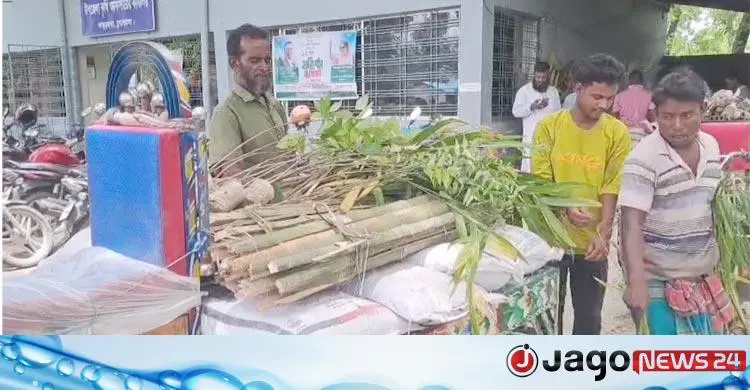
Allegations have been raised that poor-quality saplings and bamboo stakes were supplied in Chuadanga under a government priority tree-planting project. Beneficiaries have questioned the quality of the materials distributed to farmers and government primary school students in four upazilas of the district, and allege irregularities in the gap between the government allocation and purchase prices.
The allegations point at Masudur Rahman Sarkar, deputy director of the Department of Agricultural Extension (DAE) in Chuadanga.
Contacted by mobile phone, Masudur Rahman Sarkar said: "I am in a meeting in Jashore. I'll talk about this when I get back."
25,000 saplings in four upazilas
The programme was taken up in the 2025-26 financial year under the agricultural rehabilitation assistance head to fulfil the government's election pledge. Under it, 25,000 saplings of various species were to be planted in Chuadanga Sadar, Alamdanga, Damurhuda and Jibannagar upazilas. Distribution of saplings, bamboo stakes and organic fertiliser, and the planting, have been completed.
Beneficiaries say that although the government price of each bamboo stake was set at Tk 50, the stakes supplied were immature and poor quality, worth no more than Tk 15 to 20 on the market.
They also questioned the government prices of the saplings. According to them, the government price was set at Tk 30 each for amra, jam and bael saplings, Tk 40 for olive, Tk 30 for date palm and Tk 60 each for mango and palmyra palm. They allege the saplings were bought for less from the government horticulture centre and BADC.
Union Parishad member Shah Mohammad Farhad Hossain went to the upazila agriculture office with farmers of ward 4, Dhanyaghara-Durgapur, in Kurulgachhi union of Damurhuda upazila, to collect saplings. He said the farmers refused to take the saplings and stakes after seeing their quality, so he took them himself and planted them along the village road. Some of the saplings have already died, he said.
Beneficiaries say the poor materials threaten the project's purpose and waste public money, and have demanded an investigation into the purchase and supply of materials.
Officials' responses
Alamdanga upazila agriculture officer Masud Hossain Palash admitted the saplings were poor quality. He said they had been supplied to the upazila agriculture office by the government horticulture centre through the deputy director's office, and about 800 saplings were returned because many were substandard.
Amjad Hossain, nursery supervisor at the Chuadanga Horticulture Centre, disagreed. He said the centre had produced and supplied saplings to the set standard, and the allegation that it supplied poor saplings was not correct.
Damurhuda upazila agriculture officer Sharmin Akter said the government had taken up the programme in 2025-26 under the agricultural rehabilitation assistance head to fulfil its election pledge, and that after planting the government would monitor the saplings through GPRS tracking.
In Jibannagar upazila, beneficiaries say saplings were distributed to farmers but bamboo stakes were not.
Deputy director Masudur Rahman, who had the central role in the project, said the saplings, bamboo stakes and organic fertiliser were bought following tender procedures and government instructions, and the materials supplied were of good quality.
Chuadanga-1 MP Masud Parvez Russell said the tree-planting project is an important government initiative and any allegation of irregularities should be investigated. The project money must be spent properly and beneficiaries must receive quality materials, he said.
Chuadanga Deputy Commissioner Lutfun Nahar said there is no room for irregularities in government projects. The allegations will be checked, and spending and the quality of materials will be monitored. If saplings and bamboo stakes of the right quality were not used, they will have to be replaced.
She said the district's programme to plant 25,000 trees is part of the government's plan to plant 25 crore trees in five years. The agriculture department has been told to replace any poor saplings or stakes found, and instructed to take steps so the planted trees grow quickly and are protected from livestock.
The agriculture department said the 25,000-tree programme is supposed to be monitored round the clock through GPRS tracking. Beneficiaries say, however, that it is essential to ensure not only distribution and planting but also that the saplings grow properly and the project money is spent correctly.
Source: Jagonews24. First published in Bengali on The Agro News.
Comments
(0)