
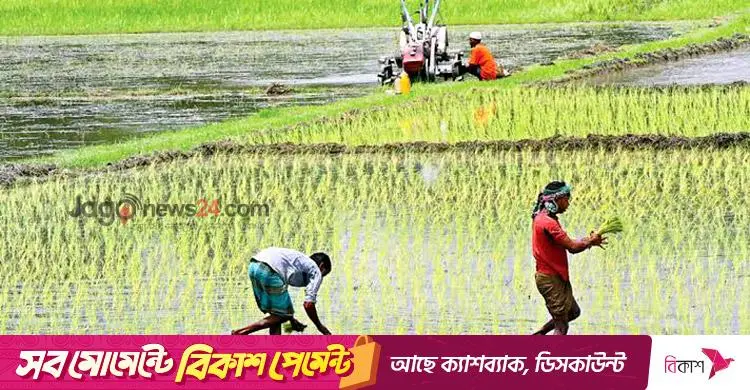
Cultivation has increased in Barishal. Encouraged by government incentives, farmers are growing more, fallow land is shrinking and crop production has risen compared with before.
Sources say many farmers have grown various crops on uncultivated and fallow land after receiving free seed and fertiliser. In the 2024-25 season, about three and a half thousand hectares more land was cultivated in Barishal district than the previous year.
According to the data, cultivation in the Barishal region rose significantly thanks to support from the agriculture department, private organisations and farmers' combined efforts. Along with incentives, the expansion of irrigation under various government projects has brought fallow land under cultivation.
Upazila figures
According to the Barishal agriculture department, 162,753 hectares were cultivated in Barishal district in 2023-24: 15,773 hectares in Barishal Sadar, 11,880 in Babuganj, 16,601 in Wazirpur, 29,125 in Bakerganj, 10,257 in Gournadi, 10,200 in Agailjhara, 14,995 in Muladi, 17,680 in Hizla, 26,962 in Mehendiganj, 8,370 in Banaripara and 920 in the Barishal City Corporation area. That year the district had 1,174 hectares of permanent fallow land (cultivable but not cultivated), 9,211 hectares of temporary fallow and 10,385 hectares of fallow land in total.
After the government incentives, 166,172 hectares were cultivated in 2024-25, or 3,419 hectares more than the previous year: 16,710 hectares in Barishal Sadar, 11,525 in Babuganj, 17,031 in Wazirpur, 30,185 in Bakerganj, 10,428 in Gournadi, 10,209 in Agailjhara, 15,381 in Muladi, 18,825 in Hizla, 26,712 in Mehendiganj, 8,190 in Banaripara and 976 in the City Corporation area. This year the district has 1,062 hectares of permanent fallow, 5,591 hectares of temporary fallow and 6,653 hectares of fallow in total.
The agriculture department said 376,562 families in Barishal are involved in farming: 79,760 landless farm families, 133,292 marginal, 108,152 small and 49,740 medium farm families. Most of these farmers are poor and live below the poverty line.
Tk 4.81 crore in incentives
For these farmers, the government gave Tk 4 crore 81 lakh 52 thousand in incentives in Barishal district in 2024-25. Of this, Tk 2 crore 99 lakh 58 thousand 300 was distributed for hybrid Boro, synchronised HYV Boro, wheat, maize, mustard, sunflower, groundnut, soybean, mung, lentil, grass pea, Aus and onion. Distribution of another Tk 1 crore 81 lakh 93 thousand 700 is under way for lemon, hybrid chilli, coconut saplings, Aman, summer vegetables, local palmyra saplings, neem, bael, jamun, jackfruit and mango saplings.
Yunus Khan, a farmer in Dehergati union of Babuganj upazila, told Jago News he had received free government seed and fertiliser to grow mustard on one bigha this time. Farmers Salam, Joynal and Ansari of the same union said they had received free seed and fertiliser for mustard per bigha.
Farmer Joynal said around a hundred farmers in the union had received incentives, each given free seed and fertiliser for one bigha, and that growing mustard has brought smiles to everyone's faces.
Those involved believe that if the incentives continue next season, all the district's permanent fallow land can be brought under cultivation.
Md Musa Ibne Sayeed, additional deputy director (crops) of the Department of Agricultural Extension (DAE), Khamarbari, Barishal, told Jago News that production has risen as cultivable land in the Barishal region increased, which is a positive sign. The main reason is that farmers have been encouraged through improved technology and incentive programmes, bringing fallow land under cultivation and raising yields.
Source: Jagonews24. First published in Bengali on The Agro News.


Comments
(0)