
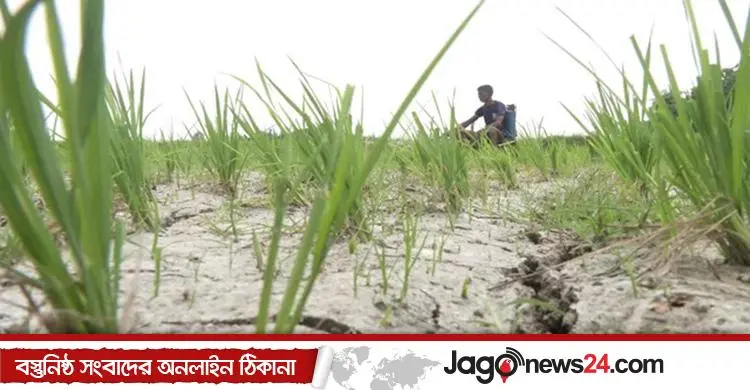
Crop production in the Barind region is being hampered as the groundwater table falls, and water quality is deteriorating. In many areas, particularly in Rajshahi, Chapainawabganj, Naogaon, Natore, Rangpur, Dinajpur, Bogura and Pabna, many crops can no longer be grown, leaving farmers in difficulty.
Dr Bidhan Chandra Das, retired professor of zoology at Rajshahi University, said the findings came from a recent research report on the Barind region.
Research on drought in the north-west
Dr Das said an article published in January in the Elsevier group's journal Climate Services set out the many negative effects of drought in the north-west of the country. It said the cost of growing crops in the region has risen, the groundwater table has dropped, surface water quality has been spoiled, many crops cannot be grown and soil moisture has fallen. People's incomes have declined, there is a shortage of clean water for drinking and household use, health problems have appeared, and farmers are finding it hard to raise livestock.
The article also found that rainfall alone is not responsible for the severity of drought in the north-west. Groundwater shortage, lack of flow in canals and rivers, high population density and deforestation are also to blame, and it goes without saying that these are mainly man-made.
He said Dr Chowdhury Sarwar Jahan, senior professor of geology and mining at Rajshahi University, had given the BBC several reasons for the Barind water crisis. In summary, only Aman rice used to be grown in the region, but since the 1990s three crops a year have been grown. Rainfall has also fallen: in the two decades after the 1980s and 1990s it was about 400 mm lower. Because the land here is higher than the rivers, what rain does fall runs off quickly into them.
The professor added that two research papers published in two international journals in 2023 show that Bangladesh has been hit by exceptional drought 13 times in five decades. These droughts damaged the country's natural resources, especially forests, fisheries and agriculture, and the sectors that depend on them. In an agricultural country like Bangladesh a disaster such as drought has deep negative effects on the economy. Experts say drought has become more frequent in Bangladesh and many other countries mainly because of climate change.
Efforts and global warnings
He said the Barind Multipurpose Development Authority (BMDA), founded in 1992, has taken up many projects in irrigation management, agricultural development and socio-economic development to overcome drought in the region. Several have been completed and some are ongoing. A number of rubber dams and cross dams have been built, and efforts are being made to reduce pressure on groundwater.
In 2019 UNICEF said that by 2040 one in four children in the world would face severe and long-lasting drought. According to a World Meteorological Organization (WMO) report of 2021, about 90 per cent of all drought-related deaths in the world occur in developing and poor countries. Drought often strikes Bangladesh, especially the Barind region, or the north-west, but research shows it is also spreading to other parts of the country, he said.
Source: Jagonews24. First published in Bengali on The Agro News.
Comments
(0)