
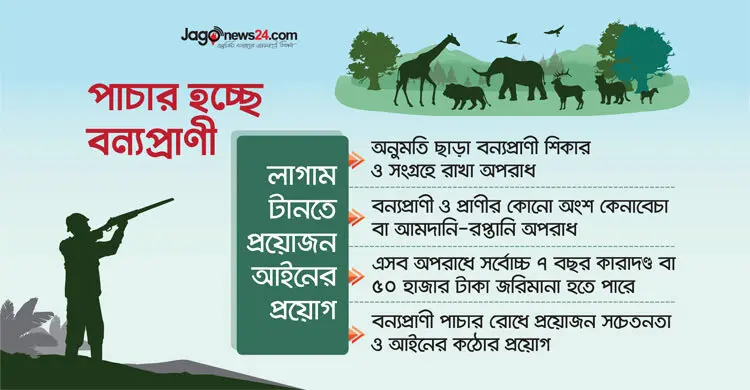
Wildlife is often seen being sold by the roadside. The trade goes on openly and freely. Ordinary people pay it little heed, and members of law enforcement agencies often ignore it too. Lack of knowledge of the wildlife conservation and security law and lack of awareness are mainly driving the crime. But it is not only sold openly: many wild animals are also sold and trafficked in secret, and Bangladesh is one of the main routes for wildlife trafficking. As a result, large numbers of wild animals are hunted and trafficked every year. Those involved believe public awareness and strict enforcement of the law could stop illegal wildlife trafficking.
Recent arrests in Dhaka
Police recently rescued two langurs in Jatrabari in the capital and arrested two people. One of the rescued animals was a capped langur (mukhpora hanuman) and the other a spectacled langur (chashmapora hanuman). Three young men were waiting with the two illegally caught langurs in front of the Dholpur Maternity Hospital to sell them. Acting on a tip-off, police arrested two, Kausar, 33, and Shaj Uddin, 19, while the third man with them fled.
Jatrabari police station SI Mukit Hasan filed a case against the accused under sections 26(1A) and (F) of the Forest Act 1927, sections 6(1) and 34(kha) of the Wildlife (Conservation and Security) Act 2012, and sections 25(B) and (D) of the Special Powers Act 1974. The court then sent the two arrested men to jail.
On 20 September, police rescued two tokay geckos in the Kutubkhali area under Jatrabari police station and arrested a young man named Newton. The young man, from a small ethnic community, told police the geckos had been brought from Khagrachhari and were to be handed to a man from Faridpur. Jatrabari police station SI Monir Hossain filed a case against Newton under the Forest Act, the Wildlife Conservation and Security Act and the Special Powers Act.
Few cases filed
Five cases over wildlife hunting and trafficking were filed in Dhaka metropolitan area from January 2022 to 21 September 2023, according to the prosecution division of Dhaka Metropolitan Police (DMP). Police of the stations concerned were the plaintiffs. One case each was filed at Paltan police station on 20 June, 1 August and 27 August 2022, and one each at Jatrabari police station on 4 September and 20 September 2023. Before that, six such cases were filed in 2021: one at Motijheel police station on 22 October, one at Ramna Model police station on 16 October, one at Jatrabari on 29 October, another at Jatrabari on 11 November, one more at Jatrabari on 7 December and one at Sabujbagh police station on 18 December.
The number of cases alone does not give an accurate picture of wildlife trafficking, because very few cases are filed compared with the number of animals trafficked each year. Police usually take action and file a case when a complaint comes in, but very few such complaints come, because most people are not aware that hunting and trafficking wildlife is illegal and punishable by law.
13 districts named in Cambridge study
On 25 November last year (2022), a research report titled "Exploring Market-Based Wildlife Trade Dynamics in Bangladesh" was published on the University of Cambridge website. The research, carried out under the University of Cambridge, says wildlife is openly bought and sold in 13 districts of Bangladesh. Animals caught in these districts are brought to Dhaka and Chattogram and then trafficked within the country and abroad for large sums of money.
The report says live animals from Bangladesh are trafficked mostly to neighbouring India and Myanmar. They include the Royal Bengal tiger, capped langur, slow loris, venomous snakes, tokay geckos and small reptiles. These animals are also trafficked to Thailand, Singapore, China, Malaysia, Vietnam and Laos.
Wildlife is sold and trafficked not only in secret but also openly. Open and hidden wildlife markets have grown up mainly in areas around forests, where prices are agreed in advance and the traffickers then catch the animals from the forest and sell them.
The 13 districts named in the report are Satkhira, Bagerhat, Chapainawabganj, Kushtia, Mymensingh, Sylhet, Kishoreganj, Manikganj, Gopalganj, Rangamati, Cox's Bazar, Bandarban and Gazipur.
Wildlife is not sold in any one fixed place. Body parts of these animals are commonly traded in crowded places such as bus stands, haats and bazaars. Oil and body parts of pangolins, mongooses, snakes and other animals are usually sold, and many buyers believe they work as medicine. Wildlife skins, teeth and claws are also widely used to make bags, belts, home furnishings, gift items and jewellery. With such demand for live and dead wildlife, trafficking and trade are booming.
Many wealthy people in the country keep wild animals without permission, and some homes display wildlife body parts such as rhinoceros or deer horns, elephant tusks and tiger skins. Some collect such animals or parts as a hobby or to display status. It is alleged that a large share of these animals or parts is collected illegally.
Calls for enforcement
Those involved want the law applied properly to stop wildlife hunting and trafficking. They believe bringing the accused to justice and ensuring punishment will reduce trafficking.
Wildlife researcher Shahriar Caesar Rahman told Jagonews that wildlife trafficking is an international problem and a big problem for Bangladesh, and that the government's goodwill is needed to stop it.
Tapas Kumar Pal, additional public prosecutor (APP) at the Dhaka Metropolitan Court, told Jagonews that wildlife trafficking is a heinous crime. The law must be enforced to stop it, and bringing the accused to justice will reduce trafficking considerably, he said.
The investigating officer in this year's langur rescue case at Jatrabari police station is SI Rasedul Islam. He told Jagonews that the preliminary investigation had established that the accused caught the langurs and kept them in their custody to traffic them abroad. Many others are involved with them, and efforts are under way to arrest them, he said.
Sharmin Jahan Tumpa, the lawyer for the accused in that case, told Jagonews that Shaj Uddin has long earned his living showing tricks with langurs, and was arrested on 4 September when he came to perform in front of the Dholpur Maternity Hospital in Jatrabari.
The lawyer said the accused Kausar knew nothing about the matter. He was passing through the area at the time and was arrested by police on suspicion. "I hope he will get bail," she said.
What the law says
Section 6(1) of the Wildlife (Conservation and Security) Act 2012 says no one may hunt or collect any wild animal without a licence or permit under the act. Likewise, no plant may be intentionally picked, uprooted, destroyed or collected without permission.
The penalties
Section 34(kha) of the act says buying, selling, importing or exporting any wild animal, part of a wild animal, its meat, or any product derived from it or forest produce from anyone without a licence or permit is an offence. Buying, selling, importing or exporting any plant or its products without a licence or permit is also an offence. The penalty is up to one year in prison or a fine of up to Tk 50,000, or both. For a repeat offence, the penalty is up to three years in prison or a fine of up to Tk 2 lakh, or both.
Section 25(B/D) of the Special Powers Act 1974 says bringing (importing) certain goods into Bangladesh is prohibited under laws in force. Selling or displaying such goods, or keeping them in possession or control for sale, is a punishable offence, carrying a prison term of one to seven years.
Source: Jagonews24. First published in Bengali on The Agro News.
Comments
(0)