
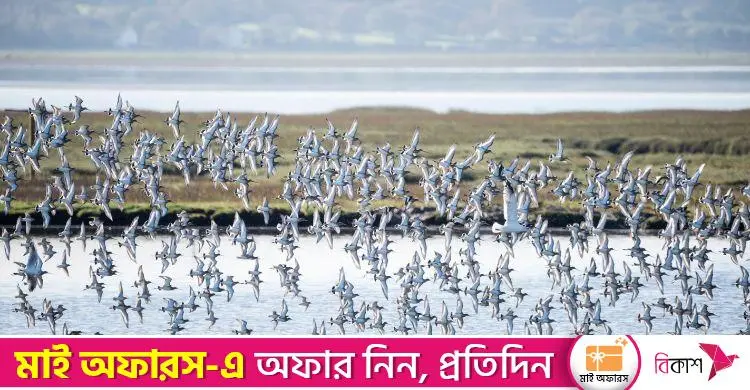
Bangladesh is a land of extraordinary natural beauty. Nature has generously adorned the country: here the scenery of the hills, there green forests, elsewhere fields of crops stretching to the horizon, and elsewhere again the wide waters of haors and baors.
Taken together, Bengal truly appears in a rare beauty, and the many birds and animals that roam it make nature more enchanting still. Bangladesh is a land of rice and songs, and a land of birds and animals too.
Over time, however, forests are being cleared. With big trees gone, many of the country's bird species are disappearing. Even so, Bengal's pride as a land of birds and animals remains.
We still wake to birdsong and are charmed by birds' chatter. Rows of egrets have not vanished. The cuckoo's call in spring is sweet, and green-and-red parakeets perching on a carambola tree to eat its fruit still delight us.
So Bengal is not only green with crops. Many kinds of birds live in trees, woods, hills and mountains, their music filling the skies of Bengal and inspiring poets to verse at the cuckoo's call.
Many familiar birds are our daily companions: cuckoo, parakeet, myna, shalik, doel, egret, kingfisher, dove, weaver bird, sparrow, "bou kotha kao", chatak, drongo, bulbul and many more. Moving in flocks, they make nature beautiful and fill the fields of Bengal with their calls.
In the morning birdsong wakes us, and in the evening their chatter closes the noise of the day. Flocks in flight give nature another look, and the calls of birds and wild animals in the green forest create an enchanting atmosphere that can move even a troubled mind.
That is why birds and wild or domestic animals feature so strongly in the work of nature-loving poets. Birds do not only feed our sense of beauty; they also make a great contribution to filling nature with flowers and fruit.
Pollinators and guests
Birds contribute especially to the pollination of flowers and crops, or more precisely to the process of reproduction and production, which is very important economically. In addition, many species of migratory birds come to our country in different seasons.
In winter, unable to bear the cold, thousands of birds fly thousands of miles from Siberia and other cold regions in search of a little warmth. These guests arrive at Hakaluki, Hail Haor and other haors and baors, and at the Jahangirnagar campus. The arrival of our own birds and migratory birds creates a different kind of scene in nature.
The migratory birds and their play in the water dress nature in a different look. Haors, baors and lakes ring with their wingbeats and calls, and when winter ends they fly back to their homelands.
The calls of migratory birds already fill the surroundings. But everyone needs to stay alert so that hunters' greedy eyes do not fall on them, and so that this beautiful ornament of nature, which keeps the natural balance, is not destroyed.
Birds also help economic progress. Yet the reality is that humanity is gradually wiping out this great benefactor for its own needs, which amounts to self-destruction. An environmental organisation has raised just such a worrying matter.
In its words, for lack of a favourable environment and habitat, the world's common birds and wildlife are steadily disappearing, with dire consequences.
Global declines
A survey report by the environmental organisation BirdLife International says 45% of common birds in Europe have disappeared. Australia's figures are even more worrying, with more than 80% of birds gone. It says at least 56 of 124 species in 20 European countries have disappeared in the past 26 years.
The rate of disappearance among birds of crop fields is 79%. The situation in Africa is also worrying, with countless birds and wild animals falling to hunters every year. In Asian countries the hunting of migratory birds is severe, and 62% of birds have been wiped out by hunters.
Researchers say hunters' greed is not the only cause of the destruction of birds. The destruction of biodiversity is another major cause: every day biodiversity is being harmed somewhere in the world, so birds and wild animals are losing their ranges, and food shortages are having an even more serious effect.
According to environmental organisations, the failure of governments to deliver the fund for protecting biodiversity that they promised at the Earth Summit is accelerating the extinction of birds and wildlife. In their words, 1,226 species in various countries are now at risk, of which 190 may soon become extinct. In recent years 99.9% of the white-feathered Indian kite has disappeared altogether.
Because of poison bait in crop fields and the use of the anti-inflammatory drug diclofenac in treating livestock, the Indian white kite is now close to zero. The waste of livestock given diclofenac-type drugs becomes toxic, and kites and vultures that eat it die. Hunting and trade are also driving species in our own country to extinction.
Tigers and elephants
The Royal Bengal tiger, Bangladesh's symbol of pride, is now on the road to extinction, with numbers falling at an alarming rate every year. According to the latest survey there are only 115 tigers in the Bangladesh part of the Sundarbans. In 2004 the number was 440. The report says the number fell by 334 in just 11 years.
According to the Forest Department, about 70 tigers have died in the Sundarbans since 1980 from attacks by poachers and forest pirates, beatings by villagers and natural disasters. By its records there were 453 tigers in the Sundarbans in 1982, falling to 440 in 2004.
According to the latest information, the report says, the tiger count is 106. On the other hand, a survey conducted by the UN Food and Agriculture Organization says there are 369 tigers in Bangladesh.
According to the Forest Department, a camera-trap survey found 83 to 130 tigers in the Bangladesh and Indian Sundarbans, meaning that on average the actual number in the Bangladesh part is at most 115.
While Asian elephants are claimed to number 40,000 to 50,000 worldwide, in Bangladesh there are no more than 200. This threatened friend of nature has been identified as critically endangered. Elephant experts say numbers are falling because of human encroachment on elephant ranges, food shortages in nature and other reasons.
The IUCN says elephant numbers have halved over three generations. Asian elephants are found in Bangladesh, Bhutan, India, China and Indonesia, but their numbers are falling, with deforestation and poaching for tusks among the main causes.
Elephant hunting, theft and smuggling are also rising. According to information published in 2012 by the International Union for Conservation of Nature, humans killed 47 elephants in the 10 years from 2003 to 2012. In the last 10 years, elephant numbers in Bangladesh have halved from 400, meaning there are now fewer than 200.
Vultures, turtles and frogs
Two hundred bird species are under threat, among them the vulture, whose numbers keep falling in the country. Vulture numbers have fallen by 98% since the 1970s. There were 50,000 vultures before independence; now there are fewer than 300 in all.
The use of drugs such as diclofenac and ketoprofen in treating livestock is one of the main causes of the vultures' decline, along with loss of habitat and food. Even in areas declared safe for vultures, they are not safe. Without awareness, this animal that keeps the environment in balance may disappear from Bangladesh for ever.
A few decades ago vultures could be seen in every village; now the bird is hard to find. Three species of vulture lived permanently in the country, one of which has already gone extinct, and the native Bengal vulture is also on the road to extinction.
According to the Forest Department, there are 23 vulture species in the world. Six species were once seen in the country, three of them resident. The Bengal and slender-billed vultures have survived their struggle with nature, but the resident king vulture has become extinct.
In 2003 American researcher Dr Lindsey Oak proved that vultures die of kidney failure within 24 hours of eating the carcasses of cattle and goats treated with diclofenac sodium. As a result, India and Pakistan in 2006 and Nepal in 2009 stopped diclofenac sodium and began using meloxicam and other alternatives instead.
The Bangladesh government banned the production and use of diclofenac sodium in livestock treatment in 2010, but it is still used in some places.
Many species of turtle are disappearing from the country. Freshwater turtles and the world-famous Bostami turtle face an existential crisis. The Bostami turtle is hard to find anywhere in the world except at the shrine of Bayezid Bostami in Chattogram, and even in the shrine's pond their numbers have fallen. The pond beside the shrine is now home to 150 to 350 turtles.
Turtles could once be seen in old ponds across the country, as at the shrine, but are now hard to find. As elsewhere, freshwater turtles have declined in the Mymensingh region. According to statistics, 28 species of turtle were once found in the country: five marine species, two hill species and 21 species of freshwater turtle in canals, wetlands, haors and other inland waters.
An IUCN survey in 2000 listed 20 of the country's freshwater turtle species as endangered. In 1998 the Bostami turtle was named among the most endangered animals.
In the past 35 years, 200 species of frog have been lost, a loss that should have taken the next 500 years. Frogs have declined in the country before their importance was understood. The exact number cannot be determined, but environmentalists fear pesticide use is the reason. Frogs also continue to be killed for food and export. It is thought that if the surviving frog species cannot be protected, the first blow will fall on the ecosystem.
According to the Forest Department, 14 notable animal species have become extinct in Bangladesh in recent decades: the striped hyena, grey wolf, barasingha or swamp deer, blackbuck, nilgai, gaur, banteng (a kind of wild cattle), wild water buffalo, Sumatran rhinoceros, Javan rhinoceros, Indian rhinoceros, native peafowl, pink-headed duck and freshwater crocodile.
People are the cause
A lack of love for animals is one of the main reasons they are disappearing. There is a habit of throwing stones at a bird, snake or frog on sight, and a mindset of hunting. People are a main reason animals are losing food and habitat: for human needs, animals are becoming food on one hand and luxury goods on the other.
People are affecting biodiversity directly and indirectly. Forests are being cleared to expand farmland, and population growth is unsettling the environment. Shortages of habitat and food are also reducing the numbers of many species.
It is impossible to imagine how many deer are still hunted from the Sundarbans. Many well-off people in Dhaka still eat venison. Without deer there will be no tigers in the Sundarbans; the shrinking of the tigers' food is one of the main reasons for their decline.
Environmental organisations are demanding that governments quickly complete raising the funds as promised. Otherwise, with the alarming decline of biodiversity, the earth will gradually become unfit for human habitation. So let us all become aware to save birds and wildlife, the ornaments of nature, and keep nature's beauty intact.
Source: Jagonews24. First published in Bengali on The Agro News.

Comments
(0)