
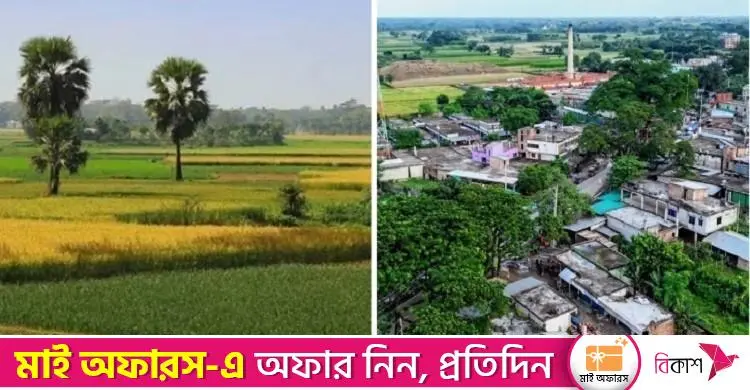
The state of our agriculture and farmers is growing more difficult by the day. A huge amount of the country's land is going to non-agricultural uses. If this goes on, the fear that one day there will be no land left to farm is not unfounded. Bangladesh, one of the most densely populated countries in the world, still depends on agriculture, and its economy still rises and falls with farm output. Yet day by day farmland is going to non-farm uses. Most land is lost to new homesteads, roads and infrastructure, brick kilns, factories and acquisition for urbanisation. If land degradation continues at the current rate, Bangladesh will have no farmland left by 2050. Agriculture has kept the country fairly stable even amid global recession and turmoil, so protecting farmland is urgent, and a national land-use plan and policy are needed to ensure land is used properly.
The trend of using farmland for non-farm purposes must be firmly stopped. In agriculture-dependent Bangladesh, survival will be hard if farmland is not protected. Farmland keeps shrinking: since independence it has halved, while the population has grown more than two and a half times. Fifty-four years ago Bangladesh was already one of the world's most densely populated countries. With the population growing two and a half times, a great deal of farmland went to building homes, and building roads, markets, schools and offices cannot avoid using farmland either. Farmland is also widely used for industry.
What the surveys show
The Bangladesh Bureau of Statistics (BBS) agriculture census also confirms the loss. In December 2022 the BBS published the "Agriculture Census 2019", which found that cultivable land fell by 4 lakh 16 thousand acres in 11 years, from 1 crore 90 lakh 97 thousand acres in 2008 to 1 crore 86 lakh 81 thousand acres in 2019. A research report by the Soil Resource Development Institute (SRDI), titled "Trends of Agricultural Land Loss in Bangladesh", says 69,760 hectares of cultivable land go to non-farm uses every year, and infrastructure construction alone takes 3,000 hectares a year.
Under the National Land Use Policy 2010 and the Agricultural Land Protection and Land Zoning Act 2010, farmland may not be used for anything other than farming. But for lack of alternative land, farmland is being filled in for homes, factories, brick kilns and other non-farm structures. Protecting farmland is essential for survival, above all for food production. Bangladesh once earned the pride of food self-sufficiency through the sweat of its farmers, yet that cultivable land is now shrinking fast. Every day fertile village land is sold to housing companies, fields are filled in for roads, and land goes to industrial projects.
Government statistics say about 70,000 hectares of cultivable land go to non-farm uses each year, meaning about 219 hectares are lost every day. Experts fear that if this continues, food security for the coming generation will face a major crisis. The reason for their concern: after independence Bangladesh had about 2 crore 17 lakh hectares of cultivable land and a population of just 7 crore 90 lakh. In 2000 the land fell to 80 lakh 18 thousand hectares and the population rose to 13 crore. In 2017-18 farmland fell to 80 lakh hectares. According to 2023-24 figures, the country has about 79 lakh 46 thousand hectares of cultivable land and a population of about 18 crore. In other words, farmland has fallen by more than about 1 crore 37 lakh hectares since independence.
Differing figures
The agriculture department says land is shrinking because ponds are dug on farmland, homes are built, and roads, bridges and culverts are built in new areas. A World Bank report says that, according to 2023 data, Bangladesh's total cultivable land is 2 crore 1 lakh 57 thousand acres, or 80 lakh 30 thousand hectares. With a total population of about 18 crore, cultivable land per head comes to 0.44 hectares. Because of house and road building and other causes, about 80,000 hectares of the country's land go to non-farm uses each year. With no precise survey in the country, the figures for cultivable land do not match.
According to various sources, the country is losing farmland at about 1 per cent a year, or about 219 hectares of cultivable land a day. By the estimates of the BBS and the agriculture department, farmland shrinks by 68,700 hectares a year, roughly 1 per cent annually. The SRDI report "Trends of Agricultural Land Loss in Bangladesh" says that in the 12 years after 2000, 68,760 hectares of cultivable land went to non-farm uses every year, and infrastructure alone took 3,000 hectares. The National Land Use Policy 2010 and the Agricultural Land Protection and Land Zoning Act 2010 say farmland may not be used for anything but farming, and that no homes, factories, brick kilns or other non-farm structures may be built by filling in farmland, but the law exists in name only.
The Ministry of Environment, Forest and Climate Change says Bangladesh had 90 lakh 15 thousand hectares of actual cropland in 1982-83, which fell to 80 lakh hectares in 2017-18. On average about 69,000 hectares of cultivable land go to non-farm use every year. Rapid population growth and rising demand are cutting land per head and shrinking farmland, forests and wetlands. DAE data show that the country's cultivable land now stands at 79.46 lakh hectares, 53 per cent of it double- or triple-cropped. But farmland is the first to be acquired for infrastructure, brick kilns, factories and new homesteads.
Private researchers say irrigated farmland covers 74 lakh 48 thousand hectares and cropping intensity is 194 per cent. Rice production in fiscal 2019-20 was 3 crore 66 lakh 38 thousand tonnes. Total cereal production in the same year was 4 crore 30 lakh 36 thousand tonnes, rising to 4 crore 66 lakh 35 thousand tonnes in 2020-21. Farm output has grown mainly because of hybrids, agricultural research and new seed varieties. According to the Land Survey Department, the country had 2 crore 17 lakh hectares of cultivable land in 1971, which now stands at just 81 lakh 58 thousand hectares. Bangladesh's population was 7 crore 90 lakh in 1971, 13 crore in 2000 and now 18 crore.
Losses by region
Statistics show that every year 15,945 hectares turn into non-farm land in Rajshahi division, 15,131 hectares in Dhaka, 11,096 hectares in Khulna, 8,781 hectares in Rangpur and 6,661 hectares in Barishal. In Chattogram division 17,968 hectares a year go to non-farm uses. Urban planner Engineer Delwar Hossain Majumder, former president of the Institution of Engineers Chattogram, said: "When we became East Pakistan in 1947, this region of 4 crore people had a food deficit. After independence in 1971, Bangladesh with 7 crore people still had a food deficit. Now Bangladesh with 18 crore people is largely self-sufficient in food. That is the fruit of the tireless work of people from farmers to agricultural scientists. But unplanned urbanisation and handing unethical advantages to some people are shrinking farmland fast."
Pointing to the negative effects in villages too, he said: "As families split, members leave the old homestead and build new ones on farmland. That too is reducing farmland. The government should protect farmland by building multi-storey buildings on old homesteads. Long-term zero-interest loans could be arranged for multi-storey homes." Agricultural economist Dr Jahangir Alam showed in a study how much land was lost each decade: land fell by an average of 0.97 per cent a year in 1984-1996, 0.74 per cent in 1996-2008 and 0.21 per cent in 2008-2019. Over the past 35 years farmland has fallen by an average of about 0.35 per cent a year.
At the regional level, cultivable land in the Rajshahi region fell from 7.42 lakh hectares in 2008-09 to 7.18 lakh hectares in 2023-24. In Naogaon district, cultivated land fell from 2.74 lakh hectares in 2015 to 2.63 lakh hectares in 2025. The Chattogram region has lost about 52,000 acres of farmland over the past decade, mainly to port-based industrialisation and infrastructure projects. Khulna division lost about 15,000 hectares in a decade, and some upazilas have lost half their cultivated land. The Dinajpur region lost 3,232 hectares in six years, with housing projects the biggest threat there. In Khagrachhari the number of houses doubled in a decade, and farmland has fallen below 1 lakh acres. The main causes are housing projects and new settlements; industry, brick kilns and factories; roads, bridges, culverts and other infrastructure; digging ponds and dividing family homesteads; and unplanned urbanisation and irregular land use.
Output, costs and forests
With less land, production of wheat, Boro and Aman rice, sugarcane, jute, pulses and other crops is falling, although hybrids and new research are raising output. Rice production was 3 crore 66 lakh tonnes in 2019-20; it rose in 2020-21, but the growth did not last because of land loss. Data from the Bangladesh Agricultural Research Council show that over the past seven years farm production costs have risen 3.5 per cent while farm prices have risen only 1.31 per cent. Farmers are counting losses, and many are selling their land and moving to other occupations. Forests and biodiversity are also under threat: forest land fell by 5.41 per cent in 2015-23, and although social forestry has grown, it has not made up for the loss of natural forest, putting biodiversity and wildlife at risk.
Engineer Delwar Hossain Majumder believes unplanned urbanisation and unethical advantages for some people are shrinking farmland fast, and that the division of land for homesteads in villages is also reducing it. The government, he says, should encourage multi-storey buildings on old homesteads and offer long-term zero-interest loans for this. Professor Ashikur Rahman of Khulna University said the way housing projects are springing up at upazila level is very alarming, and an integrated plan is urgently needed to protect food security. Experts say industrial and housing projects on triple-cropped land must be stopped, satellite towns should be built at upazila level to ease urbanisation pressure, minimum prices for farm produce should be announced, and government khas land should be identified and brought under cultivation.
Bangladesh once became self-sufficient in food. But rapidly shrinking farmland, rising production costs and the pressure of urbanisation now threaten that achievement. To protect food security, both farmland and farmers must be saved now, or filling the next generation's plate of rice will become hard. At the same time, homes, roads, structures and factories must still be built. To meet this challenge, planned housing is needed everywhere from village to city. Building multi-storey homes on less land would stop the careless use of farmland for housing. Reclaiming land from the sea should also be considered.
The writer is a researcher and a former college principal.
Source: Jagonews24. First published in Bengali on The Agro News.
Comments
(0)