
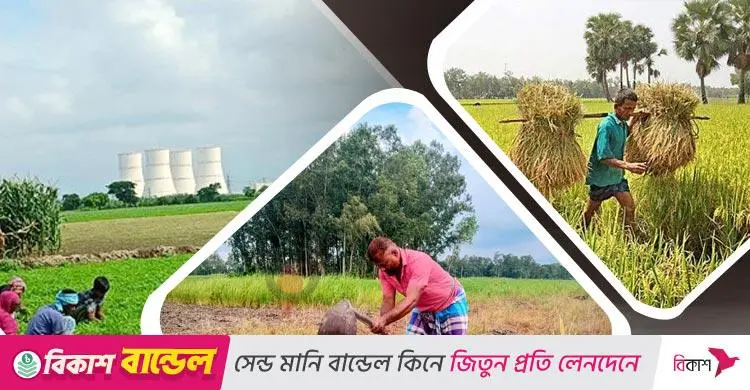
Agriculture is the main occupation of most people in this country. About 80 per cent of people are directly or indirectly involved in it; agriculture is the country's lifeblood. The population of this densely populated country keeps rising, while farmland shrinks constantly because of unplanned urbanisation and industrialisation, land grabbing, river erosion, housing and infrastructure. Experts say food security will be threatened as a result. Natural disasters such as drought, floods, tidal surges, salinity, cold waves and heavy hailstorms already hamper crop production, mainly because climate change is increasing cyclones, storm surges, river erosion and other disasters in Bangladesh. Farmers try to grow crops in the face of all this, and the condition of agriculture and farmers is becoming more miserable by the day. A huge amount of land is going to non-farm uses. If this continues, the fear that land for cultivation may one day run out is not baseless.
Bangladesh, one of the most densely populated countries in the world, still depends on agriculture, and its economy is still determined by the rise and fall of farm output. Yet farmland is steadily going to non-farm uses. Land is degraded most by acquisition for new homesteads, roads and infrastructure, brick kilns, factories and urbanisation. If land degradation continues at the current rate, Bangladesh will have no farmland left by 2050. Meanwhile, amid global recession and instability, agriculture has kept the country relatively stable. Protecting farmland is therefore urgent, and a national land-use plan and policy is needed to ensure land is used properly. The tendency to use farmland for non-farm purposes must be firmly stopped.
Farmland halved since independence
In agriculture-dependent Bangladesh, survival will be hard if farmland protection fails. The amount of farmland keeps falling: since independence it has halved, while the population has grown more than two and a half times. Fifty-four years ago Bangladesh was already one of the most densely populated countries in the world. With the population growing two and a half times, farmland has been widely used to build homes for the extra people. Using farmland for roads, markets, schools and offices cannot be avoided, and it is also used extensively for industry.
The Bangladesh Bureau of Statistics (BBS) agriculture census has also confirmed the fall. According to it, arable land fell by 4,16,000 acres in 11 years, from 1,90,97,000 acres in 2008 to 1,86,81,000 acres in 2019. A research report by the Soil Resource Development Institute, titled "Trends of farmland loss in Bangladesh", says 69,760 hectares of arable land go to non-farm uses every year, and 3,000 hectares a year are lost to infrastructure alone. Under the National Land Use Policy 2010 and the Agricultural Land Protection and Land Zoning Act 2010, farmland may not be used for anything but farming. But for lack of alternative land, farmland is being filled in for houses, factories, brick kilns and other non-farm structures. Protecting farmland, especially for food production, is undeniably necessary for survival, yet houses, roads, buildings and factories must also be built. To tackle this, planned housing must be introduced everywhere from village to city. Multi-storey buildings on less land should end the careless use of farmland for homes, and reclaiming land from the sea must also be considered.
According to BBS, the country's total land, including arable land, forests, rivers and lakes, is 1,47,60,000 hectares, of which farmland is 85,20,000 hectares. According to a statistic from Equity BD, 89,000 hectares a year are turning into non-farm land in Bangladesh because of urbanisation, industrialisation and river erosion. If this continues, 50 per cent of the country's total land will go to settlements alone by 2030. In 1960 just 10 per cent of families owned 37 per cent of the country's land; now 70 per cent of families own only 15 per cent of farmland. Even so, in 1960, 19 per cent of people were landless.
Landlessness and food security
According to BBS, 25.8 per cent of people in the country are now landless, and 26 per cent regularly suffer food insecurity, meaning they are hungry most of the time. During the 2008 food crisis, even though the country had the dollars needed to buy food abroad, it could not buy at a fair price, because India, Thailand and Vietnam raised rice and wheat prices by 100 to 300 per cent. So there is considerable doubt whether food can be bought on the world market in future even with dollars in hand. The pride we take in food self-sufficiency could vanish before long, because neighbouring India's hostile water policy has already reduced the navigability of rivers and brought salinity to the coast, and farmers cannot grow crops properly.
Climate change is also keeping farmland yields below expectations. Urgent action is needed; otherwise, many believe, huge numbers of people will be displaced and a food crisis could follow, along with rising unemployment and poverty. Many who lose farmland will be forced into other occupations. Without a farmland protection law, people are destroying land however they can. The state has no integrated plan to protect land either, although the government had set a target of land zoning by 2017. Civil society believes the government should have no doubt about how quickly the misuse of farmland can be stopped.
Once the bulk of the country's land was the main source of its food. Sadly, given how fast land is shrinking because of unplanned urbanisation, industrialisation, infrastructure and housing, ordinary people believe protecting farmland is urgent. We often say in the media that Venice and cities in other countries are beautiful, but there the government and people together keep their canals and rivers in their natural state, while we are destroying canals and water bodies across the country. Dhaka once had 70 water bodies; through our own wrongdoing that has fallen to 20 to 25. Using up existing land rather than increasing farmland is nothing short of self-destructive.
What other countries do
Many countries urbanise and industrialise while protecting farmland. In several Middle Eastern countries, canals are dug at great cost to grow crops in the desert. In Vietnam, flyovers are built over land between cities to protect farmland. By contrast, in our country seeds left on the ground sprout easily without any cultivation, yet this boundless gift of nature is being wilfully destroyed year after year. Such fertile land is rarely seen anywhere else in the world. Where there is great scope to achieve food self-sufficiency and export surplus crops, this destruction of farmland cannot be acceptable.
Bangladesh has a very large population for its land. The population grows by about 25 lakh a year, but farmland does not grow by even one per cent; rather, one per cent of the area is being lost. Islands occasionally rise in the sea and chars in rivers, but when they will become cultivable cannot be said. So we must focus on our existing farmland; if it slips away, the crisis will certainly become severe. The Ministry of Land must therefore immediately take the necessary steps to enact and enforce a farmland protection and land-use law. Agricultural khas land must be allotted to landless farmers. Non-agricultural khas land must not be allotted for any non-farm use other than development work, and such a provision must be introduced and enforced. Farmland must be saved from grabbers, and a broad awareness campaign must be run, in which journalists can play a leading role.
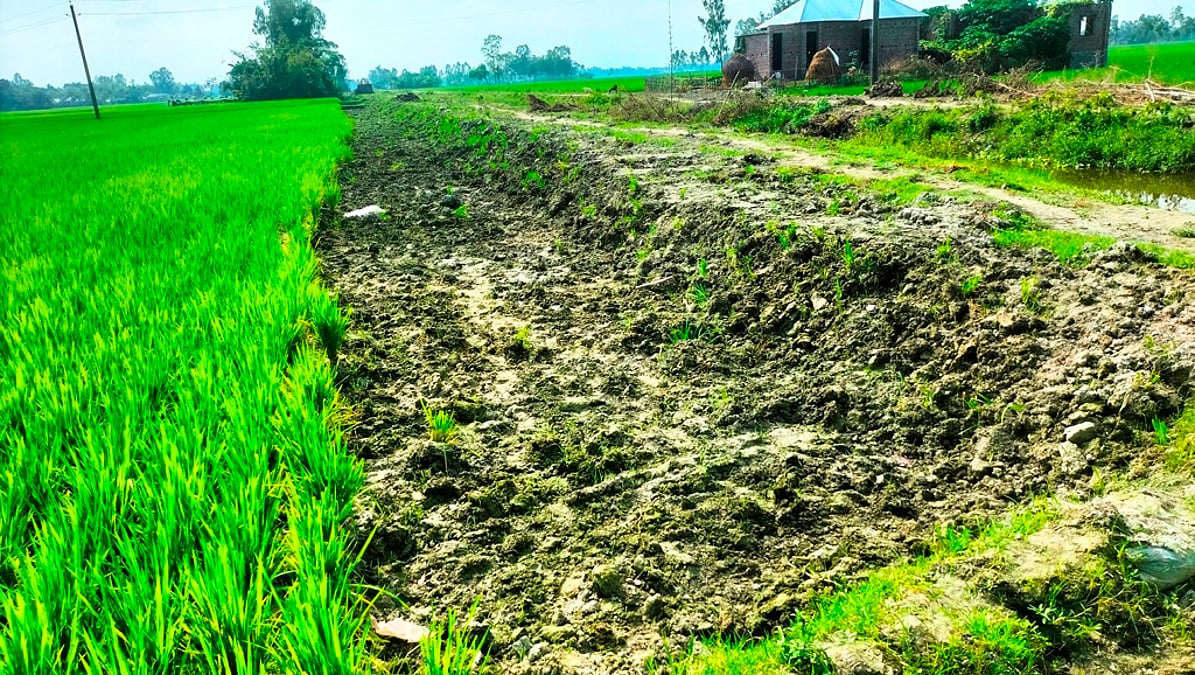
There is a risk that the country's total cultivated land will be halved within a few years because of settlement. Farmers cannot produce enough because farmland is scarce, and civil society fears that even with taka or dollars in hand, enough food will not be available, since there may be no surplus food for sale. Urbanisation and industrialisation must be planned so as to protect farmland. It is deeply regrettable that in various parts of the country some unscrupulous brick kiln owners are constantly cutting soil en masse from fertile farmland for a little money. Experts say that unless such soil cutting is stopped now, the food crisis may become even worse. Some controversial bureaucrats and politicians are also building fish projects and resorts at the expense of farmland; the government must take strict action against them and quickly enact and implement a specific law to protect farmland.
Unplanned urbanisation, industrialisation, housing and infrastructure must be reined in and carried out in a planned way that spares farmland. The land that feeds people must be protected at any cost, and the government must take effective steps immediately. Many civilisations have been wiped out by human recklessness; if we do not learn, we will meet the same fate. Multi-storey buildings should be built to meet housing demand and ease the pressure on farmland. Experts say farmland must be protected through planned rural urbanisation and housing technology. In the current pace of development, what we really need is planned villages.
The writer, Dr Forkan Ali, is a researcher and former principal.
Source: Jagonews24. First published in Bengali on The Agro News.
Comments
(0)