
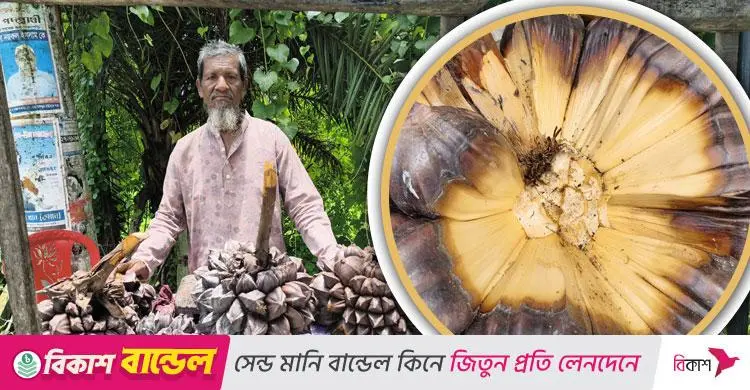
Golpata is a plant that grows untended in the salt water of coastal areas, and its fruit is giving local people an extra source of income. The fruit is now sold commercially in front of the historic Sixty Dome Mosque in Bagerhat, where at least 10 vendors sell it alongside green coconuts.
On the spot, some vendors had arranged the fruit on vans and others had tied it up at small tea stalls. Visitors from across the country and abroad crowd round the stalls, and the fruit is drawing a strong response. Some said they were seeing it for the first time; others had read about it in books. Because it is little known outside the coast, many were keen to find out about it.
A mangrove palm
Golpata is a coastal palm that grows in almost all mangrove areas. Its leaves are about 3 to 9 metres long. It grows in Bangladesh, Malaysia, the Philippines, Vietnam, Singapore, Thailand, Indonesia, Australia, Borneo, Papua New Guinea, Cambodia and Myanmar.
Besides the Sundarbans, the plant is found beside rivers, canals and wetlands in Bagerhat Sadar, Morrelganj, Sarankhola, Chitalmari, Rampal and Mongla. It is mainly used for roofing houses on the coast. Such a roof keeps a house cool in the heat and comparatively warm in the cold, and lasts about 3 to 4 years.
Several bunches grow from beneath the leaves, each holding 50 to 150 fruits. The fruit is known locally as golfol. Coastal communities began eating it simply out of interest. It tastes much like the soft kernel of the palmyra (taal) fruit and is 3 to 4 inches long.
Vendors and visitors
Abdur Rahman, a golfol seller in front of the Sixty Dome Mosque, said: "I have been selling golfol for 6 to 7 years. At first I earned more, but now that there are more stalls, earnings have fallen a little. Still, alongside green coconuts it helps as an extra income."
Mainul Islam, from Shonir Akhra in the capital, said: "I came with my family to see the Sixty Dome Mosque and found this new fruit on sale. I tried it; it is a lot like taal kernel."
Tanvir Siddiqui, another visitor from Gazipur, said: "This fruit is not found in our area. Seeing everyone else, I tried it too. It is cooling, but it tasted somewhat salty. I am thinking of buying some to take home."
Tonmoy Dutta, the Sadar upazila agriculture officer, said: "Because this fruit grows only on the coast, visitors buy it with great interest. But if vendors cut too much fruit, there is a risk that the plants will decline. Since the plant grows naturally from the fruit, those involved are being advised to be careful about this as well."
Source: Jagonews24. First published in Bengali on The Agro News.

Comments
(0)