
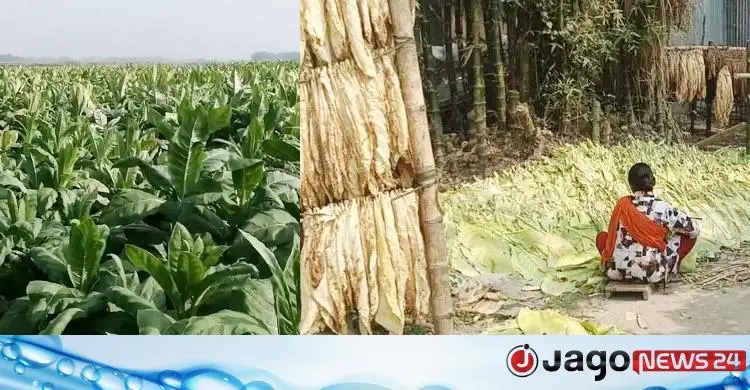
Land under tobacco is growing in Bangladesh day by day. Farmers receive one-off financial support from tobacco companies, which makes them comfortable growing the crop, and on the strength of those payments they keep expanding it. The spread of tobacco farming is a matter of deep concern for public health: it does harm not only indirectly through smoking and tobacco use, but from the farming process itself.
The main reasons tobacco farming is a warning sign for public health are as follows.
Harm to farmers, water and land
When farmers handle tobacco leaves, raw nicotine passes through the skin directly into the blood. This is called green tobacco sickness. It causes nausea, dizziness, severe weakness and, in the long term, complex problems such as breathing difficulty. Those who have farmed tobacco for many years become tolerant and do not notice the harm, but over time they fall ill.
Tobacco farming uses large amounts of chemical fertiliser and high doses of pesticide. Rain washes these pesticides into water bodies, harming fish and sources of drinking water, and livestock eat them along with grass.
Curing the leaves takes large quantities of wood burned in thousands of kilns. This destroys forest and raises the level of carbon dioxide in the atmosphere, which indirectly affects public health.
Growing tobacco on fertile land prevents the cultivation of food grains or pulses, which undermines food security in the long run.
More tobacco farming also means a greater supply of cheap tobacco products on the market, which can lead to non-communicable diseases such as cancer (of the lung and mouth), heart disease (heart attack and stroke) and chronic lung disease.
Women and children are often used in tobacco processing. Research has found that children living in tobacco-growing areas suffer more breathing problems, and that among pregnant women the risk of miscarriage and the rate of children born with disabilities are much higher than normal. Besides reducing food cropping, tobacco creates a toxic cycle whose price is paid in public health. To secure lasting public health, it is urgent to encourage farmers to grow food crops instead.
Crops that could replace tobacco
Bangladesh has ample scope to grow profitable and environmentally friendly crops in place of tobacco. Because tobacco damages health, alternative crops are essential for farmers' long-term progress.
Tobacco is usually grown in winter, the rabi season. In that period wheat, pulses, oilseeds, spices and many other crops can be grown instead.
Tobacco-prone areas such as Kushtia and Nilphamari have great potential for spices. Garlic and onion, dried chilli and pulses are always in demand, and if stored properly farmers get good prices.
With strong demand for edible oil in the country, mustard and sunflower are highly profitable. Mustard can be harvested in a short time with little irrigation and needs less labour than tobacco, and Aman rice can follow it. Lentil, mung and grass pea increase soil fertility by adding nitrogen, whereas tobacco growers use excessive urea and MOP, which harms the soil.
Early winter vegetables such as cauliflower, cabbage, tomato and bean can bring farmers quick cash. There is scope for more than a hundred crops, including pulses, mustard, sesame, wheat, barley, potato, onion or garlic, tomato, coriander and black cumin, as well as orchards, all of which can give farmers cash income.
Tobacco uses a great deal of chemical fertiliser, damaging soil health and human health, and demands heavy physical labour from farmers. The risk of cancer and skin disease is double in tobacco farming, while other crops carry no such health risk. Bali-type tobacco is dried in the open air, and where it is dried the smell causes environmental damage and harms public health. Spending on fertiliser and pesticide is high, while other crops cost comparatively less.
What could be done
If farmers are given easy-term loans, quality seed and marketing support for alternative crops, through government or private channels, they could cut tobacco growing considerably. Incentives could be offered to tobacco farmers to switch, which would benefit them. Drying raw tobacco first in the sun and then only lightly in the kiln would greatly reduce the wood burned, while still producing leaf to the companies' requirements.
If drying, curing and storage were done away from homes, organised by the companies through tobacco growers' associations, the environment and public health would benefit. Two- or three-storey threshing floors and warehouses could be built if needed. The price of tobacco leaf should not be raised, because a higher price would draw more people into growing it. Closing tobacco companies would not be right either, as smokers might turn to other drugs, which could lead to a worse situation.
Following integrated pest management (IPM) in tobacco would reduce the need for excess chemical fertiliser and pesticide. Above all, tobacco is an intoxicant and consuming it is never good for the body. Some benefits of tobacco leaf for external use are known, and it has some scientific and medicinal uses, but its commercial or medical use is tightly controlled and research on it continues.
Source: Jagonews24. First published in Bengali on The Agro News.
Comments
(0)