
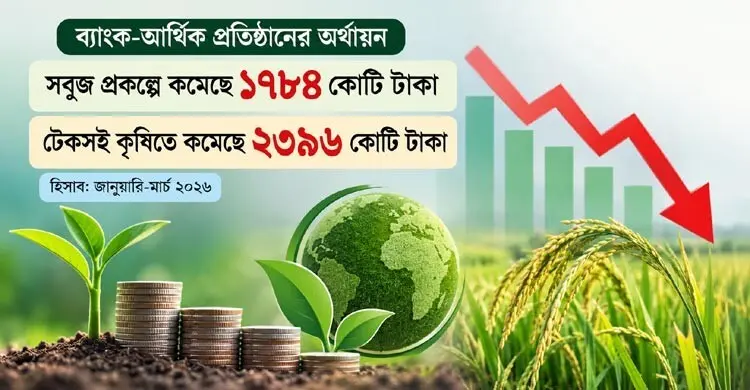
Banks and financial institutions have cut lending to green, or environment-friendly, projects and to sustainable agriculture, even though overall lending to sustainable development projects to tackle the effects of climate change has risen.
According to Bangladesh Bank's latest report on sustainable finance, total financing for sustainable projects stood at Tk 1,57,056 crore at the end of March this year, up from Tk 1,40,745 crore at the end of December last year. Sustainable finance rose by Tk 16,311 crore in three months.
In the January-March quarter, banks provided Tk 97,558 crore and financial institutions Tk 2,499 crore in sustainable finance, the report shows.
Green and farm lending down
The picture for green projects is different. Total financing by banks and financial institutions for green projects stood at Tk 5,196 crore at the end of March, down from Tk 6,980 crore at the end of December, a fall of about Tk 1,784 crore in three months. In the first quarter, banks provided Tk 4,663 crore and financial institutions Tk 534 crore to green projects.
The report also shows that financing for sustainable agriculture fell. It stood at Tk 8,228 crore at the end of March, down from Tk 10,624 crore at the end of December, a drop of about Tk 2,396 crore in three months.
Under Bangladesh Bank's sustainable finance policy, banks can lend for 68 types of sustainable products under 11 categories, covering sectors including agriculture, CMSMEs, environment-friendly industry and socially responsible enterprises.
Under central bank directives, banks aim to direct at least 20 per cent of their total loans to sustainable sectors and 5 per cent of their total term loans to environment-friendly or green projects. Green projects include solar power generation, effluent treatment plants (ETPs), environment-friendly brick production and other green ventures.
Bangladesh Bank regularly evaluates the activities of banks and financial institutions to increase sustainable and green finance, and publishes an annual sustainability rating based on various indicators.
Entrepreneurs cite costs and delays
Zahirul Islam Zahid, managing director of Alvi Fashion, told Jagonews: "The rise in sustainable finance is certainly positive. But in practice, entrepreneurs still face relatively higher costs, long approval processes and difficulty getting finance to carry out environment-friendly or green projects. That is why many entrepreneurs cannot move ahead with green investment despite their interest."
"The fall in green project lending indicates that existing policy support and incentives need to be strengthened," he said. "If long-term finance on easy terms, low-interest loans and quick loan approval can be arranged, investment in environment-friendly industry will rise significantly. That will increase the country's climate adaptation capacity on the one hand and make Bangladesh's exports more competitive in international markets on the other."
Helal Ahmed Jony, research fellow at the private research organisation Change Initiative and a banking sector analyst, told Jagonews: "The increase in sustainable finance is positive, but increasing the volume of loans alone is not enough. It must be ensured that the finance is used for genuinely environment-friendly and sustainable projects."
Calling the simultaneous fall in green finance a concern, he said: "To tackle climate risk, banks need more policy support, incentives and effective supervision to increase investment in renewable energy and environment-friendly industry."
Warning against fake green projects
Dr Abdul Bayes, former vice-chancellor of Jahangirnagar University and former professor of economics, told Jagonews: "Bank lending to sustainable and green projects is undoubtedly a positive initiative. But screening and effective supervision must be ensured so that no one can use the name 'green project' to show fake or paper projects, take loans on easy terms and embezzle the money."
Saying global demand for goods produced in environment-friendly ways is growing fast, he said: "Such projects reduce energy and production costs in the long run, which ensures sustainable business growth. Being environment-friendly, these projects also get loans more easily."
Dr Bayes added that some organisations try to take large easy loans by presenting themselves as green projects on the strength of minor environment-friendly activities or mere publicity. Proper investigation, verification and regular monitoring are therefore essential to distinguish genuine environment-friendly projects from fake or nominal ones.
Source: Jagonews24. First published in Bengali on The Agro News.

Comments
(0)