
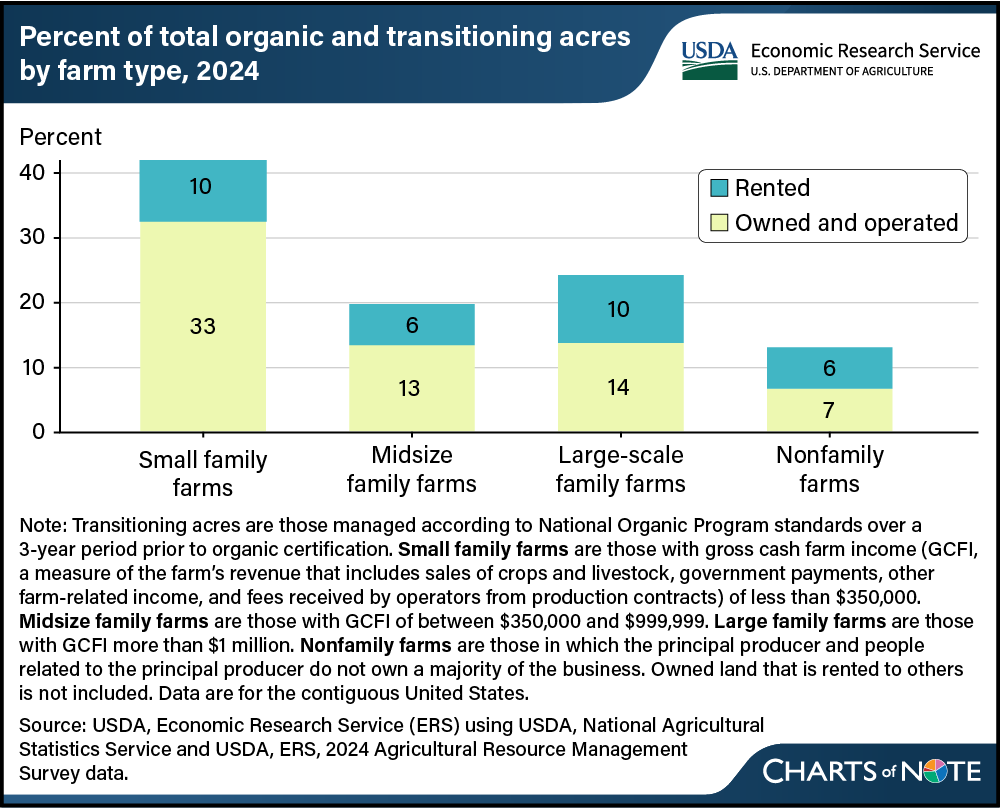
The majority of organic farmland in the contiguous United States is owned by the farmers who work it rather than rented, and small family farms operate the largest share of it, according to a Chart of Note from USDA's Economic Research Service (ERS).
To market products as organic, producers must be certified by USDA unless their gross annual sales of agricultural products are under $5,000. Certification ensures that production and handling follow the standards of the USDA National Organic Program (NOP), and it requires a three-year transition period during which the land must be managed to NOP standards but its output cannot be sold as certified organic.
In 2024, small family farms operated over 40 percent of organic land, counting both certified acres and acres in transition, and a larger proportion of that land was owned by the farmer than rented.
Midsize family farms operated 19 percent of organic land and large family farms 24 percent, with higher proportions owned in both groups.
Nonfamily farms operated under 15 percent of organic land, divided almost evenly between rented and owned acres.
The ownership pattern matters because of the transition rule: three years of managing land to organic standards without an organic premium is an investment a farmer is more likely to make on land held outright than on a short lease, and the data show organic acres concentrated where that security exists. The chart, prepared by ERS economists Kate Binzen Fuller, Sharon Raszap Skorbiansky and Katherine Lacy, appears in the ERS report America's Farms and Ranches at a Glance, published in February 2026.
Source: USDA Economic Research Service


Comments
(0)